
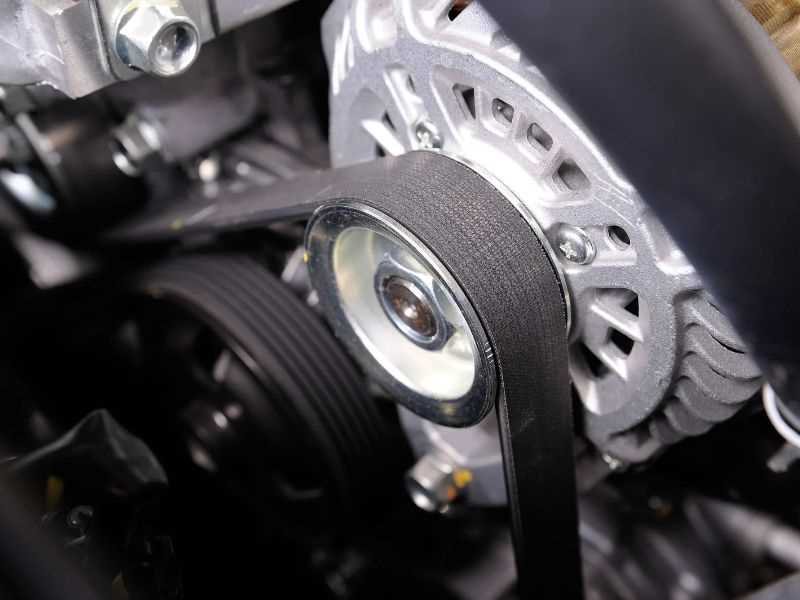
To measure a V-belt pulley, take the outside diameter, the width across the top of a groove, the number of grooves and the spacing between them, the face width, the bore and the keyway. Two of these need care. The diameter a caliper reads is not the one a classic inch pulley is ordered by, and the groove width and depth, not the groove angle, tell you which belt section the pulley takes. The sections below take the numbers in order, then cover wear, belt length and what to write on the order when the replacement has to be stainless steel.
What to Measure on a V-Belt Pulley
You need a digital caliper, a tape measure and, for the wear check, a sheave gauge, which is a metal template shaped like a new groove. Clean the grooves first and hold the caliper square to the surface, because dirt and a tilted tool both move the reading. Take eight measurements and write them down in this order:
- Outside diameter. Measure across the widest part of the rim. If the pulley is too big for the caliper, wrap a tape around the rim and divide the circumference by pi (3.14).
- Pitch or datum diameter. This is the diameter the belt rides on, and the next section shows how to get it from the outside diameter.
- Groove top width and depth. The width across the top of one groove names the belt section.
- Number of grooves and the spacing from the centre of one groove to the centre of the next.
- Face width. One pulley guide asks for the width of the belt housing, the part where the belt runs, and then the overall width of the whole pulley.
- Hub extension. If the hub sticks out past the belt housing, measure how far.
- Bore. The hole that fits the shaft.
- Keyway width and depth. The slot that takes the key.
Before you measure anything, look for a number. Some makers stamp or cast it into the pulley, sometimes spread over the spokes. Take a pulley with 5-5V on one spoke, 1870 on a second and E on a third. It reads as five grooves of 5V section, a diameter of 1870 and bushing E, so the catalog number is 55V1870E. Painted numbers rub off over time, so a pulley that has been in service for years often has to be measured. Even then the number of grooves and the overall width together confirm the belt type, according to the same guide.
Outside, Pitch and Datum Diameter
A caliper gives you the outside diameter, but the belt does not ride on the rim. It sits down in the groove, and the pitch diameter is the effective diameter where the belt transmits power in the groove. One published guide says the number that matters is the datum diameter, which it describes as slightly smaller than the outside diameter. It adds that belt makers size their belts from the datum diameters of the pulleys. If you use the outside diameter in a belt-length calculation, the belt comes out slightly long.
For the classic inch sections (A, B, C and D) a pulley is sized by its datum diameter. A belt maker's design manual states that the datum system is used for classical V-belts and sheaves only. The outside diameter and the datum diameter differ by a fixed amount for each section. The same manual has a table of the amount to subtract from the outside diameter. For standard sheaves its datum row reads 0.25 inch for A, 0.35 for B, 0.40 for C and 0.60 for D. For the narrow sections the table gives the pitch diameter instead: 0.05 inch below the outside diameter for 3V, 0.10 for 5V and 0.20 for 8V.
| Belt section | Subtract from the outside diameter (in) | You get |
|---|---|---|
| A | 0.25 | Datum diameter |
| B | 0.35 | Datum diameter |
| C | 0.40 | Datum diameter |
| D | 0.60 | Datum diameter |
| 3V | 0.05 | Pitch diameter |
| 5V | 0.10 | Pitch diameter |
| 8V | 0.20 | Pitch diameter |
The table is for standard-groove sheaves in the inch sections only; it does not apply to metric SP pulleys. An A-section sheave that reads 8.35 inches across the rim has a datum diameter of 8.35 - 0.25 = 8.10 inches. A B-section sheave that reads 6.05 inches has 6.05 - 0.35 = 5.70 inches. Both sums are our own arithmetic on the manual's offsets.
There are two limits. A combination sheave, one groove that runs either an A or a B belt, has no datum diameter at all, and the manual says the diameters listed for combination grooves are outside diameters. Also, the manual names 3V, 5V and 8V sheaves by outside diameter and A, B, C and D sheaves by datum diameter. Find out which one your supplier's catalog uses before you quote a size.
Reading the Groove to Find the Belt Section
The easiest way to identify the section, according to a pulley guide, is to measure the width across the top of the groove with a caliper. Compare it with the belt widths: an A belt is 1/2 inch wide and a B belt 5/8 inch. Narrow belts are named in eighths of an inch, so a 3V belt is 3/8 inch wide, a 5V is 5/8 inch and an 8V is 1 inch. Width alone does not separate every pair, because a B belt and a 5V belt are both about 5/8 inch wide. Compare the groove depth with the belt height too, 11 mm for B and 14 mm for 5V. Metric SPZ, SPA, SPB and SPC belts are sized in millimetres. The same guide warns that the metric and inch systems are not interchangeable, even when the numbers look close. If the width you measure falls between two standard sizes, the groove is probably worn, which the wear section below covers.
That also answers the question of whether a 1/2 inch belt will do in a 5/8 inch groove. In a plain B groove the belt is too narrow, so it rides low. A belt that sits too low can bottom out in the groove, while one that sits too high loses its grip on the sidewalls. The exception is a combination sheave, whose one groove is made to run either an A or a B belt.
| Belt section | Belt top width x height (mm) | Groove datum width (mm) | Minimum groove top width, smaller pulleys (mm) |
|---|---|---|---|
| Z (classical) | 10 x 6 | 8.5 | 9.7 |
| SPZ | 9.7 x 8 | 8.5 | 9.7 |
| A (classical) | 13 x 8 | 11 | 12.7 |
| SPA | 12.7 x 10 | 11 | 12.7 |
| B (classical) | 17 x 11 | 14 | 16.1 |
| SPB | 17 x 13 | 14 | 16.1 |
| C (classical) | 22 x 14 | 19 | 21.9 |
| SPC | 22 x 18 | 19 | 21.9 |
| 3V | 9.7 x 8 | See the pulley maker's table | See the pulley maker's table |
| 5V | 15.8 x 14 | See the pulley maker's table | See the pulley maker's table |
| 8V | 25.4 x 23 | See the pulley maker's table | See the pulley maker's table |
The belt sizes come from a belt overview and the groove values from a pulley maker's catalog, which lists Z and SPZ, A and SPA, B and SPB, C and SPC as one groove each. The minimum groove top width grows slightly on the larger pulleys, to 9.9, 12.9, 16.4 and 22.3 mm for the same four grooves. Do not try to name the section from the groove angle. In SPZ to SPC grooves the angle is 34 degrees on small pulleys and 38 on large ones. Narrow-belt grooves are cut between 36 and 42 degrees, rising with diameter, and the belt itself has a 40 degree included angle. Our pulley selection guide has the angles in a table. A belt guide also says it is safe practice to use 5V and 3V belts with SPB and SPZ pulleys, but not the reverse.
Checking the Grooves for Wear
A new groove has a known shape and a worn one does not. To check, press a sheave gauge into the groove and hold a flashlight behind it. Any light between the gauge and the groove walls means wear. One guide gives the limits: when groove wear reaches 0.015 inch the pulley is no longer acceptable for steel-cord belts, and at 0.025 inch it should be replaced whatever the belt. These are small numbers you will not catch by eye, which is why the gauge is the usual shop method.
The belt gives you a second check. A properly fitted belt has its top surface within 1/16 inch of the rim. If it sits deeper, the groove is worn or the belt section is wrong. One guide says the pitch diameter step can be skipped when you already know the belt size or when the pulley and belt are badly worn.
Counting Grooves and Finding the Face Width
The number of grooves sets the number of belts the drive needs. The spacing from groove to groove has to match on the driving and the driven pulley, or the belt set tracks unevenly and wears on one side. A pulley maker's catalog gives the face width as F = 2f + e(n - 1). Here n is the number of grooves, e is the distance between groove centres and f is the distance from the edge to the first groove centre.
A pulley maker's catalog shows the values of e and f in millimetres: 12 and 8 for SPZ, 15 and 10 for SPA, 19 and 12.5 for SPB and 25.5 and 17 for SPC. For an SPZ pulley with three grooves, 2 x 8 + 12 x (3 - 1) = 40 mm, and the catalog lists the same 40 mm. For an SPA pulley with two grooves, 2 x 10 + 15 x (2 - 1) = 35 mm. The second sum is our own arithmetic. If your pulley has a hub that extends beyond the belt housing, write its length down separately, because the face width covers only the grooved rim.
Bore, Keyway and Hub Type
Measure the bore with an inside caliper or a telescoping gauge, then check it with a micrometer. The keyway needs two numbers, the width and the depth, and they follow the shaft size. One guide gives examples. A shaft between 1 and 1-1/4 inches takes a 1/4 inch wide keyway, and in metric a 23 to 30 mm shaft takes an 8 mm wide keyway that is 3.3 mm deep. A belt maker's manual adds that nominal shaft-size bores are normally furnished with standard keyseats. If the pulley is a fixed-bore pulley, state the bore diameter on the order.
Pulleys also differ in how they sit on the shaft. A pulley maker lists a finished bore with keyway and set screws, a plain bore, an idler and a bushed type. A bushed pulley is a different order, because the hub takes a taper bush and it is the bush bore that has to match the shaft.
Working Out the Belt Length
If the belt is still on the drive, one guide wraps a string around the outside of the belt to get its circumference. If it is gone, measure the centre distance between the two shafts with the machine in its normal operating position, and note the range of the motor slide or tensioner. One maker's manual gives the estimate Tentative Belt Length = 1.57 (D + d) + (Tentative Center Distance x 2), where D and d are the large and small pulley diameters. The exact formula adds the term (D - d) squared divided by 4C. In that manual D and d are datum diameters for classical belts and outside diameters for narrow belts.
Take a classical drive with D = 10 inches, d = 5 inches and a centre distance of 20 inches. The exact formula gives 2 x 20 + 1.57 x (10 + 5) + (10 - 5)^2 / (4 x 20) = 63.86 inches. The rule of thumb without the last term gives 2 x 20 + 1.57 x (10 + 5) = 63.55 inches, which is 0.31 inch short. The gap grows when the two pulleys are very different in size, which is why one guide calls the shortcut a quick estimate only. These sums are our own arithmetic on the manual's formulas.
Belt tables list inside, outside or pitch length, so check which one a listed length refers to. A worn belt can have stretched by 1 to 2 percent, according to one belt guide, so compare the measured length with the length worked out from the centre distance. If the exact size is not available, take the closest standard length that still lets you tension the belt.
Checking the Minimum Pulley Diameter
Each belt section has a smallest pulley it should run on. If your measured diameter is below the figure for the section, check the drive with the belt supplier before you order a copy. The two lists we read, a belt overview and a pulley catalog, agree for the Z, A, SP and narrow sections and differ for B and C, so the table shows both.
| Belt section | Belt overview, pitch diameter (mm) | Pulley catalog, pulley diameter (mm) |
|---|---|---|
| Z | 50 | 50 |
| A | 71 | 71 |
| B | 125 | 112 |
| C | 200 | 180 |
| SPZ | 63 | 63 |
| SPA | 90 | 90 |
| SPB | 140 | 140 |
| SPC | 224 | 224 |
| 3V | 63 | 63 |
| 5V | 140 | 140 |
| 8V | 335 | 335 |
Ordering a Stainless Replacement
One pulley maker's catalog says all its pulleys are cast iron, with a phosphated surface to prevent rust, and a supplier of stainless sheaves says they are completely custom manufactured. A belt maker's manual says its made-to-order sheaves are not carried in stock. A stainless replacement is therefore made to your measurements, so the measurements are the order.
Tell the maker the belt section, the diameter and whether it is the outside or the datum diameter, and the number of grooves. Add the face width and hub length, the bore and keyway or the bush size, and the speed the pulley will run at. The speed matters because one maker balances cast iron pulleys statically up to 6,500 feet per minute and calls for dynamic balancing above that for steel and other materials.
Conclusion
Take the outside diameter and convert it to the datum diameter for A, B, C and D pulleys. Read the belt section from the groove width, check the grooves for wear, and write down the grooves, face width, bore and keyway. If the belt is gone, work out its length from the centre distance and check the pulley is not below the minimum diameter for its section.
Profab Machine makes each stainless steel V-belt pulley to your drawing, CNC turned from 304 or 316L stainless steel. The grooves suit A to D, SPZ to SPC or 3V to 8V belts, and the bore is finished, plain or taper-bush. Send the numbers from this page, or the old pulley, and an engineer reviews the grooves, the bore and the keyway before cutting.