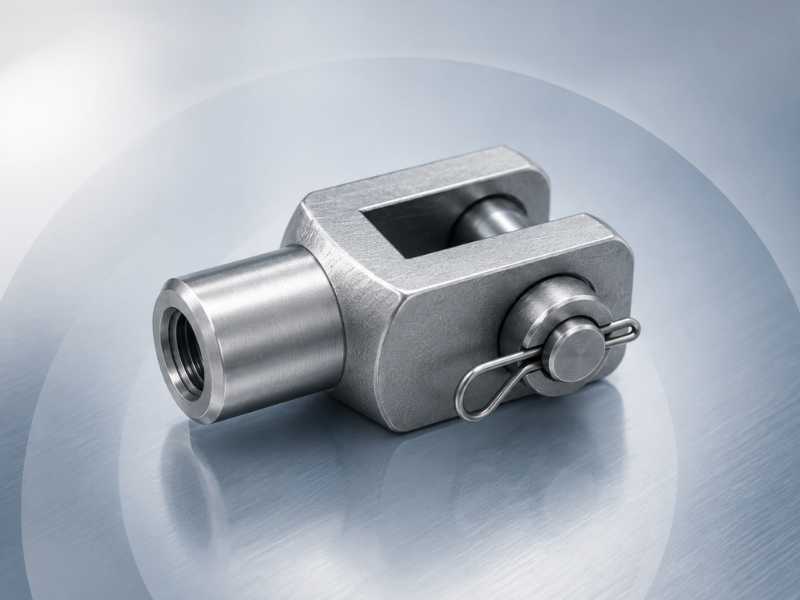
A clevis rod end on a spec sheet looks clean: a bore size, a thread size, a radial load rating. In the field, that number tells you almost nothing about when the part is actually going to let go. Most of the clevis rod ends that come back to a shop cracked at the fork root, seized in the bore, or sloppy after six months were never overloaded in the sense the datasheet means. They were carrying a load the rating never accounted for in the first place. The pin was fine for pure shear. The fork was fine for a centered load. Then the installation put something else into the joint, and the part started dying on a schedule nobody planned for.
This is what actually shows up on a teardown bench, five failure paths that hide behind a rating that looks perfectly adequate on paper.
Pin Bending Nobody Sized For
Every clevis rod end drawing assumes the pin sits in double shear, load split cleanly across two planes with the mating eye centered between the fork legs. That assumption holds as long as the gap on either side of the eye stays small and the load stays close to the pin's centerline. Widen that gap, whether from an undersized eye, a spacer washer nobody accounted for, or wear that's already opened the fit up, and the pin starts picking up a bending moment on top of the shear it was designed for. Structural design references built around Eurocode pin connections size bending resistance directly off that lug gap and treat eccentric loading across the shear plane as a governing check once the gap grows past a small fraction of the pin diameter, a the Eurocode bending check. It's exactly the geometry a worn or poorly shimmed clevis rod end produces over time.
The failure signature is distinct from a shear break. Instead of a clean 45-degree shear plane, you get a pin that's visibly curved before it finally cracks, usually right at the edge of the fork bore where the moment peaks. If the rod end also threads into a mounting tube or a jam nut, check thread engagement while you're in there. Engagement under 1.5 times the thread diameter under bending load lets the whole shank flex instead of the pin doing the work it was designed for, and that flex shows up downstream as pin bending even when the pin itself measures fine.
Fork Spreading That Feeds On Itself
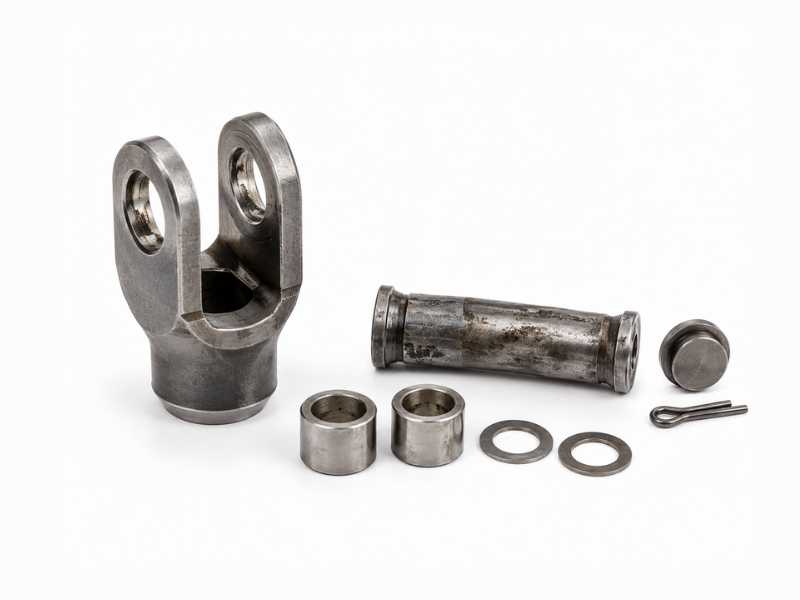
The fork legs on a clevis rod end aren't rigid the way they look on a drawing. Under repeated load they flex outward slightly, and that flex opens the gap between the legs by a small amount every cycle. On its own that's not dramatic. The problem is what it does to the pin-bending mode described above. A wider gap means more eccentric loading on the next cycle, which bends the fork legs a little further outward, which widens the gap again. It's a feedback loop, and it accelerates once the legs have taken any permanent set at all.
Crack initiation almost always starts at the fork root, the transition where the leg thickens back into the body, not at the bore itself. That's a stress concentration point independent of the pin, and it's where fatigue cracks propagate fastest once the spreading cycle has taken hold. Catching this early means measuring the gap between the fork legs on a stainless steel clevis rod end against a new part, not just checking pin diameter. A pin that measures in spec doesn't tell you the fork has already opened up 0.1 mm on each side.
Off-Axis Load the Bracket Geometry Introduces
A clevis rod end handles rotation in the plane the pin allows and, depending on the design, a limited amount of misalignment beyond that. It was never built to carry load along an axis the pin wasn't meant to see. That's exactly what happens when the mounting bracket on one end and the rod on the other aren't installed on a common centerline. The joint doesn't complain immediately. It just starts carrying a side load the pin and bore weren't sized for, on top of the radial load that was actually planned for.
It's the same mechanism that shows up across the whole rod end family: a small mounting error binds the linkage, drives the load into the side of the pin instead of straight through it, and wears the bore out of round faster than anyone expects from what looks like a minor install tolerance. On a clevis rod end without a spherical insert at the eye, there's no self-aligning capacity to absorb that error the way a ball-and-socket rod end can. The fork and pin take the full misalignment directly, and bore elongation follows faster than a duty cycle calculation would predict. Before blaming the part, check the two mounting points against a straightedge or a laser line. A few degrees of bracket misalignment does more damage over a service life than most engineers expect from something that looks like a rounding error on the install sheet.
Dynamic Shock Loads a Static Number Doesn't Capture
Size a clevis rod end to the load you measured under normal running conditions and you've sized it to the wrong number. Real duty cycles carry momentary peaks, a jolt when a cylinder bottoms out, a snag when a conveyor catches, a shock transmitted back through linkage when a mechanism hits a hard stop, and those peaks can run several times higher than the steady-state load for a fraction of a second. A joint sized only to average or nominal load looks over-built on paper and fails early in practice, because the fatigue damage from repeated peak events accumulates far faster than the average load suggests.
This is also where material selection gets misused. 17-4PH gives you meaningfully higher yield strength than 304 or 316L, which makes it attractive for a high-shock application, but that strength doesn't automatically buy you the same corrosion resistance in a submerged or continuously wet chloride environment. Where shock loading and marine or wash-down exposure overlap, treat strength and corrosion resistance as two separate selection criteria, not one. Sizing for the peak event, not the average, is the part of the job that actually prevents the failure. Picking a grade because it's stronger, without checking what it gives up, is how a shock-resistant joint turns into a corrosion problem eighteen months later.
Vibration Fatigue at the Pin-to-Bore Interface
Continuous low-amplitude vibration doesn't need to move the pin far to do damage. Micro-motion on the order of microns, repeated for millions of cycles, is enough to break down the passive oxide layer on stainless steel at the pin-to-bore contact and start a fretting process. Research on fretting in mechanical joints, most of it built around aerospace fastener and bearing interfaces, the three progressive fretting stages: initial adhesion and metal transfer, then oxidized debris generation, then a steady-state condition that mixes abrasive, corrosive, and fatigue damage together. A clevis pin bore under continuous vibration runs through the same stages, just on a slower clock than a jet engine mount.
The diagnostic tell is a reddish-brown powder at the bore, not the dull gray wear you'd expect from ordinary sliding contact. Treat that color as fretting, not general wear, because the two failure mechanisms respond to completely different fixes. Ordinary wear responds to better lubrication. Fretting responds to reducing the relative micro-motion at the interface, tighter fit, better clamping, or a bushing material chosen specifically to resist it. In wash-down or outdoor installations the debris and any moisture that's found its way into the joint compound the problem further, since a clevis geometry naturally traps water at the bore, which is one of the reasons clevis internal corrosion in a lot of outdoor duty cycles.
Conclusion
None of these five paths show up on a load rating table, and that's the point. A clevis rod end that fails early almost never fails because the number on the datasheet was wrong. It failed because the actual installation put a load into the joint that the number never described: an eccentric moment on the pin, a fork that's already spread past its original gap, a bracket that isn't quite on centerline, a shock event the sizing calculation treated as average, or a vibration signature nobody checked until the bore was already scored.
If your application experiences continuous vibration, marine exposure, or shock loading, the clevis rod end should be evaluated based on the actual duty cycle rather than just the nameplate rating.
Profab Machine manufactures stainless steel clevis rod ends in 304, 316L, and 17-4PH, sized and finished for the duty cycle, not just the nameplate rating.