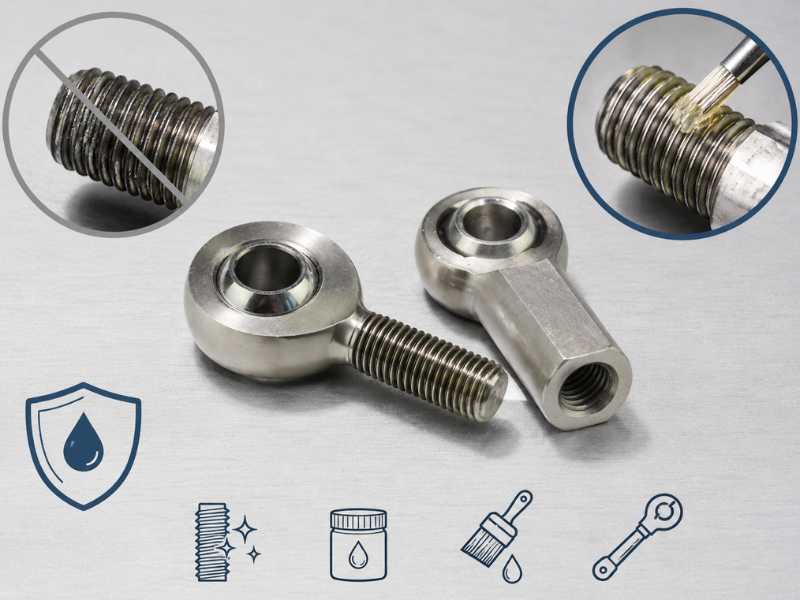
A stainless steel heim joint that galls during installation is not always a defective part. In most cases, it is a predictable failure from a known mechanism, one that can be avoided with the right lubricant, the right installation speed, and an understanding of why stainless behaves differently from carbon steel at the threaded interface.
Galling destroys threads in seconds. Once it starts, disassembly typically requires cutting the joint off the rod end. The cost is not just the hardware. It is the labor, the downtime, and in a marine or food processing installation, the scheduling problem that follows.
This article covers what causes thread galling in stainless rod ends specifically, and the prevention measures that work in practice.
Why Stainless Steel Galls and Carbon Steel Does Not
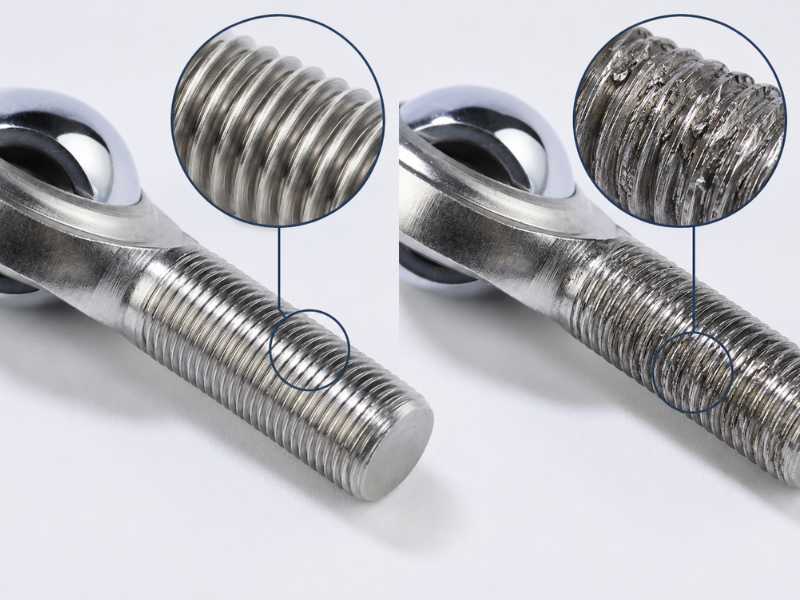
The same property that makes stainless steel corrosion-resistant creates its galling tendency. The passive chromium oxide layer on austenitic stainless (304, 316, 316L) is thin, on the order of a few nanometers, and reforms quickly when exposed to oxygen. Under the contact stress and friction of thread engagement, that layer is disrupted faster than it can reform. When bare metal contacts bare metal under pressure, the ductile austenitic matrix cold-welds at the asperity peaks, a process called solid-phase welding.
Carbon steel does not have a passive layer to disrupt. Its surface oxidizes continuously, and that oxidation actually provides a degree of lubrication at the thread interface. Hardened carbon steel (grade 8, 10.9) additionally resists the plastic deformation that drives cold-welding in austenitic stainless.
Three material characteristics make 304 and 316 particularly susceptible:
High ductility. Austenitic grades are among the most ductile engineering metals. Under thread contact stress, the material at asperity peaks deforms and transfers across to the mating thread rather than fracturing cleanly.
Work hardening during engagement. As the threads engage and the material at contact points deforms, austenitic stainless work-hardens rapidly. The hardened material then generates more friction on subsequent contact, accelerating the adhesion cycle.
Low thermal conductivity. Stainless dissipates heat more slowly than carbon steel. Heat generated by friction concentrates at the thread interface, increasing the tendency for adhesive bonding.
The practical result is that a stainless heim joint threaded onto a stainless rod end adjuster or jam nut can gall almost instantly under the wrong conditions, particularly if installed with a power tool or without lubrication.
Where Galling Occurs in a Heim Joint Assembly
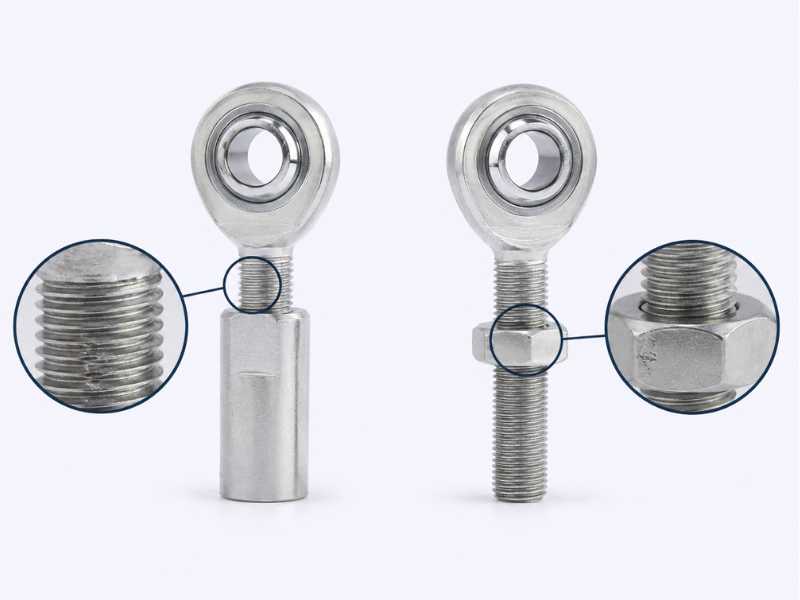
Thread galling in heim joint assemblies happens at two locations:
The rod end shank threaded into the housing or clevis. When assembling a male-threaded rod end into a female-threaded housing, the shank thread engages under increasing torque as the joint seats. Without lubrication, this is a high-risk engagement point in 316 stainless.
The jam nut against the rod end shank. The jam nut is the highest-risk location. It is typically a 316 stainless nut running on a 316 stainless thread. Identical material pairing, thin passive layers on both surfaces, and the tendency to run jam nuts fast to save installation time combine to make this the most common galling failure point in stainless rod end assemblies.
Galling at the jam nut does not always announce itself immediately. Sometimes the nut advances normally for several turns, then locks abruptly as the galled section reaches full contact. By that point, the thread is already damaged. Attempting to back the nut off typically worsens the damage.
Prevention: What Works
Lubrication Is Not Optional
The single most effective prevention measure is applying an anti-seize compound to the threads before installation. This is not a precaution for difficult assemblies. It is standard practice for any stainless-on-stainless threaded connection.
The anti-seize type matters. Three formulations are in common use:
Nickel-based anti-seize. The most widely used for stainless steel threads in industrial and marine applications. Nickel provides effective film strength at the thread interface and does not promote galvanic corrosion in the same way copper-based compounds can when used with 316 stainless in wet environments. Rated for temperatures up to approximately 1,200°C, though that ceiling is irrelevant for rod end applications.
Molybdenum disulfide (MoS2) anti-seize. MoS2 provides an exceptionally low friction coefficient at the thread interface and reduces galling tendency effectively. It is appropriate for dry industrial environments. In marine or washdown applications, MoS2 compounds can retain moisture at the thread interface in ways that accelerate crevice corrosion on 316 stainless over time. Check the compound's compatibility with the operating environment before specifying it.
Food-grade / PTFE anti-seize. In food processing equipment or pharmaceutical installations where thread lubrication must be FDA H1-compliant, nickel or MoS2 compounds are not acceptable. PTFE-based or white food-grade anti-seize compounds provide adequate galling protection for low-torque rod end assemblies in these environments. They have lower film strength than metal-based anti-seize and should not be relied on in high-torque or high-vibration installations without confirmation from the compound supplier.
Application method: coat the male thread lightly but completely. Excess compound is not more protective and creates contamination problems in food-grade environments. A thin, even film on the first several thread pitches is sufficient.
Lubricant Selection by Environment
Marine / coastal (saltwater exposure): nickel-based anti-seize, metal-free where possible to avoid galvanic coupling with 316 in continuous immersion.
Industrial dry / indoor: nickel or MoS2 anti-seize, either is appropriate.
Food processing / pharmaceutical: FDA H1 food-grade PTFE anti-seize only. Confirm compound rating with the manufacturer.
Chemical processing: confirm anti-seize compatibility with the specific process chemical before use. Some compounds are not suitable for strong acid or oxidizing environments.
Installation Speed
Power tools are the most common cause of thread galling in stainless rod end assemblies. A high-speed driver generates friction heat at the thread interface faster than the anti-seize film can dissipate it. Once the contact temperature rises enough, adhesion begins regardless of lubrication.
The correct installation approach for any stainless threaded connection is to start the thread by hand for the first several turns, confirm that the thread is engaging correctly without resistance or cross-threading, and then use a hand tool or torque wrench for final engagement and seating.
If a power tool must be used for production efficiency, set the clutch to the lowest practical setting and stop well short of final torque, finishing with a hand tool. This is standard practice in marine hardware assembly and food equipment fabrication, where stainless fasteners are the norm and galling-related rework is a recognized production cost.
Thread Fit: The Specification Issue Nobody Mentions
Galling risk increases significantly when the thread fit is tight. A 6g/6H fit (standard commercial tolerance) provides adequate clearance for most applications. Tight-tolerance threads (4g/6H or custom close-fit) reduce clearance at the thread flanks, increase contact pressure during engagement, and raise galling probability even with lubrication.
For rod end assemblies that require positional precision, confirm with the supplier what thread tolerance class is being machined. If the application can tolerate a slightly looser fit, specify standard tolerance rather than tight. The fit difference has no effect on assembled strength at the loads typical rod ends carry, but it has a measurable effect on installation reliability.
Surface finish on the thread also matters. A finely ground or rolled thread with Ra below 0.8 µm has fewer asperity peaks than a thread cut at standard toolpath parameters. Rolled threads, which are formed rather than cut, additionally have a work-hardened surface layer that resists the adhesion mechanism. For high-volume production rod end assemblies where installation galling is a recurring problem, specifying rolled threads rather than cut threads is worth the additional manufacturing cost.
Dissimilar Material Pairing
Where the design permits, pairing a 316 stainless rod end shank with a jam nut or housing in a different material reduces galling risk. Common options:
316 stainless with 303 stainless. The sulfide inclusions in 303 (the free-machining grade) disrupt the homogenous surface that promotes cold-welding. Galling risk is lower than 316-on-316, though not eliminated. Note that 303 should not be used in saltwater or chlorinated environments; the sulfide inclusions are pitting initiation sites.
316 stainless with brass or bronze. A brass jam nut on a 316 stainless thread effectively eliminates galling at that interface. Brass has lower hardness than stainless and does not form a passive layer, so the cold-welding mechanism does not apply. The trade-off is that brass is softer and should not be used where the jam nut is subjected to impact loads or where the assembly is frequently adjusted.
Coated threads. PTFE thread coating applied to either the male or female thread reduces friction coefficient significantly and prevents direct metal-to-metal contact at the thread peaks. Some rod end suppliers offer PTFE-coated threads as a product option for marine and food-grade assemblies. This is particularly effective for jam nuts, which require frequent adjustment over the service life of the assembly.
Do Not Use Threads to Pull the Assembly Into Position
A common installation error is using the rod end thread to pull a gap closed between two connection points. If the rod is slightly short of spanning the distance, the temptation is to thread the rod end further in on one side to take up the slack. This applies axial tension to the engaged threads during installation, increasing contact stress before the assembly is even under load. Galling under these conditions is almost certain without heavy lubrication.
Rod end assemblies should be installed with both ends at approximately mid-travel of their threaded adjustment range, with the structural gap closed by other means (adjusting turnbuckle length, repositioning the anchor point) before final thread torquing. Threads are for tension adjustment and jam locking, not for pulling the structure into position.
What to Do When Galling Has Already Occurred
If a stainless heim joint galls during installation and will not advance or back off:
Do not apply additional torque in either direction. The galled section has already begun cold-welding. More torque extends the weld zone and makes disassembly harder, not easier.
Apply penetrating oil generously to the thread interface and allow it to dwell for a minimum of 30 minutes. In field conditions, overnight penetration is more reliable.
Apply gentle heat to the housing or nut (not the shank) with a heat gun. Differential thermal expansion between the outer nut and inner shank can break the adhesion bond enough for the thread to back off. Keep temperatures below 300°C to avoid sensitization of 316 stainless at the thread interface.
If the thread cannot be freed, cutting the jam nut off with a rotary tool is typically less destructive than continuing to apply torque. The shank thread can often be salvaged if the galling is confined to the nut face.
For assemblies installed in accessible locations, documenting which joints galled and at what point in the installation allows the cause to be identified and the installation procedure corrected. Recurring galling at the same location in a production assembly is a specification or process problem, not a random hardware failure.
Inspection Before Installation
Thread condition on arrival from the supplier is a legitimate quality checkpoint, not an optional step. Burrs, machining marks, or surface contamination on the thread flanks create friction concentrations during engagement that initiate galling earlier than clean threads under otherwise identical conditions.
Before installing stainless rod ends in any application where disassembly later is required, inspect the thread visually for:
Tool marks running transverse to the thread helix (machining burrs from the threading tool). These create high-friction lines across the thread flanks.
Surface oxidation or light rust on the thread from storage in humid conditions. While austenitic stainless does not rust in the conventional sense, storage contamination can leave deposits that increase thread friction.
Any deformation at the thread lead-in (the first one or two pitches). Lead-in damage from rough handling in transit is the most common thread defect on received parts and is also the section where galling most commonly initiates.
A clean, lightly oiled thread in good condition is the baseline for reliable installation. Reject threads that do not meet that baseline before installation, not after.
Profab Machine supplies stainless steel heim joints machined to the thread class and tolerance the application requires. Custom thread configurations, rolled threads, and PTFE-coated thread options available on request.