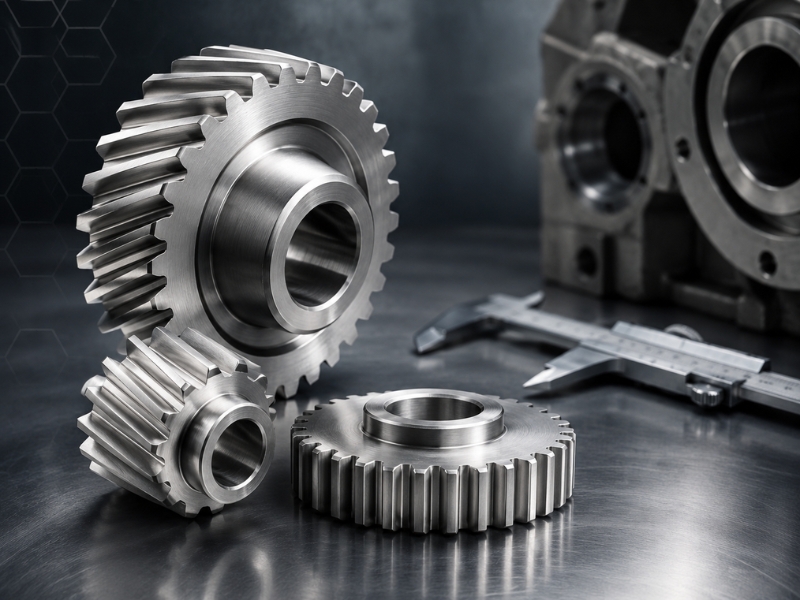
In environments where carbon steel rusts, brass corrodes, and plastic creeps under load, stainless steel gears are the reliable option. Food processing lines, marine deck equipment, pharmaceutical filling machines, and chemical dosing systems all run on stainless steel gears for the same reason: the material holds up where alternatives do not, and it does so without sacrificing the dimensional precision that gear applications demand.
The engineering case for stainless is well established. What most specification guides do not cover in depth is how to get the full performance advantage out of the material, because stainless steel gear applications have a set of grade selection and surface treatment decisions that static or structural stainless components do not. Get those decisions right, and a stainless gear will outlast the equipment it drives. Leave them to default or to the supplier's discretion, and service life shortens for reasons that are entirely preventable.
This article covers the grade selection logic, the surface and lubrication decisions that determine long-term wear performance, and the procurement verification steps that confirm the specified material was actually delivered.
Why Grade Selection Matters More for Gears Than for Static Components
Stainless steel performs differently in sliding contact than it does in static or bolted applications. The same properties that make austenitic stainless steels (304, 316) corrosion-resistant create a tendency toward adhesive wear under sliding contact loads.
Austenitic stainless has low thermal conductivity compared to carbon steel. Under the intermittent sliding contact at gear tooth faces, heat generated by friction dissipates more slowly. The material is also relatively ductile and has a lower work-hardening rate than many alternatives. Combined, these characteristics make austenitic grades prone to adhesive wear and, at higher contact stresses, galling.
For a static component, the alloy composition is the primary variable. For a gear, tooth profile geometry, surface finish, contact stress, lubrication regime, and alloy composition all interact. Specifying the right grade is necessary but not sufficient.
The Three Grades That Actually Appear in Gear Applications
Grade 303: The Machinist's Choice, Not the Engineer's First Choice
Grade 303 (UNS S30300, EN 1.4305) is the free-machining variant of 304, achieved by adding sulfur to approximately 0.15% by weight. That sulfur content forms manganese sulfide inclusions throughout the microstructure, which act as chip-breakers during CNC turning and milling. The practical effect is that 303 machines faster, produces better surface finishes with standard tooling, and costs less per part when machining hours are significant.
The same sulfide inclusions that improve machinability reduce corrosion resistance. Sulfide inclusions are preferential sites for pitting corrosion initiation. In salt spray testing, 303 shows measurable pitting earlier than 304 under equivalent conditions. For gear applications in humid or mildly corrosive environments, 303 may be adequate. For washdown environments, coastal industrial settings, or any application with periodic water or chemical contact, the machinability benefit does not justify the corrosion trade-off.
303 is also not weldable for practical purposes. If the gear requires any weld attachment to a shaft or housing, 303 is disqualified.
Grade 304: The Baseline for Most Industrial Gear Applications
Grade 304 (UNS S30400, ASTM A276, EN 1.4301) is the workhorse. With 18% chromium and 8% nickel, it forms a stable passive layer that resists most industrial atmospheres, fresh water, organic acids, and weak alkalis. For gear applications in food processing equipment without chlorinated cleaning agents, general industrial machinery, and architectural or decorative mechanisms, 304 is the appropriate baseline.
304 machines with more difficulty than 303. The material is ductile and tends to work-harden at the cutting zone, which requires higher cutting speeds and rigid tooling setups to avoid built-up edge on cutting tools. For custom gear production with tight profile tolerances, this machinability challenge has real cost implications. A gear manufacturer quoting a 304 stainless gear will price in longer cycle times than equivalent carbon steel or brass components.
Grade 316: The Right Answer for the Right Environment
Grade 316 (UNS S31600, ASTM A276, EN 1.4401) adds 2 to 3% molybdenum to the 304 composition. Molybdenum stabilizes the passive layer in chloride-containing environments, significantly improving resistance to pitting and crevice corrosion. In practice, 316 is the specification for marine gear applications, food equipment subjected to chlorinated CIP cleaning cycles, pharmaceutical machinery, and chemical processing equipment where 304 would pit within a service period measured in months.
316 is meaningfully harder to machine than 304. Machinists consistently describe it as "gummier," a practical way of saying the material has higher ductility at the cutting zone, generates more heat, and wears cutting tools faster. For identical gear geometry and tolerances, a 316 stainless gear will cost more to machine than the same gear in 304. That premium is typically 20 to 40% on machining cost, independent of material cost differences.
316L (EN 1.4404) is the low-carbon variant, specified where welding is required or where sensitization risk in corrosive service is a concern. For machined gear components that are not welded, the distinction between 316 and 316L is rarely material to performance.
Grade Selection at a Glance
Dry indoor environment, no corrosive exposure: 303 acceptable if welding is not required. 304 preferred. Humid industrial, mild chemical, food contact without chlorinated cleaning: 304. Marine, saltwater, chlorinated washdown, chemical processing: 316. Welded gear assemblies in corrosive environments: 316L.
The Galling Problem Nobody Mentions in the Product Literature
Galling is adhesive wear in its most severe form. Under sufficient contact stress between two sliding metal surfaces, the protective chromium oxide layer that gives stainless its corrosion resistance can be disrupted locally. When that happens between two austenitic stainless steel surfaces, the base metal contacts directly, forms adhesive bonds, and transfers material from one surface to the other. In a gear pair, this begins as surface roughening on the tooth flanks and progresses, if not addressed, to seizure.
The reason galling is specifically a stainless steel concern rather than a carbon steel concern comes down to the same passive layer that makes stainless useful. Carbon steel does not have a passive layer; it simply oxidizes. Stainless steel's passive layer is thin and can be reformed when disrupted under most conditions. Under the repeated high-contact-stress sliding at meshing gear teeth, it cannot reform fast enough.
Practically: a 304 spur gear running against a 304 spur gear under inadequate lubrication at moderate loads is a galling candidate. Two carbon steel gears at equivalent loads are not.
How to Reduce Galling Risk
Dissimilar material pairing. The most reliable mitigation in gear applications is to pair the stainless steel gear with a pinion made from a different material. In practice, bronze (phosphor bronze or manganese bronze) is the most common pairing. Bronze has a lower hardness than stainless steel and acts as the sacrificial element in the pair, wearing before the stainless gear. The hardness mismatch also reduces the tendency for adhesive bonding. Several established gear manufacturers explicitly specify stainless steel ring gear or spur gear with bronze pinion as a standard configuration for wet or food-grade environments.
Surface hardening. Where the application requires both elements to be stainless, nitriding or hard chrome plating can raise surface hardness enough to reduce the adhesive tendency. DLC (diamond-like carbon) coatings have been used in dry-run gear applications where lubrication is not possible and galling resistance must be achieved entirely through surface treatment. DLC is expensive and requires careful adhesion management, but it provides both galling resistance and low friction coefficient.
Electropolishing. Electropolishing removes surface asperities, reduces the Ra surface roughness, and smooths the peaks that initiate adhesive contact. For food-grade applications where lubrication is restricted and galling risk must be managed without coatings, electropolishing the tooth flanks is a meaningful mitigation. The result is also a cleaner, more hygienic surface than a machined or ground finish.
Lubrication. Where lubrication is permissible, molybdenum disulfide-containing greases provide better anti-galling protection than standard petroleum greases on stainless-to-stainless contact. In food processing environments, FDA-compliant H1 lubricants with molybdenum disulfide or PTFE additives serve the same function within regulatory constraints.
Surface Finish and Gear Accuracy: The Specification Nobody Sends
A stainless steel gear ordered by tooth module, pitch diameter, and grade is underspecified for most precision applications. The surface finish on tooth flanks directly affects noise, wear rate, and galling tendency, yet most custom gear purchase orders do not include a surface finish specification.
For CNC-machined stainless gears, typical as-machined surface roughness is Ra 1.6 to Ra 3.2 µm depending on toolpath and cutting parameters. Ground tooth flanks reach Ra 0.4 to Ra 0.8 µm. Electropolished surfaces typically achieve Ra 0.1 to Ra 0.4 µm. Each step improvement in surface finish reduces the contact stress at asperity peaks, extends gear life in sliding contact, and reduces noise.
For procurement teams specifying custom stainless gears: include an Ra requirement for tooth flanks in the drawing. Ra 0.8 µm is a reasonable standard for industrial precision gears. If the application involves food contact or dry-run operation, specify electropolishing as a post-machining treatment.
Stainless Steel Gears by Application
Food and beverage processing equipment. The standard specification is 316 for all gear components in contact with or near food product, with passivated or electropolished tooth flanks. Grease lubrication requires an H1-rated food-grade lubricant. Bronze pinion pairing is acceptable provided both mating elements are specified and verified to the correct grade.
Marine and offshore equipment. 316 for saltwater exposure environments. For gears running in enclosed, grease-lubricated gearboxes on vessels, the grade is determined by the risk of salt ingress rather than continuous immersion. A well-sealed gearbox in a protected installation can use 304 economically. An exposed windlass or deck winch mechanism should default to 316 regardless of lubrication status.
Pharmaceutical and bioprocessing equipment. The surface finish requirement often drives specification more than grade. Crevice-free design, Ra 0.4 µm or better on product-contact surfaces, and passivation per ASTM A967 are standard requirements. 316L is preferred over 316 for welded assemblies.
Chemical processing. Environment determines grade. Chloride-bearing environments require 316 at minimum. Reducing acid environments or elevated-temperature service may require duplex grades (2205) or higher-alloy austenitic grades. Standard 304 and 316 are not suitable for all chemical processing conditions; the specific chemical, concentration, and temperature must be evaluated against published corrosion data.
General industrial machinery. 304 covers the majority of applications where carbon steel is being replaced for corrosion reasons in non-extreme environments. 303 is cost-effective for high-volume custom machining where corrosion exposure is limited and welding is not required.
Conclusion
Stainless steel gears offer a genuine performance advantage in corrosive, hygienic, and chemical environments where carbon steel, brass, or cast iron are inadequate. That advantage comes with material-specific engineering requirements that standard procurement and specification practices frequently miss.
Grade selection follows environment: 303 for dry machining-intensive applications, 304 for general industrial and mild food processing use, 316 for marine, chloride, and pharmaceutical applications. Galling risk is real in stainless-on-stainless contact and is best managed through dissimilar material pairing, lubrication selection, or surface treatment. Surface finish specification on tooth flanks deserves to appear on every custom gear drawing. Grade verification requires actual chemical composition testing (OES or similar), not a magnet test, since machining-induced magnetism doesn't reliably distinguish 304 from 316.
For procurement teams sourcing custom stainless gears at volume, those specification elements are not optional refinements. They determine whether the gear performs to design intent or requires replacement before the equipment pays back its installation cost.
Profab Machine provides custom stainless steel gears in 303, 304, 316, and 316L, with passivation and electropolishing available. Contact Profab Machine to work through the right grade and finish for your application.