
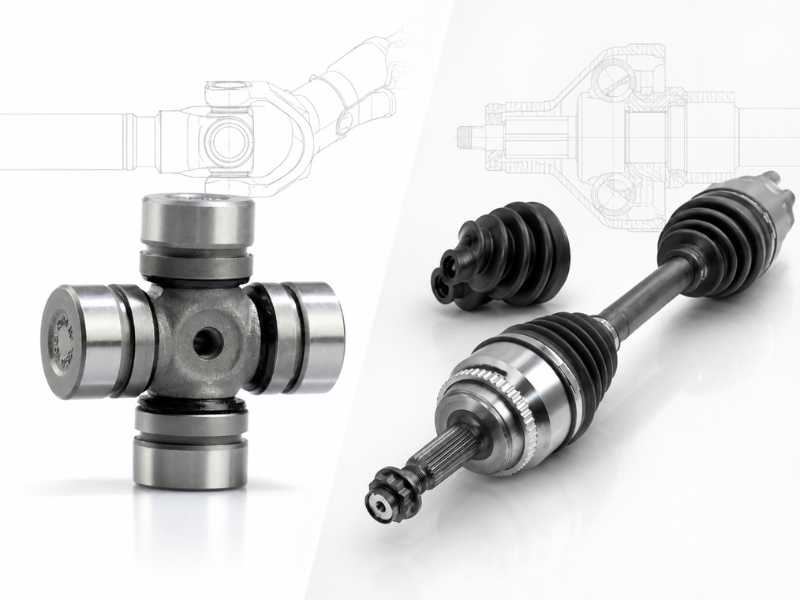
These two joint types solve the same fundamental problem: transmitting rotational power between two shafts that aren’t aligned. They solve it differently, and the difference has real consequences for vibration, angle capacity, maintenance, and cost.
What a Universal Joint Does
A universal joint (also called a U-joint, Cardan joint, or Hooke’s joint) connects two shafts at an angle using a cross-shaped trunnion with bearing cups at each arm. When one shaft rotates, it drives the other through the cross, allowing the angle between them to change during operation.
The core limitation of a single U-joint is that it doesn’t transmit rotation at constant velocity. When the joint operates at an angle, the output shaft speeds up and slows down twice per revolution relative to the input shaft. At small angles, this velocity variation is minor. At larger angles, the variation produces a pulsing vibration that travels through the driveshaft into the vehicle. Standard U-joint shafts start to vibrate at high speed once the angle exceeds around 4 degrees. Beyond that, the sinusoidal speed variation introduces cyclic torque spikes and vibration twice per revolution, leading to accelerated wear and potential mechanical binding if the joint’s physical angle limit is exceeded.
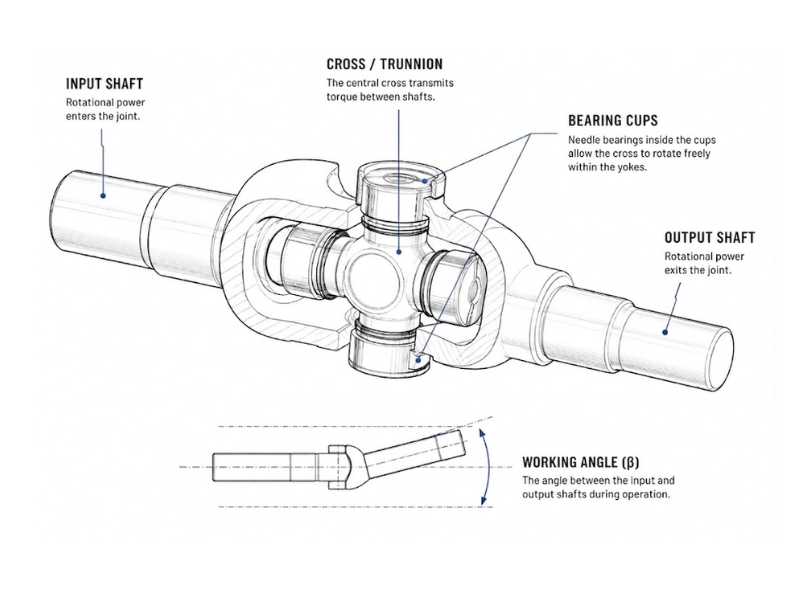
This is why driveshafts using single U-joints are designed with the front and rear joints at equal angles and in the same plane. When both joints are phased correctly, the velocity variation from the front joint cancels out the variation from the rear joint. Near-constant output velocity results, even with single U-joints at both ends, provided the operating angle stays within limits.
| Feature / Joint Class | Universal Joint (Cardan Type) | Constant Velocity (CV Joint) |
|---|---|---|
| Velocity Trait | Non-constant (or near-constant for double cardan) | True Constant Velocity |
| Internal Mechanism | Cross trunnion & needle bearing cups | Balls or tripod rollers in spherical/linear tracks |
| Max Continuous Angle | 4°–12° (Single), 15°–25° (Double Cardan continuous) | 26°–50° depending on design |
| Axial Plunge (Length Change) | No (Requires external splined slip yoke) | Yes (Inboard designs like Tripod & DOJ offer internal plunge) |
| Vibration & Torque Ripple | Pulsing vibration at high angles/speeds | Zero angular velocity fluctuation |
| Sealing & Maintenance | Greased trunnion, optional grease fittings; robust against debris | Requires sealed rubber/silicone boot; vulnerable to boot tears |
| Primary Applications | Trucks, industrial driveshafts, steering linkages, heavy equipment | FWD/AWD halfshafts, precision industrial automation |
Types of Universal Joint and CV Joint
Understanding joint selection requires separating true Constant Velocity (CV) designs from Cardan-style Universal Joints, as each type offers distinct angle capacities, velocity profiles, and structural advantages.
Universal Joints (Cardan / Non-CV Types)
Single Cardan Joint
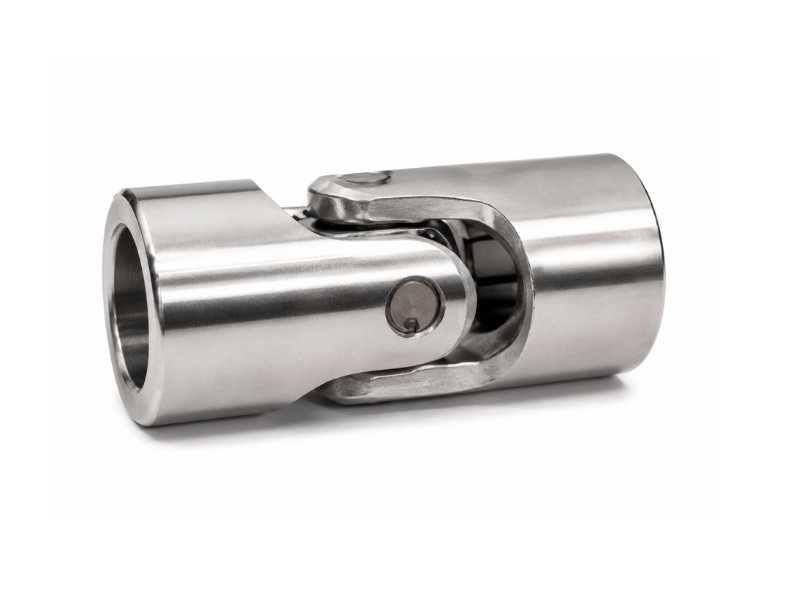
The classic single Cardan joint, commonly known as Hooke’s joint, uses a central cross member, four needle bearing cups, and two yokes to transfer torque across an offset. While the physical structure can articulate up to 30° to 40°, continuous high-speed operation must be kept within 4° to 12° to prevent severe sinusoidal velocity fluctuation. Its primary strengths are simplicity, extreme robustness, and high torque capacity relative to its package size, making it a staple in rear propshafts, steering shafts, and industrial machinery where shaft alignment can be controlled and joint phasing is strictly maintained.
Double Cardan Joint
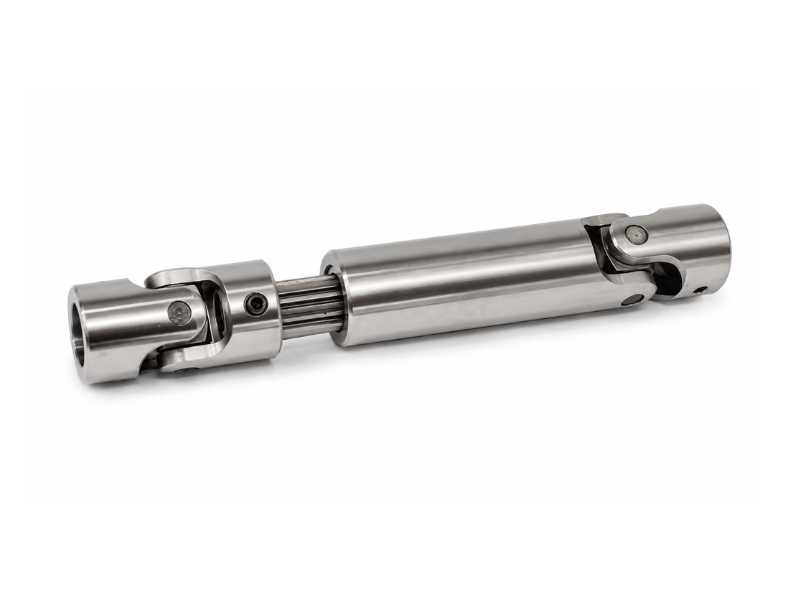
A double Cardan joint connects two single Cardan joints in series using a central coupling yoke paired with a precision centering socket. By operating each half of the assembly at half the total shaft angle, the velocity variations from the front and rear joints cancel each other out. This configuration delivers near-constant velocity output and eliminates the high-angle pulsing characteristic of single U-joints. It handles continuous operating angles from 15° to 25°, and can reach up to 30° to 45° in specialized high-angle setups such as front propshafts on lifted 4×4 vehicles, transfer case output shafts, and high-offset steering columns.
CV Joints (True Constant Velocity Types)
Rzeppa Ball Joint (Outboard CV)
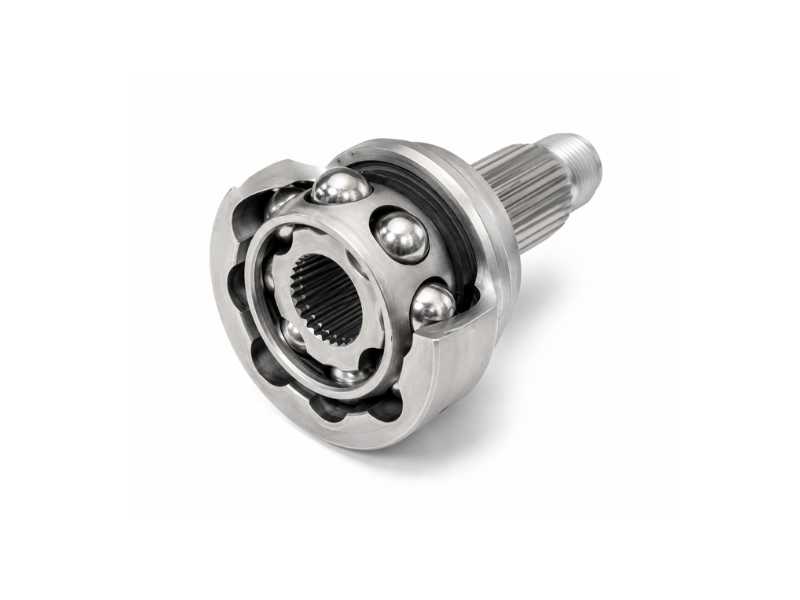
The Rzeppa design achieves true constant velocity by housing six steel balls in spherical tracks between an inner and outer race, forcing the contact points to remain on the bisecting angle plane at all times. This geometry allows exceptional angle capacity, typically reaching 45° to 60° of articulation without rotational speed variation. Because it maintains completely smooth power transmission even under tight turning angles, it is universally used on the outer wheel-end halfshafts of front-wheel-drive and all-wheel-drive vehicles.
Double Offset Joint - DOJ (Inboard Plunging CV)
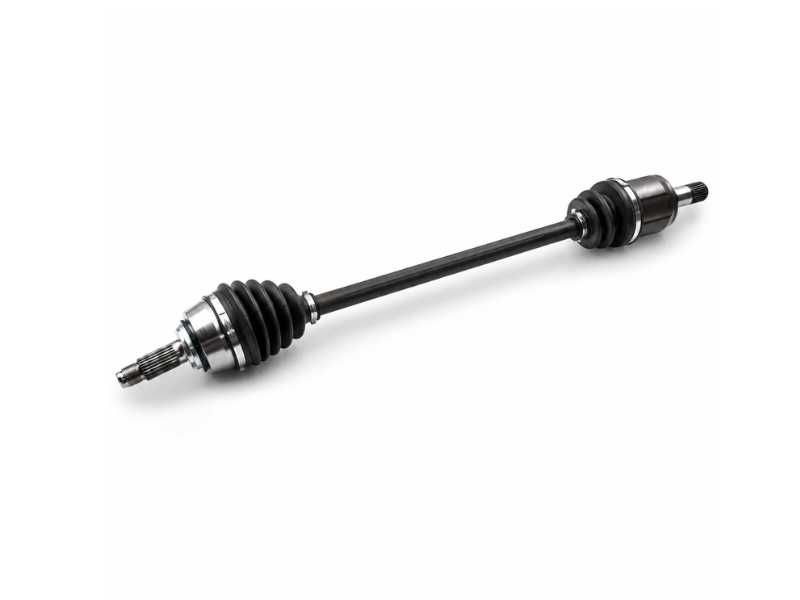
The Double Offset Joint is a plunging CV joint that uses steel balls constrained within straight cylindrical tracks, allowing it to combine true constant velocity with internal axial length adjustment. It accommodates operating angles up to 30° to 40° while delivering generous axial travel. Compared to tripod joints, the DOJ provides higher structural stability and superior load capacity, making it an ideal choice for inboard differential-side halfshafts on high-performance FWD and 4WD vehicles, as well as heavy-duty industrial drives requiring both plunging movement and smooth torque transfer.
Tripod Joint (Inboard Plunging CV)
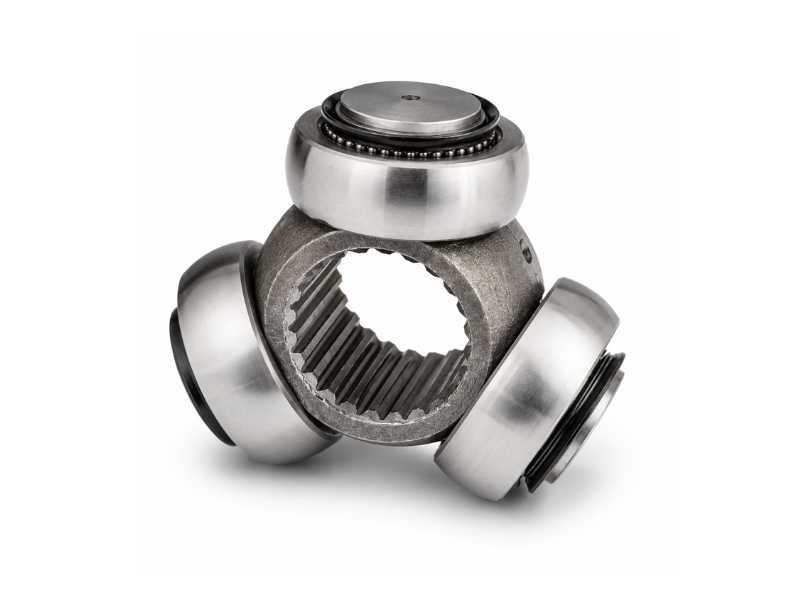
A tripod joint features a three-pronged spider housing equipped with needle-bearing rollers that slide along a three-grooved outer housing. It articulates up to 35° to 45°, though typical working limits sit around 26°, while offering up to 50 mm of axial plunge. The design provides exceptionally low plunging resistance, allowing the driveshaft to adjust smoothly to length changes during suspension travel. As a result, it is widely deployed on the inboard halfshafts of light passenger vehicles and front-wheel-drive assemblies.
A note on terminology: in industrial driveline work, a “double universal joint coupling” sometimes refers to two standard U-joint couplings at each end of a floating intermediate shaft rather than a purpose-built combined housing. The phasing principle is the same. The hardware is different.
The Naming Confusion You'll Encounter in Off-Road Forums
This is where the terminology gets messy enough to cause real parts-ordering errors.
In the off-road and 4×4 community, the front propshaft of a lifted truck is frequently called a “CV shaft” or described as having a “CV joint” at the transfer case end. In most cases, what’s actually there is a double cardan joint, not a true CV joint.
As Pirate 4×4’s definitive thread on this subject explains: because “near constant velocity, double-cardan-style universal joint shaft” is a mouthful, common practice dropped the qualifications. The off-road community consistently calls double cardan shafts “CV shafts,” even though they’re not true constant velocity joints.
The practical difference: a double cardan joint is near-constant-velocity, not perfectly constant velocity. At very high angles or very high speeds, some velocity variation remains. For off-road and overlanding use, this distinction is irrelevant. For high-speed road use at the angles a lifted truck’s front propshaft operates, the double cardan performs well enough that the imprecise labeling causes no problems. But when someone asks whether they need a “CV shaft,” the answer requires knowing which meaning of “CV” is in play.
Choosing Between Joint Types
Steering shafts in most vehicles use U-joints to connect the steering column to the steering rack or gearbox, routing the shaft around dashboard structure, engine components, and firewall clearance. These joints operate at relatively low angles and at low rotational speeds. Vibration from velocity variation isn’t a significant issue at these speeds.
Double cardan joints appear in steering shafts where larger angles are unavoidable, such as vehicles with adjustable columns, collapsible safety mechanisms, or tight packaging that requires more angular offset than a single U-joint handles smoothly.
In custom steering linkages on 4×4 vehicles, heim joints serve a different function from both U-joints and CV joints. A heim joint in a tie rod or drag link is a pivot and articulation point, not a rotating power transfer joint. The comparison to U-joints and CV joints doesn’t apply in that context.
When your application demands corrosion resistance alongside precision torque transfer, standard steel joints aren’t enough. Profab Machine manufactures custom and precision-machined stainless steel universal joints—available in 304, 316L, and 17-4PH grades—engineered for marine hardware, food processing machinery, and industrial automation assemblies.