
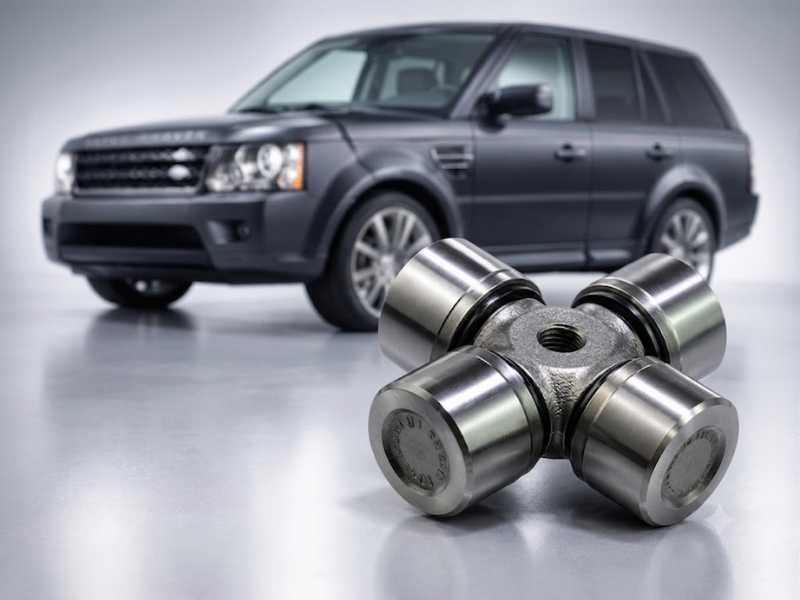
If you’ve been searching for universal joint information using the L405 platform code alongside the 2013 Range Rover Sport, you’re working from the wrong platform reference and you’ll end up ordering parts that don’t fit. The L405 is the full-size Range Rover, not the Sport. The 2013 Range Rover Sport runs on the L320 platform, which was the first-generation Sport produced from 2005 through the end of the 2013 model year. The second-generation Sport (L494) didn’t arrive until 2014.
Getting the platform right matters because the drivetrain layouts are different, the part numbers don’t cross, and the failure modes are specific to each generation.
How Many Universal Joints on a 2013 Range Rover Sport L320?
The 2013 Range Rover Sport L320 is a four-wheel drive vehicle with two propshafts: one running from the transfer case to the front differential, and one running from the transfer case to the rear differential. Each propshaft has a U-joint at each end.
That gives you four U-joints total in a standard configuration: two on the front propshaft and two on the rear propshaft.
The rear propshaft on the L320 is a two-piece design with a centre support bearing in the middle. That centre bearing is not a U-joint, but it’s the component that fails most often and produces symptoms nearly identical to a bad universal joint, which is why it causes so much diagnostic confusion. More on that below.
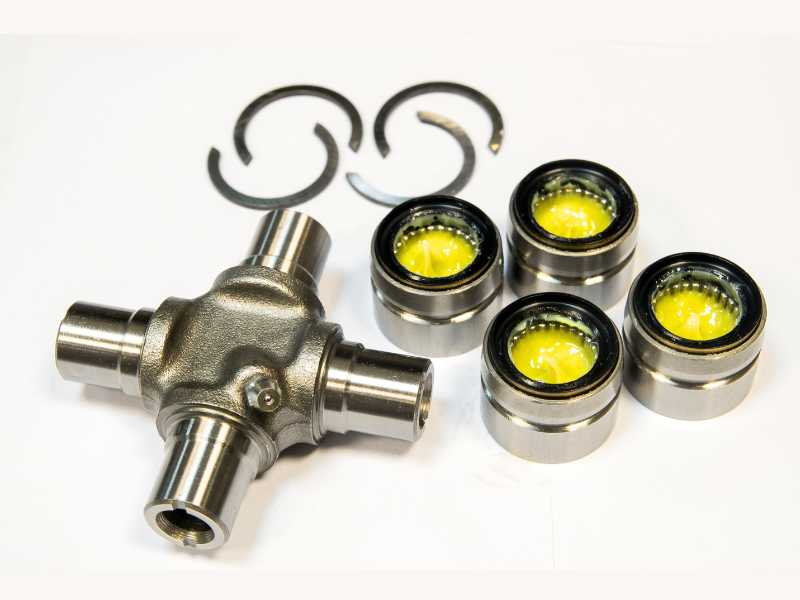
Front Propshaft: Two U-Joints
The front propshaft connects the transfer case to the front differential. It uses a conventional U-joint at each end. These joints are exposed to the elements from below, which makes them vulnerable to corrosion and contamination in markets where road salt is used during winter.
Front propshaft U-joints on the L320 are not known for high failure rates under normal use. When they do fail, the symptoms match the standard U-joint degradation sequence: a chirping squeak at low speed first, then a clunk under throttle application, then vibration that increases with speed. Because the front propshaft is shorter and operates at a less extreme angle than the rear, it generally outlasts rear drivetrain components.
Rear Propshaft: Two U-Joints Plus a Centre Bearing
The rear propshaft is where most L320 owners encounter drivetrain problems, and it’s worth understanding the layout before you start replacing parts.
The L320 rear propshaft is a two-piece assembly. The front section runs from the transfer case output flange to a centre support bearing that’s mounted to the underside of the body. The rear section runs from that centre bearing to the rear differential. In this assembly, conventional universal joints are located at the outer ends: one at the transfer case and one at the rear differential input flange. The centre junction holds the support bearing to maintain shaft alignment.
JGS4x4’s L320 propshaft documentation notes that the centre support bearing is a very common failure point on this platform, causing vibrations and clunking that are easy to attribute to a bad U-joint. The centre bearing sits in a rubber mount that deteriorates with age and heat cycles. When the mount softens, the bearing sags, which changes the operating angle of the rear propshaft sections and puts additional stress on the U-joints at both ends. In many cases, both the centre bearing and the adjacent U-joints need replacement together.
The Centre Bearing Problem That Looks Like a Bad U-Joint
This is the diagnostic trap that catches most L320 owners. The symptoms of a failing centre support bearing are almost identical to the symptoms of a bad universal joint:
A clunk or knock when pulling away from a stop or during gear changes. Vibration that increases with vehicle speed. A thudding or rhythmic noise from beneath the vehicle under load.
The difference is subtle in feel but clear in location. A bad U-joint at the transfer case or differential end produces vibration that you feel most strongly during acceleration and load transitions. A failing centre bearing tends to produce vibration that’s present at a consistent speed range, sometimes feels like a smooth hum rather than a distinct clunk, and may worsen after the vehicle has been sitting because the rubber mount takes a set when cold.
If you’ve confirmed that the U-joints themselves have no measurable play when you grab the propshaft by hand and try to rotate it, but vibration and noise persist, the centre bearing is the more likely cause. Replacing the U-joints without addressing a sagging centre bearing will not fix the vibration, and the new U-joints will wear prematurely because the propshaft angle problem remains.
⚠️ Notes: On the L320, the rear propshaft centre bearing is sold as a complete rear propshaft assembly by most Land Rover dealers. The centre bearing can be replaced independently, but it requires pressing the old bearing off the propshaft and pressing the new one on. This is a job that needs a hydraulic press. Most owners find it more cost-effective to replace the complete rear propshaft assembly rather than try to rebuild the individual bearing.
L320 vs L405 vs L494: Why the Platform Code Matters
To save anyone else the same parts-ordering headache, here’s the quick reference:
2013 Range Rover Sport = L320 (first generation, 2005–2013)
Range Rover L405 = full-size Range Rover, not the Sport (2012–2021)
Range Rover Sport L494 = second-generation Sport (2014–2022)
The L320 and L494 share some visual similarities in the Sport body style but use entirely different drivetrains. Part numbers do not interchange. If you’re ordering U-joints, propshafts, or centre bearings, confirm L320 in your parts search before purchasing. Using the VIN to look up parts is the most reliable way to avoid cross-platform errors.
Common Failure Symptoms on the L320
Based on the Land Rover forums and parts supplier documentation for this platform, the most common drivetrain complaints on the L320 follow a predictable sequence:
Vibration at highway speeds is usually the centre support bearing first. High-speed vibration that was resolved by propshaft replacement but returns with a new clunking noise under load is often the front axle half-shafts rather than the propshaft U-joints, as one documented L320 owner case on Land Rover Forums showed after the rear propshaft replacement resolved the speed vibration but left the low-speed clunk unresolved.
A clunk specifically when applying power uphill, or when rocking between drive and reverse, is more characteristic of U-joint play than centre bearing wear. Grab the propshaft sections individually by hand and try to rotate each one in isolation from the rest of the driveline. Any rotational play you can feel that doesn’t immediately translate to movement at the wheel end is play in the U-joint or yoke.
Replacement Considerations
Universal joints replacement on the L320 is straightforward for someone with basic workshop tools, a floor jack, and axle stands. The propshaft unbolts at the flanges, the old U-joints press out, and new ones press in. The centre bearing replacement is more involved and realistically requires a press.
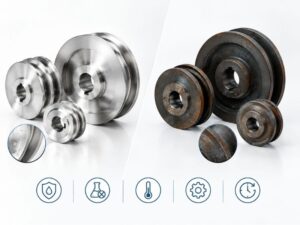
Vehicles operating in wet climates or off road conditions require superior corrosion resistance. Stainless steel universal joints hold up better than standard carbon steel replacements. The exposed underside of the L320 puts propshaft ends directly in the path of road spray and mud. Bearing cap corrosion is a primary driver of premature failure on standard joints.
Profab Machine manufactures stainless steel universal joints for driveline applications where corrosion resistance matters alongside load capacity.