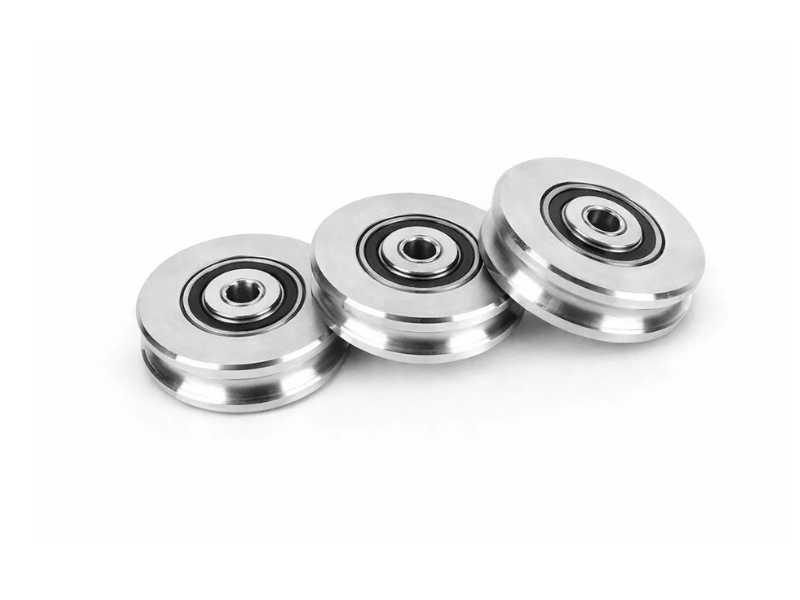
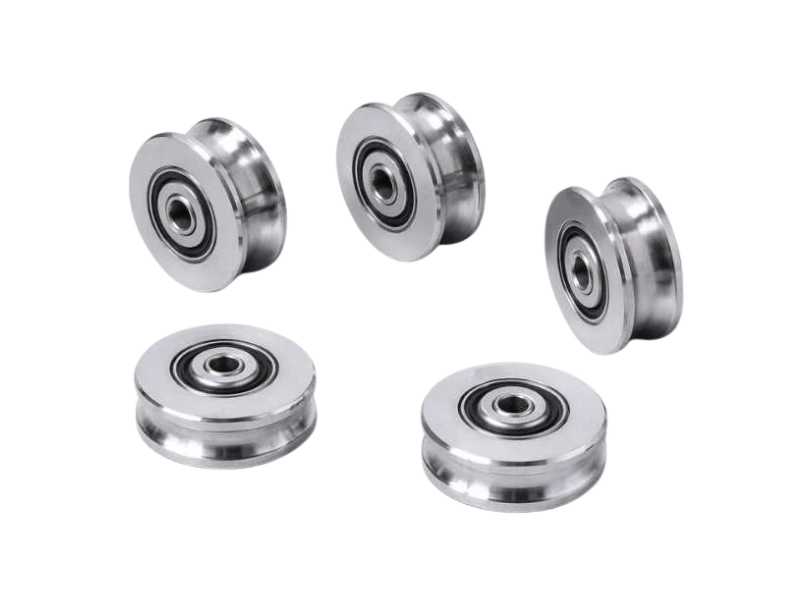
A stainless steel single pulley is a rope pulley with one grooved sheave. The wire rope or cable runs over the groove and changes direction. A single pulley redirects the load and does not reduce the force needed to lift it.
Profab Machine makes each single pulley to your drawing. You set the outside diameter, the groove for your rope, the bore, and the keyway. Choose 304 or 316L stainless steel to suit the environment.
We cut the groove to your rope size. The rope then sits on a smooth bearing surface and is not pinched. A single pulley suits light to medium lifting and routing.
Applications: Food plants, pharmaceutical areas, marine rigging, and cable routing on building facades.
The groove figures are one maker's published guidance for wire rope, based on Wire Rope Technical Board practice. We cut the groove to your rope and your drawing.
| Item | Typical for Wire Rope |
|---|---|
| Groove radius | 0.53 to 0.54 times the rope diameter |
| Groove radius, limits | About 0.53 minimum and 0.55 maximum times the rope diameter |
| Groove depth | About 1.5 times the rope diameter |
| Opening angle | 35° to 45° for normal use, 60° where the rope enters at a larger angle |
| Bore | H7 on an h6 shaft, or H6 for a tighter fit |
| Material | 304 or 316L stainless steel |
Calculated from the ratios on the Groove Reference tab, using the nominal rope diameter. Check the actual rope diameter with the rope maker before you fix the groove.
| Rope Diameter | Groove Radius | Groove Depth (about) |
|---|---|---|
| 3 mm | 1.59 to 1.62 mm | 4.5 mm |
| 4 mm | 2.12 to 2.16 mm | 6 mm |
| 5 mm | 2.65 to 2.70 mm | 7.5 mm |
| 6 mm | 3.18 to 3.24 mm | 9 mm |
| 8 mm | 4.24 to 4.32 mm | 12 mm |
| 10 mm | 5.30 to 5.40 mm | 15 mm |
Send a drawing, a STEP or DXF file, or a sample. Our engineers review the groove, the bore, and the keyway before cutting metal. We CNC machine the part ourselves, so you deal directly with the factory.
Send the rope diameter and construction. We machine the groove radius and depth to suit it. The rope then bears on the groove and does not pinch.
Choose 316L where chlorides are present, such as marine and chloride washdown. Choose 304 for food plants and dry areas where chlorides are absent.
The overall diameter of the sheave, flange to flange.
Send the rope diameter, or the radius itself. For wire rope it runs about 0.53 to 0.54 times the rope diameter.
Groove depth is about 1.5 times the rope diameter. Use a 35° to 45° opening. Tell us if the rope enters at a larger angle.
The width across the rim. Add the hub width if the hub is longer than the rim. Send the rope diameter so we check the groove clears it.
Bore size and tolerance. H7 is our usual fit on an h6 shaft. Ask for H6 where the pulley needs a tighter fit.
A DIN 6885 keyway, or a key with two set screws.
A sample or a drawing with these six dimensions is enough for us to quote. Send what you have and we will confirm the rest.
A stainless steel rope pulley is a grooved wheel that guides a wire rope or cable and changes its direction. A single pulley has one sheave.
The groove radius should be about 0.53 to 0.54 times the nominal rope diameter. That makes the groove diameter 6 to 8% larger than the rope. Send the rope diameter and we set the groove to it.
No. A single pulley only changes the direction of the rope. A block with more than one sheave gives mechanical advantage.
Yes, if the groove matches the cable diameter. Send the cable diameter and construction so we cut the groove to it.
316L suits chlorides, such as marine rigging and chloride washdown. 304 suits food plants and dry areas where chlorides are absent.
Send the rope or cable diameter, the outside diameter, the face width, the bore and keyway, the grade, and the quantity. A drawing or a sample speeds up the quote.
If you already have drawings, email them to [email protected].
[email protected] ↗We use cookies to run this site, to measure how it is used, and to show relevant ads. You can accept all, reject all non-essential cookies, or choose by category. Privacy Policy