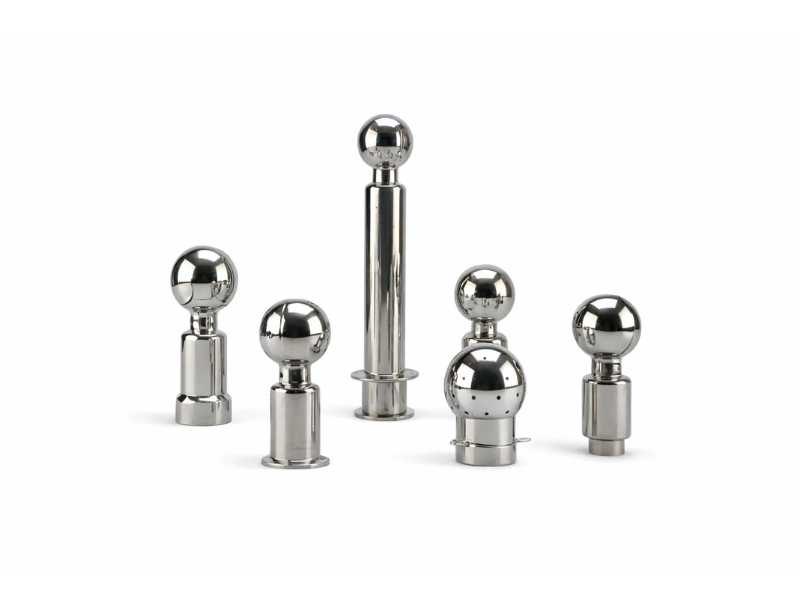
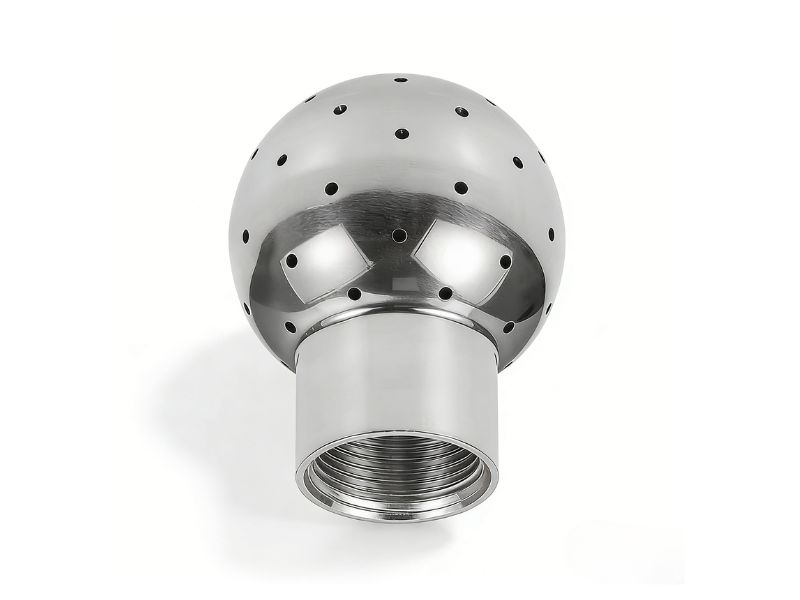
A static spray ball, also called a fixed spray ball, is a hollow sphere with drilled nozzles. It has no moving parts. The cleaning solution leaves the nozzles in a fixed pattern and washes the tank as it cascades down.
Profab Machine makes each static spray ball to your drawing. You set the ball size, the connection, the spray pattern, and the grade. Choose 304 or 316L stainless steel to suit the cleaning chemistry.
With no bearing to wear, a static ball suits light to moderate soil in tanks without obstructions. It keeps CIP validation straightforward.
Applications: CIP tank cleaning in dairy, brewery, beverage, pharmaceutical, and chemical plants.
Ball diameters from one maker run from 1-1/4 in to 5 in. Flow rate and coverage depend on the ball, the orifice pattern, and your pump, so send your rated flow, pressure, and tank size.
| Item | Typical |
|---|---|
| Connection | Tri-Clamp, NPT threaded, BSP, DIN 11851, socket-weld |
| Size range | DN15 to DN80 (1/2 to 3 in) |
| Spray pattern | 360°, 270° with drainage, 180° up, 180° down |
| Operating pressure | About 1 to 3 bar (15 to 45 psi) |
| Material | 304 or 316L stainless steel |
A 270° pattern with drainage is made to your drawing.
| Pattern | What It Does |
|---|---|
| 360° | Spreads the cleaning solution evenly over the whole tank |
| 180° up | Concentrates the spray on the vessel head, and the cascading solution washes the walls |
| 180° down | Concentrates the spray on the internal attachments below the vessel head |
| Item | What to Give on the Order |
|---|---|
| Ball and body | Ball diameter and overall length |
| Connection | Type and size, with the tank port diameter |
| Spray pattern | 360°, 270°, 180° up, or 180° down |
| Pump | Rated flow and pressure at the spray ball inlet |
| Finish | Surface roughness, with electropolishing or passivation if needed |
Send a drawing, a STEP or DXF file, or a sample. Our engineers review the dimensions and the tolerance before cutting metal. We CNC machine the part ourselves, so you deal directly with the factory.
You set the ball size, the connection, and the spray pattern. We CNC drill the orifices and machine the connection to that drawing, so the ball fits your tank port.
Coverage depends on the pump flow and pressure at the inlet. Send the rated values, and we match the orifice count and size to them.


A static spray ball is a hollow sphere with drilled nozzles and no moving parts. It sprays the cleaning solution in a fixed pattern.
A fixed pattern leaves shadow areas behind an agitator, a baffle, or a sensor. For those tanks, consider a ball that turns, or add a second ball.
Choose 360° to wash the whole tank evenly. Choose 180° up to concentrate on the vessel head, or 180° down for the attachments below the head.
About 1 to 3 bar suits most balls. Too much pressure breaks the spray into mist without cleaning better, so match the orifices to your pump.
Choose 316L for caustic, acid, and chlorinated cleaning chemicals. Choose 304 for fresh water and dry use.
Send the tank size, the connection type and size, the spray pattern, and your pump flow and pressure. Add the grade and the quantity. A drawing or a sample speeds up the quote.
If you already have drawings, email them to [email protected].
[email protected] ↗We use cookies to run this site, to measure how it is used, and to show relevant ads. You can accept all, reject all non-essential cookies, or choose by category. Privacy Policy