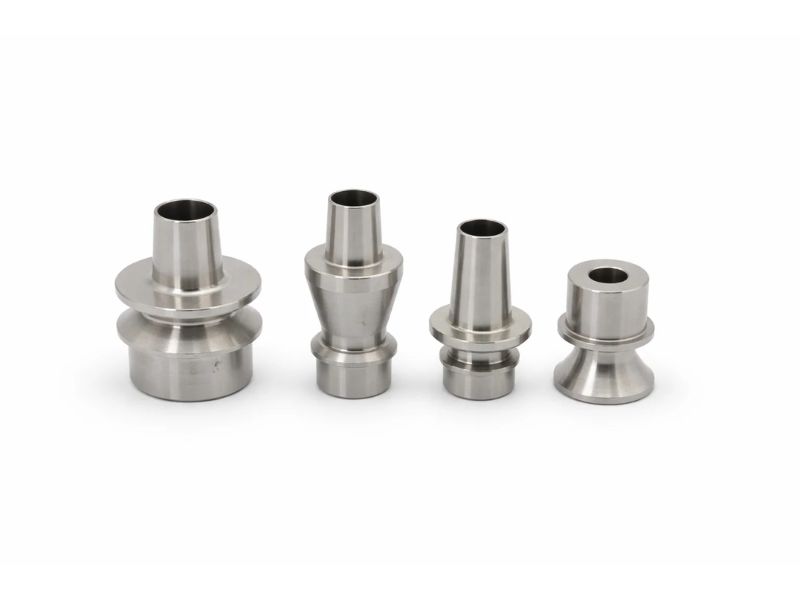

Custom high misalignment and standard spacers for rod ends in 304, 316L, and 17-4PH, with other grades on request. Sold as a matched pair, they raise the swing angle of a rod end and let a smaller bolt run through a larger bore, made to your drawing or sample.
Applications: Fabricated Suspension Links, Steering Linkages, Hydraulic and Pneumatic Cylinder Mounts, Agricultural Machinery.
A spacer is named by the rod end bore it fits and the bolt it carries. These are the bore and bolt pairs most often used. The overall width follows your bracket gap, and the angle gained depends on the rod end and the spacer shape. Standard spacers keep the bolt at the bore size. Any bore, bolt, width, and shape is made to your drawing.
| Rod End Bore | Bolt Sizes | Supplied |
|---|---|---|
| 1/2 in | 3/8 in | Matched pair |
| 3/4 in | 1/2 in or 5/8 in | Matched pair |
| 7/8 in | 1/2 in or 9/16 in | Matched pair |
| 1 in | 5/8 in or 3/4 in | Matched pair |
Spacers are used in pairs, one each side of the rod end ball, so order them as a set.
| Form | What It Does | Typical Use |
|---|---|---|
| High misalignment pair | Steps a larger bore down to a smaller bolt and gives the largest swing | A 1 inch bore on a 5/8 inch bolt, or a 7/8 inch bore on a 5/8 inch bolt |
| Standard pair | Keeps the bolt at the bore size and adds clearance from the bracket | Joints where the bolt is already the right size and the ball is narrower than the gap |
| Narrow pair | A shorter overall width | Tight brackets where the pair must fit a small gap |
| Wide pair | A longer overall width | Wider brackets, where the pair also fills the gap |
| Custom pair | Bore, bolt, width, and shape to drawing | Rod ends and joints that a standard pair does not fit |
Send a drawing, a DXF file, or a sample. Our engineers review the dimensions and the tolerance before cutting metal, and we CNC machine the part ourselves, so you deal directly with the factory.
We machine both spacers of a pair together, so the contour and the width match and the ball sits centered on the bolt.
Salt, moisture, washdown chemicals, and load drive the choice between 304, 316L, and 17-4PH. We confirm the grade against your drawing before production, and tiered pricing is available on larger orders.


A misalignment spacer fits on either side of a rod end ball. It lets a smaller bolt pass through a larger bore, and its contoured shape gives the ball more room to swing before the housing hits it.
A standard spacer keeps the bolt at the bore size and adds clearance from the bracket. A high misalignment spacer steps the bore down to a smaller bolt and removes material, so the ball can turn farther into the housing. The price of the larger angle is less spacer strength.
Only the spacer. The rod end around it is often carbon steel or chromoly, so for a washdown or marine joint pair the spacers with a stainless rod end.
Choose the spacer from the rod end bore and the bolt diameter, then check that the overall width of the pair matches the gap between your brackets.
It depends on the rod end and the spacer shape, so we do not publish a single figure. Test the fitted joint through its full travel to confirm that it stays within its range.
Choose 316L where the joint sees salt, chlorides, or chloride-based cleaning chemicals, because it resists pitting better than 304. Choose 304 for indoor, dry, or mildly humid service, where it costs less.
A quote request needs the rod end bore, the bolt diameter, the overall width, the grade, the finish, and the quantity. A drawing or a sample speeds it up.
If you already have drawings, email them to [email protected].
[email protected] ↗We use cookies to run this site, to measure how it is used, and to show relevant ads. You can accept all, reject all non-essential cookies, or choose by category. Privacy Policy