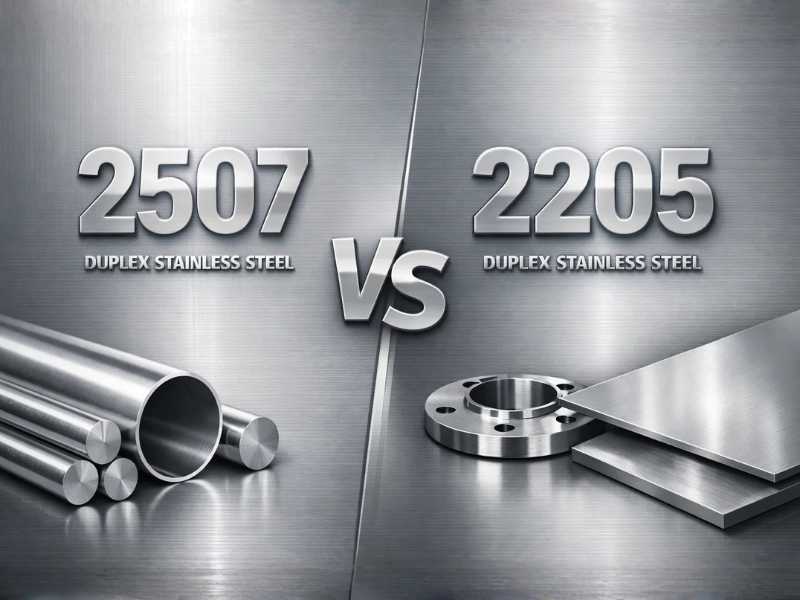
Specifying the wrong duplex grade is a quiet but expensive mistake. A procurement team orders 2205 because it's the "standard duplex," gets the material certified, welds it up — and six months into service in a warm seawater system, pitting starts. The failed component costs far less than the lost production time and the redesign. The fix, almost always, is to go back and spec 2507. The question is why that decision wasn't made upfront.
The answer is usually PREN — or more precisely, a misunderstanding of what PREN actually measures and why the 42+ threshold separates two meaningfully different levels of corrosion performance.
What PREN Actually Measures
PREN stands for Pitting Resistance Equivalent Number. It's a calculated index, not a direct test result, derived from a steel's chemical composition using this formula:
PREN = %Cr + (3.3 × %Mo) + (16 × %N)
For alloys containing tungsten — like some specialty super duplex variants — the formula extends to include 0.5×%W alongside molybdenum. For 2205 and 2507, the standard three-element formula applies.
Each coefficient in the formula reflects how effectively that element resists pitting corrosion relative to chromium. Molybdenum is 3.3 times more effective than chromium at blocking pitting initiation. Nitrogen carries the highest multiplier at 16, reflecting its powerful ability to stabilize the passive film and partition into austenite, concentrating its effect where corrosion typically initiates first.
The result is a single number used to rank steels within the same family — duplex to duplex, austenitic to austenitic. It's not absolute. A PREN of 42.1 does not guarantee seawater performance where 41.8 fails. But as the British Stainless Steel Association notes, PREN is reliable for ranking and comparing grades, not for setting exact service limits. What it does very reliably is draw a line between grades that are borderline for aggressive service and those that are not.
That line, by industry convention, sits at PREN ≥ 40 for duplex steels — and many end-user specifications, particularly in oil and gas, push that minimum to 42. The reason for the 42 floor is practical: ASTM composition allowances mean a compliant heat of 2507 sitting at the low end of its Cr and Mo ranges might produce a PREN of 40.5. Specifying 42 ensures the material delivers super duplex performance even with acceptable heat-to-heat chemistry variation.
PREN Quick Reference for Duplex Grades:
- Lean duplex (2101, 2304): PREN ~24–32 — for mildly corrosive environments
- Standard duplex (2205 / UNS S32205): PREN ~34–36 — for brackish water, mild chemical service
- Super duplex (2507 / UNS S32750): PREN ~42–43 — for seawater, offshore, high-chloride chemical processing
Composition: Where the Numbers Come From
Plug actual certified compositions into the formula and the difference becomes concrete.
2205 (UNS S32205 / EN 1.4462) — typical composition: - Chromium: 22% - Molybdenum: 3% - Nitrogen: 0.17%
PREN = 22 + (3.3 × 3) + (16 × 0.17) = 22 + 9.9 + 2.72 = ~34.6
2507 (UNS S32750 / EN 1.4410) — typical composition: - Chromium: 25% - Molybdenum: 4% - Nitrogen: 0.28%
PREN = 25 + (3.3 × 4) + (16 × 0.28) = 25 + 13.2 + 4.48 = ~42.7
The gap is approximately 8 PREN points. In raw composition terms, 2507 carries about 14% more chromium, 33% more molybdenum, and 65% more nitrogen than 2205. These aren't marginal differences — they represent a deliberate step up in alloying intensity, and they drive a proportional jump in corrosion resistance.
The molybdenum increase from 3% to 4% alone adds 3.3 PREN points. The nitrogen increase from 0.17% to 0.28% adds another 1.76. Combined with the 3-point chromium gain, 2507 clears the 40+ threshold that 2205 cannot reliably reach.
| Property | 2205 (S32205) | 2507 (S32750) |
|---|---|---|
| Chromium (%) | 21–23 | 24.0–26.0 |
| Molybdenum (%) | 2.5–3.5 | 3.5–5.0 |
| Nitrogen (%) | 0.14–0.20 | 0.24–0.32 |
| Nickel (%) | 4.5–6.5 | 6.0–8.0 |
| PREN (typical) | 34–36 | 42–43 |
| Yield Strength (min) | 450 MPa | 550 MPa |
| Tensile Strength (min) | 620 MPa | 795 MPa |
| Hardness (max) | ~290 HB | ~310 HB |
| Material cost (relative) | Baseline | ~1.5–2× 2205 |
The Strength Bonus
PREN captures corrosion performance. What the table above also shows is that 2507 carries a meaningful mechanical advantage: minimum yield strength of 550 MPa versus 450 MPa for 2205 — a 22% increase. Tensile strength rises from 620 MPa to 795 MPa.
Compared to 316L austenitic stainless (yield ~210 MPa), 2507's yield strength is more than double. This has a direct engineering consequence: under the same load, thinner sections of 2507 can substitute for heavier sections of lower-strength material. In weight-sensitive offshore structures or high-pressure piping, that substitution can reduce material consumption enough to offset part of the cost premium.
The tradeoff is machinability. At roughly 10–30% machinability rating relative to free-machining steels, 2507 is significantly harder to cut, thread, and finish than 2205. The root cause is work hardening: 2507 hardens rapidly during cutting, which accelerates tool wear and requires slower feeds, sharper tooling, and more conservative parameters than experienced machinists typically use on standard stainless. For machined precision components — custom flanges, fittings, or actuator parts — this means manufacturing cost goes up alongside the base material cost. Shops unfamiliar with super duplex often underestimate this effect.
One additional limit worth noting for both grades: neither 2205 nor 2507 is suitable for sustained high-temperature pressure service. Duplex steels are susceptible to embrittlement in the 280–475°C range due to spinodal decomposition of the ferrite phase. Design engineers specifying duplex for elevated-temperature applications should confirm operating temperatures stay well below this range.
Where 2205 Earns Its Place
2205 has been the workhorse duplex grade for a reason. Its PREN of 34–36 puts it well ahead of 316L (PREN ~24) and makes it suitable for a wide range of industrial applications where moderate chloride exposure is the concern.
Typical environments where 2205 performs reliably:
- Brackish water systems: water treatment plants, desalination pre-treatment, municipal infrastructure where chloride concentrations are measurable but below full seawater saturation
- Mild chemical processing: dilute acids, phosphoric acid environments, food processing with moderate saline contact
- Structural applications: bridge components, storage tanks, architectural elements in coastal but non-submerged environments
- Oil and gas at moderate conditions: per ISO 15156 / NACE MR0175, 2205 is acceptable for sour service up to 10 kPa H₂S partial pressure
Where 2205 runs into limits: temperature. In conditions approaching 70–80°C in concentrated seawater or brine, the risk of chloride stress corrosion cracking (SCC) increases measurably. Research on 2205 in evaporating seawater conditions has identified SCC susceptibility beginning in that temperature range under high applied stress. The PREN of 34–36 is not sufficient to maintain an intact passive film in hot, stagnant high-chloride conditions — particularly in crevices and under deposits where local chemistry concentrates.
For applications that routinely hit seawater temperatures above 50°C, or where crevice geometry is unavoidable and the consequences of failure are high, 2205 is operating close to its design envelope.
Environments That Demand 2507
Super duplex 2507 exists specifically for environments where 2205's PREN ceiling becomes a liability. The PREN 42+ threshold is not arbitrary — it marks the point where the material reliably maintains corrosion resistance in seawater at elevated temperatures, and in chloride-rich media at concentrations several times that of natural seawater.
Industries that routinely specify 2507 include:
Offshore oil and gas: Risers, umbilical tubes, subsea manifolds, topside seawater piping. In these environments, the combination of chloride, hydrogen sulfide, elevated temperature, and sustained mechanical stress creates a multi-factor corrosion challenge that 2205 cannot dependably handle. NORSOK M-630 and many operator-specific material requirements set PREN ≥ 40 as a baseline for seawater service — with some project specifications requiring ≥42 to account for composition scatter across heats.
Desalination: Both multi-stage flash (MSF) and reverse osmosis (RO) plants operate with concentrated brine streams at temperatures that push the limits of standard duplex. 2507 is the common choice for high-pressure components and pump internals in these systems.
Chemical processing: Chlorine-containing media, bleaching environments, and high-temperature acidic chloride solutions. The pulp and paper industry, for instance, uses 2507 in bleach plant equipment where both oxidizing acids and chloride are present simultaneously — a combination that accelerates localized attack on lesser grades.
Marine components: Propeller shafts, pump impellers, deck hardware in full seawater immersion service. The extended passive film stability of 2507 matters most in submerged conditions with limited oxygen replenishment — exactly the crevice scenario that accelerates pitting in standard duplex.
Key environments requiring PREN 42+:
- Seawater systems operating above 50°C
- High-concentration brine (desalination, chemical processing)
- Oxidizing acidic chloride environments (bleach plants, chemical tankers)
- Sour service exceeding 2205's ISO 15156 limits
- Any application where crevice corrosion is unavoidable and failure consequences are high
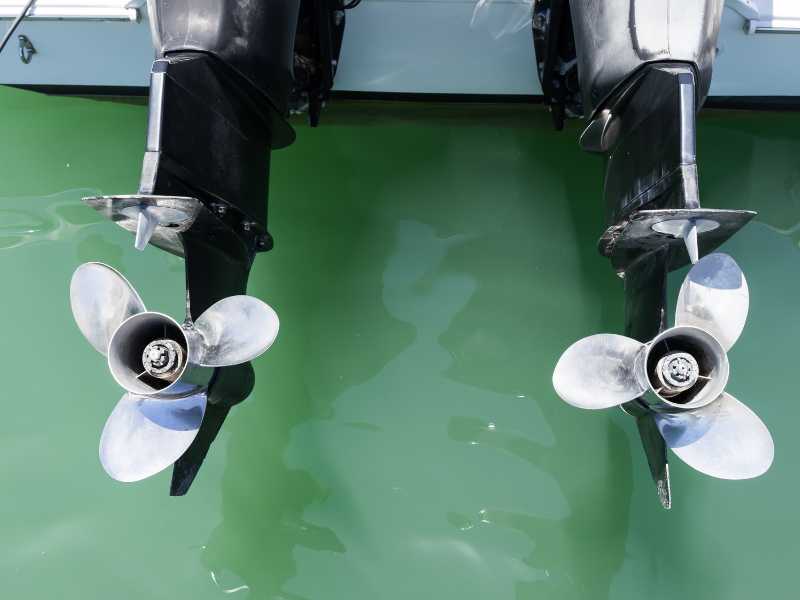
For reference, duplex stainless steels are classified by their PREN into lean, standard, and super duplex tiers — and the super duplex classification formally requires PREN ≥ 40, with 2507 typically achieving 42–43 through its higher Cr-Mo-N content.
Making the Call: A Practical Selection Framework
The decision between 2205 and 2507 is fundamentally a risk and cost conversation, not just a corrosion science conversation.
Choose 2205 when: - Operating in brackish or treated water with chloride concentrations under seawater levels - Temperature stays below 50°C in chloride-containing media - Budget is constrained and the corrosion environment is genuinely moderate - The application is structural (non-wetted or atmospheric) in coastal but non-submerged service
Choose 2507 when: - Seawater immersion or high-brine service is involved, especially above 50°C - Project specs explicitly require PREN ≥ 40 or ≥ 42 (common in oil and gas, NORSOK-governed projects) - Crevice geometry is part of the design (flange faces, gasketed joints, socket connections) - Failure consequences justify the material cost premium — offshore production downtime, contamination risk, personnel safety - The design benefits from 2507's higher yield strength to reduce section sizes and offset material cost
The 1.5–2× cost premium over 2205 is real. So is the cost of a mid-service replacement when the wrong grade was specified at the start. In high-stakes applications, the math typically favors 2507.
Profab Machine manufactures precision stainless steel components in both 2205 and 2507, with full material traceability and MTR documentation. Custom fabrication to customer drawings in super duplex grades is a core capability. Send your drawing and specified grade to our quote team for a straightforward RFQ.