

Marine Hardware
Stainless Steel Turnbuckles
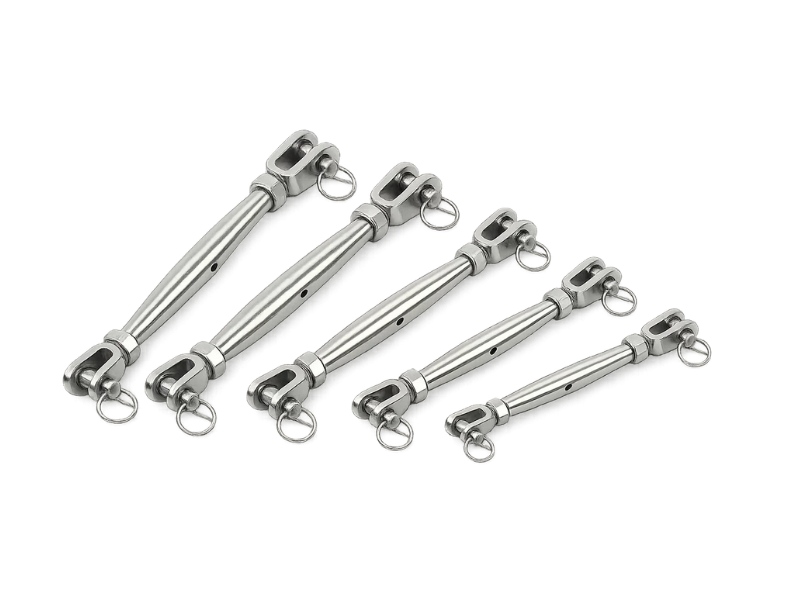
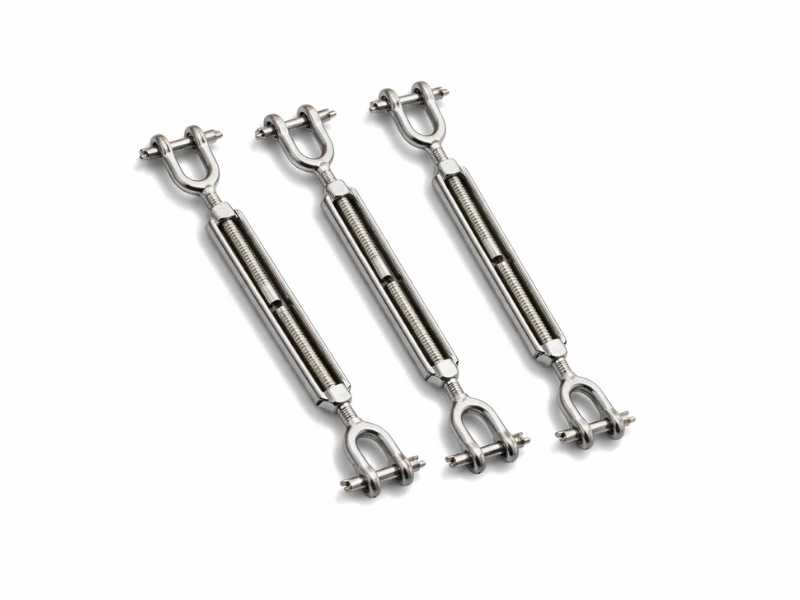
316L stainless steel turnbuckles for marine rigging, cable railing, architectural tensioning, and offshore structures. Open body, closed body, and toggle types. Eye, Jaw, Hook, and Toggle end fittings. M6–M36. WLL die-stamped. EN 10204 3.1 certs.
- ISO 9001 Certified
- Custom OEM Solutions
- Fast Global Shipping
- Technical Support
Product Range
Types of Stainless Steel Turnbuckles
Body style drives inspection access, thread protection, and aesthetics. End fittings are independent — any combination (Eye, Jaw, Hook, Toggle) can be specified with any body type.
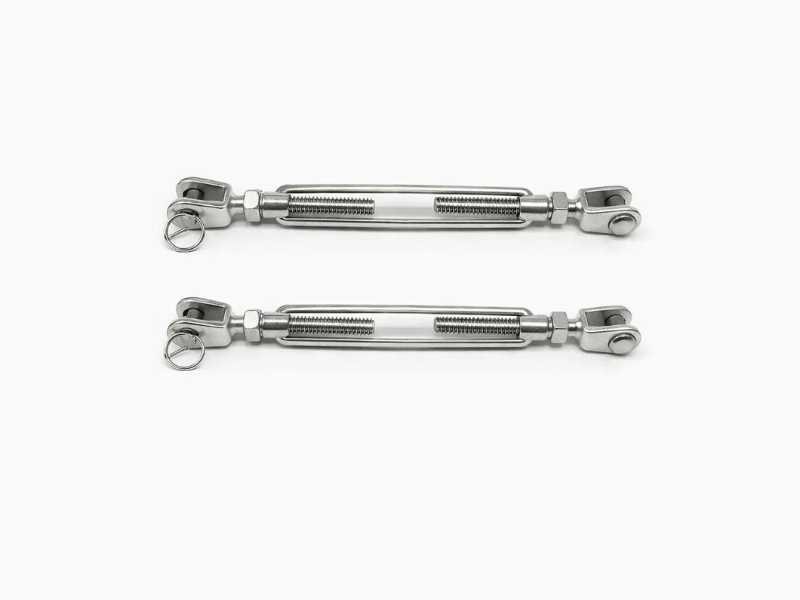
Open Body Turnbuckle
DIN 1478 compliant
Rigging · Structural
The open frame exposes both threaded studs, allowing visual inspection of remaining thread engagement — a mandatory safety check before tightening. Thread engagement markers machined on the studs confirm minimum engagement (six turns) is maintained. The most widely used body style for marine rigging, structural tension rods, and agricultural fencing where periodic adjustment and easy inspection are required. DIN 1478 compliant.
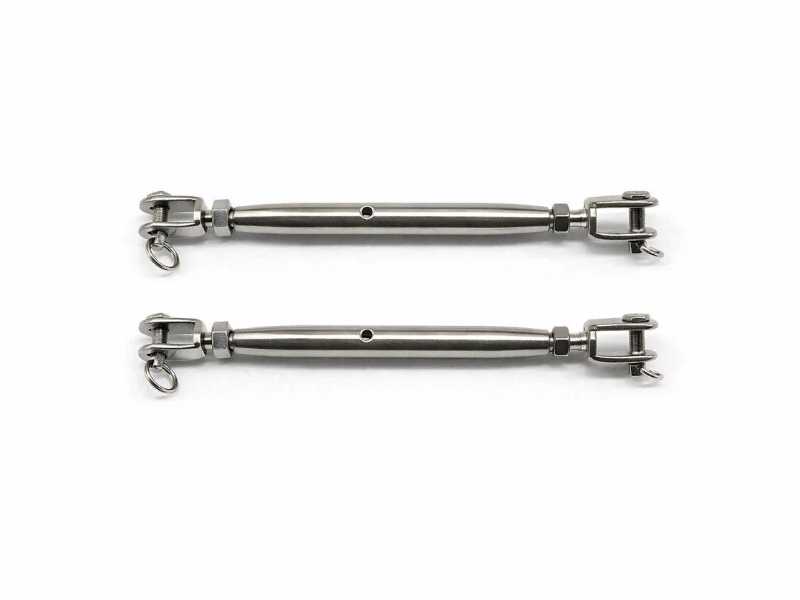
Closed Body Turnbuckle
Protected threads
Yacht rigging
A solid cylindrical barrel that fully encloses the threaded studs, protecting the thread form from salt water and contamination between adjustment events. The hex flats machined on the barrel accept a spanner for adjustment. Preferred for yacht standing rigging and architectural cable railing where both corrosion protection and clean visual profile are required. The enclosed thread geometry also reduces the risk of thread galling during adjustment in salt-spray environments.
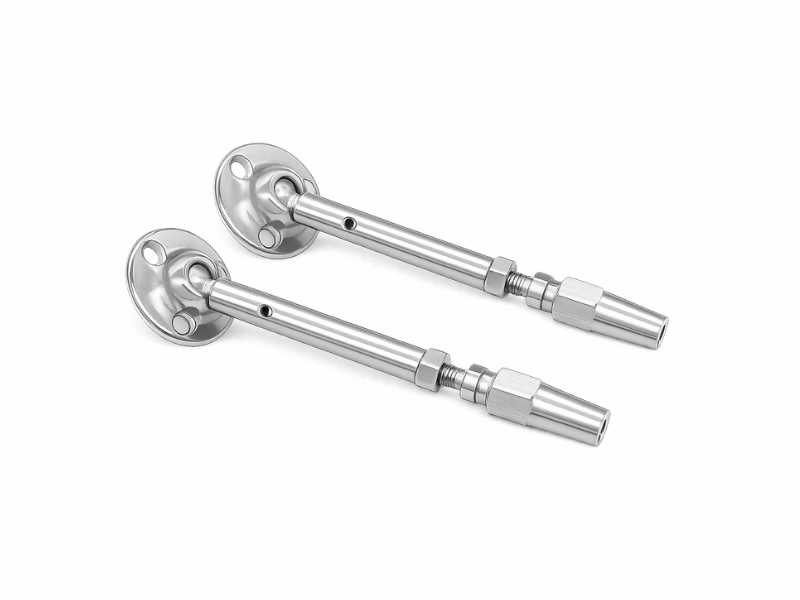
Toggle Turnbuckle
Articulating end
Glass facade
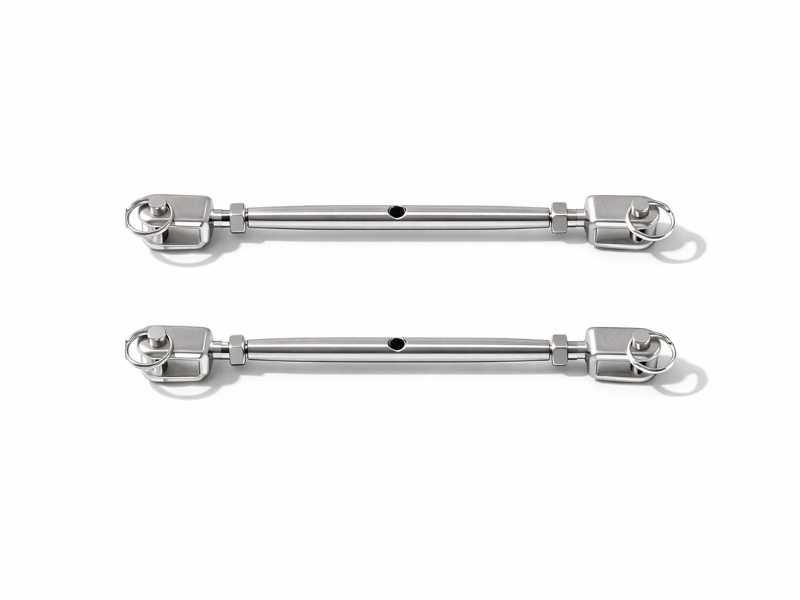
Toggle (flat-blade) end fittings pivot on a pin, allowing the turnbuckle to articulate in the plane of the bolt axis. This eliminates the bending moment that deforms rigid eye and jaw fittings when the tension rod and its anchor point are not perfectly co-axial — a condition that occurs in any structural system subject to thermal expansion, settlement, or fabrication tolerance. Toggle configuration is specified for architectural glass facades, roof canopy tension rods, and bridge handrails. Single and double-blade variants available.
WLL Reference
Thread Sizes & Working Load Limits
WLL values below apply to 316L bodies under static axial tensile load at ambient temperature. Safety factor 4:1 per DIN 1478 / ASTM F1145. Always verify suitability for your specific loading, environment, and governing standard before installation.
| Thread | Take-Up | WLL (kN) | WLL (lbs) |
|---|---|---|---|
| M6 | 50 mm | 1.2 kN | 270 lbs |
| M8 | 70 mm | 2.2 kN | 490 lbs |
| M10 | 90 mm | 3.6 kN | 810 lbs |
| M12 | 110 mm | 5.2 kN | 1,170 lbs |
| M14 | 130 mm | 7.0 kN | 1,570 lbs |
| M16 | 150 mm | 9.6 kN | 2,160 lbs |
| M20 | 180 mm | 15.0 kN | 3,370 lbs |
| M24 | 220 mm | 21.6 kN | 4,860 lbs |
| M30 | 270 mm | 33.6 kN | 7,560 lbs |
| M36 | 320 mm | 49.0 kN | 11,020 lbs |
End Fitting Selector
Choosing the Right Combination
End fitting mismatch, like a side-loaded jaw, an eye too small for the connecting shackle pin, is the most common installation error in rigging assemblies. Specify the connection geometry at both anchor points before ordering.
End Fitting Combinations
Eye / Eye (EE)
Both ends connect via pin through the eye. Most versatile — works at any angle when correctly sized to the connecting pin diameter.
Jaw / Jaw (JJ)
Fork ends on both sides. Direct pin connection to brackets. Cotter pin security. Best for removable connections to fixed anchors.
Eye / Jaw (EJ)
Most common marine/rigging combination. Eye to shackle, jaw directly to chainplate or bracket. Handles mixed anchor geometry.
Hook / Eye (HE)
Hook for quick installation without tools. Not for overhead lifting or safety-critical applications. Light duty and non-permanent.
Toggle / Eye (TE)
Toggle articulates in-plane. Specified for structural/architectural when connection geometry cannot guarantee perfect axial alignment.
Toggle / Toggle (TT)
Both ends articulate. For glass facades and canopies where both anchor points may shift with thermal expansion or structural movement.
Material Specification
Choosing the Right Grade
304 and 316L turnbuckles are visually identical. In marine service, they are not.
304 / 304L Stainless
Appropriate for indoor tensioning assemblies in genuinely non-chloride environments, like dry warehouse structural bracing, agricultural buildings well inland, and theatrical rigging in controlled venues. More cost-effective than 316L with excellent machinability. Do not specify 304 within 10 km of a coastline or for any assembly subject to salt spray, condensation in marine air, or outdoor exposure in humid coastal climates.
Indoor · Dry ag · Theatre
316 / 316L Stainless
The minimum acceptable grade for turnbuckles in any coastal, marine, or chloride-rich environment. The 2–3% molybdenum addition raises the PREN to ≥ 24, the corrosion resistance threshold at fine-pitch thread roots where seawater and chloride concentrate. Low-carbon “L” designation prevents carbide precipitation at machined thread surfaces. Profab XRF-verifies Mo content on every production batch before machining begins.
Marine · Offshore · Outdoor
Duplex 2205 Stainless
Approximately 30% higher yield strength than 316L at the same cross-section, allowing a smaller-diameter turnbuckle to achieve the same WLL at reduced weight. PREN of 34–36 provides superior resistance to stress-corrosion cracking in warm tropical seawater above 25°C. The failure mode that eliminates austenitic grades from deepwater and tropical offshore use. Specified for racing yacht standing rigging, offshore platform cable assemblies, and subsea structural connections. Available M10–M36 on request.
Offshore · Racing · Tropical
Applications
Where Stainless Steel Turnbuckles Are Used
A turnbuckle is required wherever an assembly needs in-line tension adjustment without rotating the connected load, and where the service environment makes corrosion resistance non-negotiable.
01
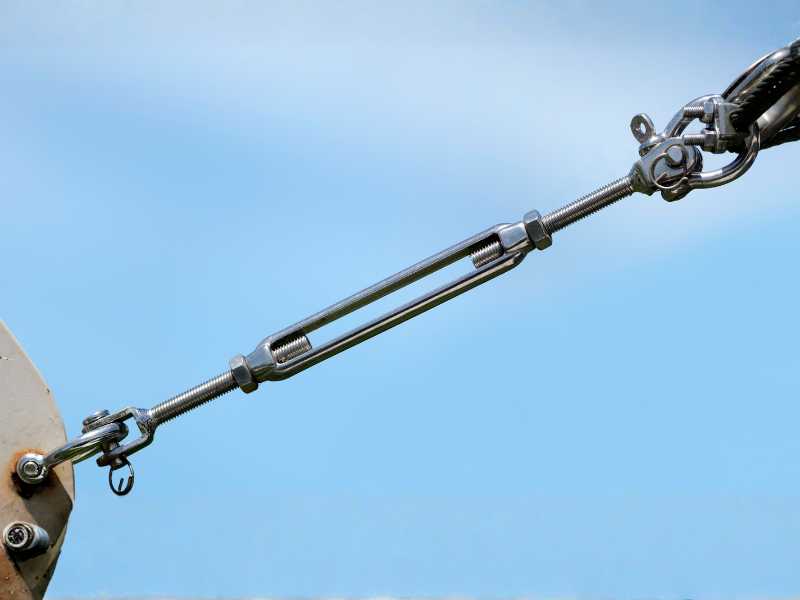
Yacht Standing Rigging
Closed-body 316L turnbuckles at the lower chainplate connections of shrouds, forestays, backstays, and inner forestays. Jaw end to the chainplate pin or toggle plate; eye or jaw at the upper terminal depending on the wire termination type. Closed-body protects threads between seasonal tuning events. Duplex 2205 for offshore passage and racing specifications where weight and extreme corrosion resistance are simultaneously required.
02
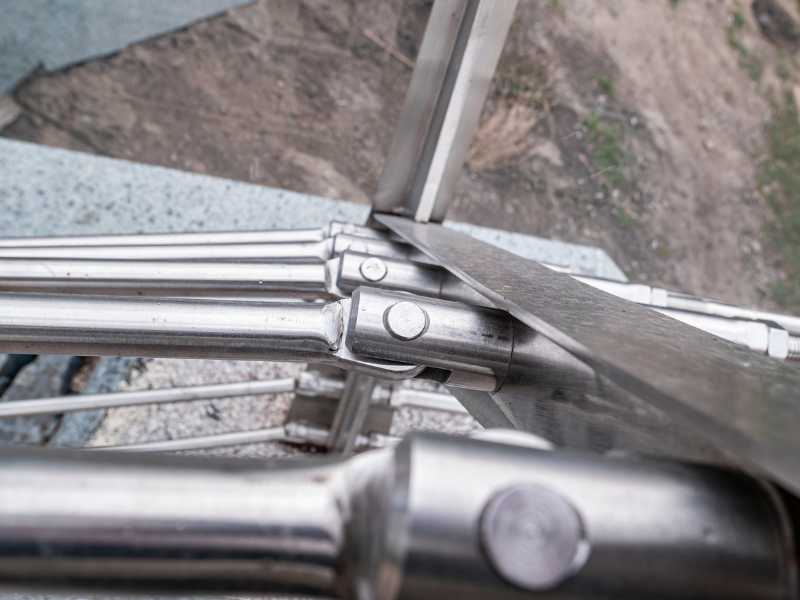
Architectural Cable Railings
Closed-body 316L turnbuckles tension the horizontal wire rope runs of balustrade systems on decks, balconies, and staircases. The clean barrel profile meets aesthetic requirements on high-visibility installations. Toggle end fittings are specified where post-drilling geometry doesn’t guarantee perfect axial alignment. Extended take-up bodies for long cable spans where standard take-up ranges are insufficient for final tensioning after assembly.
03
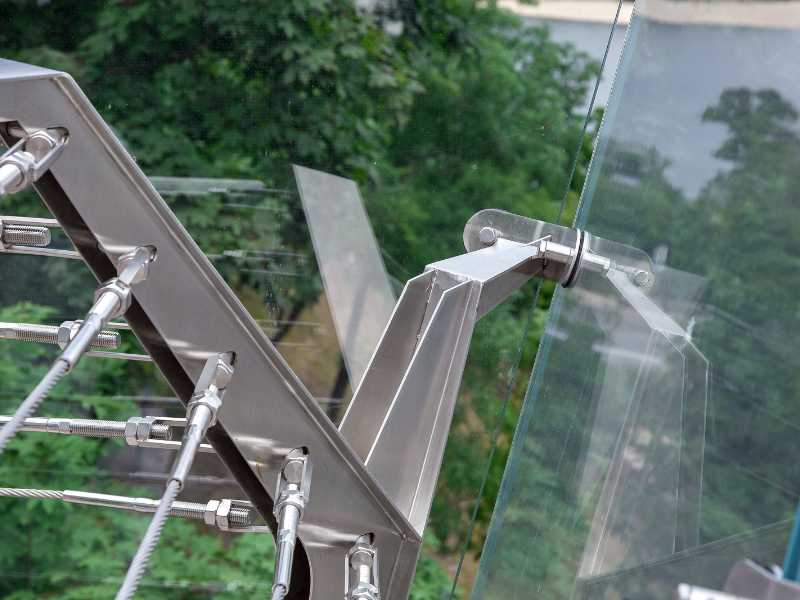
Structural Glass & Canopies
Toggle/Toggle 316L turnbuckles for the tension rod systems supporting glass canopy panels and point-fixed glazing facades. Both ends must articulate to absorb thermal expansion and structural movement that displaces anchor points out of co-axiality. Custom extended-take-up bodies available where the standard M12–M24 take-up range is insufficient for long-span roof tension rods. 304 for internal atrium applications in climate-controlled environments.
04
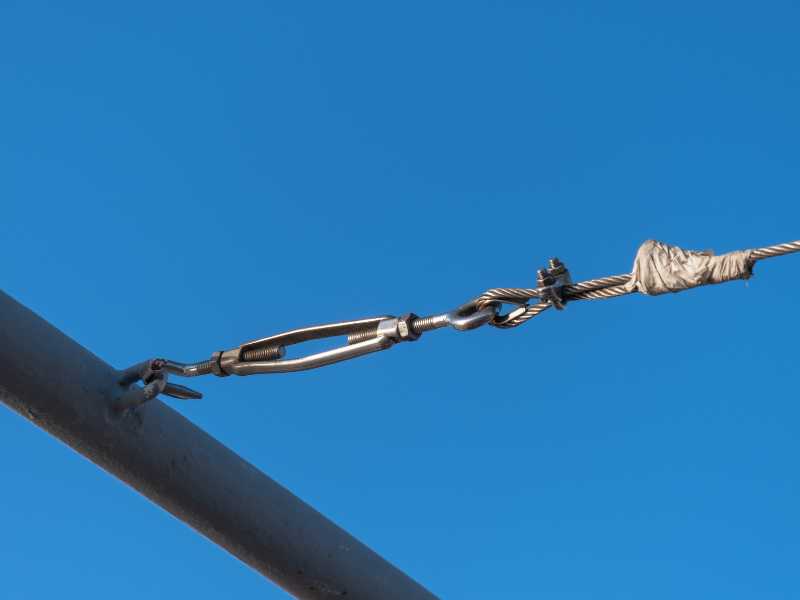
Offshore & Marine Structures
Open-body 316L or Duplex 2205 for platform structural cross-bracing, mooring pre-tensioning, and cargo securing on commercial vessels. EN 10204 3.1 material test certificates required by DNV, Lloyd’s Register, ABS, and Bureau Veritas for any turnbuckle entering a classified marine or offshore structure. Profab prepares the full documentation package without subcontracting to third-party certificate issuers.
05
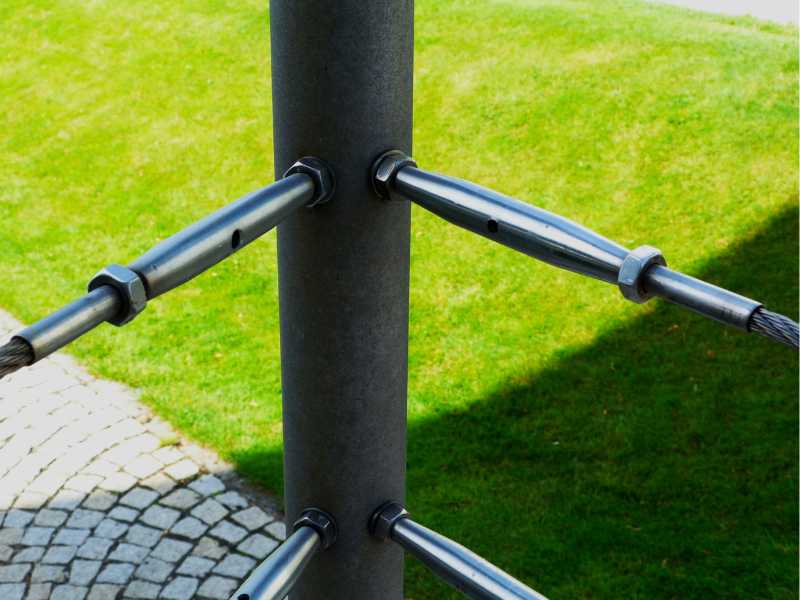
Agricultural & Rural Fencing
Open-body 316L for wire fence tensioning and aquaculture cage mooring at coastal farms — environments where galvanised hardware fails within one to two seasons and requires repeated replacement. Eye/Eye for wire rope ends; Eye/Hook for installations requiring periodic manual release. 304 acceptable for inland, non-coastal agricultural applications with no direct salt exposure.
06

Theatrical & Event Rigging
Open-body turnbuckles for flying systems and truss tensioning. Open-body is required by theatrical rigging codes so the rigger can visually confirm six turns of thread engagement before load is applied. 304 is acceptable for controlled indoor venues. Inspection holes machined on Profab open-body turnbuckles allow engagement check without measurement tools — the stud tip visible through the hole indicates minimum engagement has been reached.
Why Profab
Your Reliable Turnbuckles Supplier
01
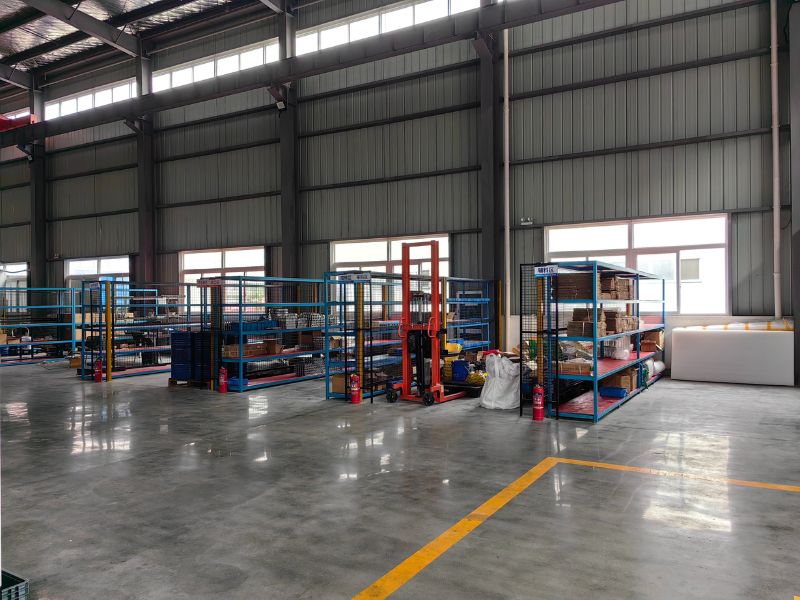
316L Mo Content Confirmed by XRF Every Batch
Profab verifies molybdenum content on every 316L production batch by XRF spectrometry before any machining begins. Mo is confirmed at 2.0–3.0%. For commercial orders, EN 10204 3.1 material test certificates with heat-lot traceability are supplied as standard. You receive analytical data confirming the grade you specified — not a supplier’s verbal assurance backed by a bar code on the raw material.
02
Matched LH/RH Thread Sets in One Clamping Operation
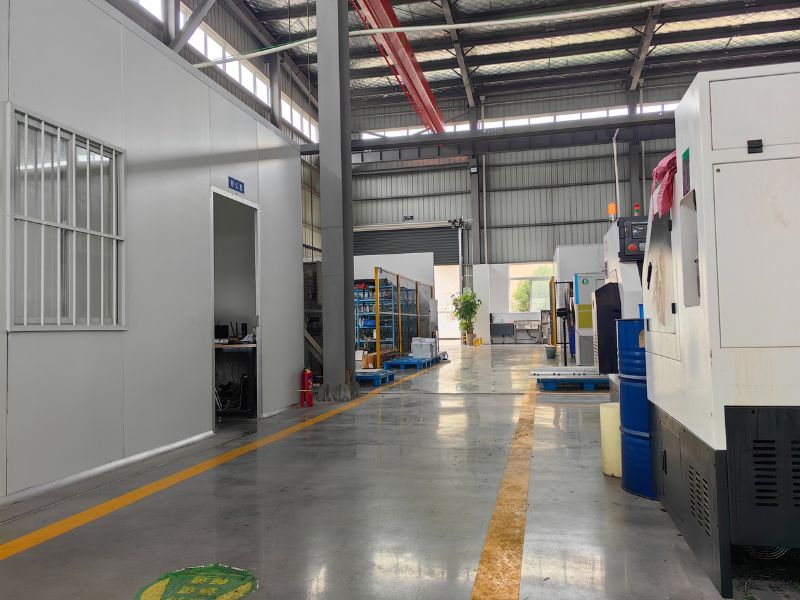
Tension rod assemblies require one stud to carry left-hand thread and the other right-hand. Profab machines both thread forms in the same 4-axis CNC clamping — ensuring thread pitch, class, and axial runout are identical on both ends. Mismatched thread geometry between LH and RH studs creates unequal take-up loading, a documented cause of premature turnbuckle thread failure in structural assemblies.
03
EN 10204 3.1 Certs — Standard on Commercial Orders
EN 10204 3.1 material test certificates — heat-lot traceable, signed by an independent inspection body — are included with commercial orders without additional charge. For offshore, yacht classification, and structural glass projects requiring DNV, Lloyd’s Register, or Bureau Veritas documentation, Profab assembles the full compliance package in-house. No subcontracting, no delays at project audit.
How to Order
From Inquiry to Delivery
1
2
3
4
Send Specs
Series, thread size, grade, hand, safety catch, quantity. DXF or drawing for custom items.
Respond Within 24 Hours
We will work on the best solution base on your request and send you a specific quote within 24 hours.
Production
7–15 days standard. Samples before full production run on new custom parts. QC report before shipment.
Delivery
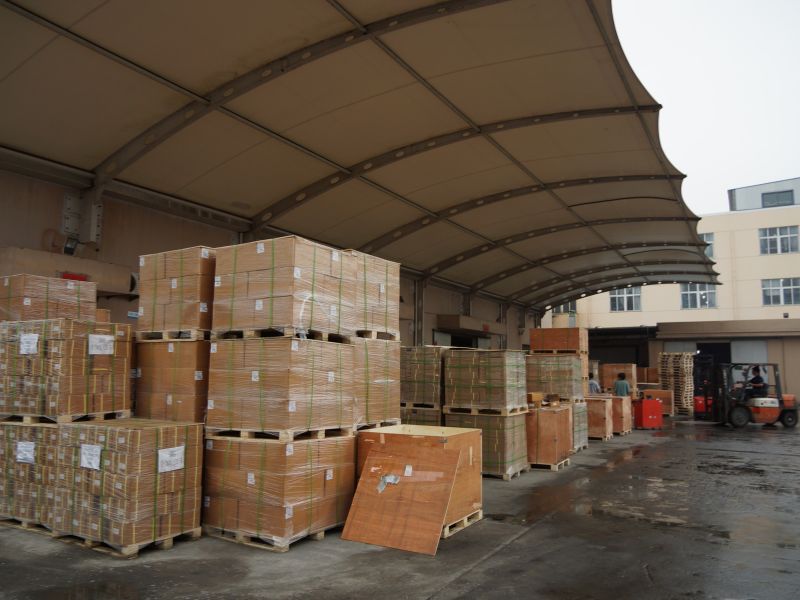
Sea, air, or express courier. Material certs and inspection report inside every box. Tracking same day.
FAQ
Common Questions
Not seeing your question? Email us at [email protected] and we typically reply same day.
Open body or closed body — which should I specify?
Open body: where periodic visual thread engagement inspection is required or specified by rigging codes (theatrical, commercial marine, offshore). The exposed frame allows the rigger to confirm minimum engagement without tools. Closed body: where the threads need protection from salt water and contamination between adjustment events — yacht standing rigging and architectural cable railings. Also preferable aesthetically for high-visibility installations. WLL, material, and end fitting combinations are identical between the two; the choice is driven by inspection requirement, environmental protection, and visual preference.
Can turnbuckles be used for overhead lifting?
Standard turnbuckles are not certified or rated for overhead lifting duty. Overhead lifting hardware must comply with ASME B30.26 or EN 13411, be individually proof-load tested, and carry a documented certificate. Standard turnbuckles are rated for static tensile loads in rigging and structural assemblies, not the dynamic shock loads of crane and hoist operations. If you require a tensioning device for an overhead lifting application, specify a rigging screw that carries an explicit overhead lifting certification with individual test documentation.
Why do stainless turnbuckles seize and how do I prevent it?
Stainless steel galls — the asperities on two stainless thread surfaces cold-weld under frictional contact during assembly. Once galling starts, it progresses rapidly and the threads can seize completely. This is not a material defect; it is the physical property of austenitic stainless under dry sliding contact. Prevention is straightforward: apply nickel-based or PTFE anti-seize compound to both thread forms before assembly, and use only a spanner or turnbuckle wrench — never a power tool. Profab applies a light coating of anti-seize to all turnbuckle threads before protective packaging. If a turnbuckle seizes in the field without anti-seize, the thread damage is a maintenance failure.
Related Products
Often Ordered Together
Get in touch with
Ready to Source Stainless Parts?
If you already have the drawings, please send email to [email protected] directly for an instant quote.
Profab
Request a Quote