
- By Profab /
- April 6, 2026
Table of Contents
The wrong cleat doesn’t announce itself at the point of purchase. It announces itself at the moment the line load exceeds what the fitting can handle — a surge load from a passing vessel, a building sea in an overnight anchorage, or a dock line under two days of wind-driven load. By that point, the selection decision is long past. This article covers the seven cleat types in common marine use, what each one is actually designed to do, and the criteria that should drive selection before the hardware goes on the vessel.
The 7 Types at a Glance
Boat cleats are not a single category of hardware. The term covers seven distinct fitting types with different mechanical principles, load ratings, and applications. Treating them interchangeably is a misapplication risk that shows up in the field more often than it should.
| Type | Mechanism | Primary Use | Suitable for Dock Lines | Typical Material |
|---|---|---|---|---|
| Horn cleat | Friction / figure-eight wrap | Mooring, dock lines, anchor rode | Yes | 316 stainless, anodized aluminum |
| Pop-up cleat (spring-loaded) | Spring-deployed horn cleat | Deck-critical vessels, performance craft | Yes (when deployed) | 316 stainless (mandatory) |
| Pull-up cleat (manual flush-mount) | Manual-lift horn cleat, flush when stowed | Low-profile deck installations, lower maintenance | Yes (when deployed) | 316 stainless (mandatory) |
| Cam cleat | Spring-loaded ridged cams | Running rigging, sheets | No | Stainless, nylon composite |
| Clam cleat | Opposed ridged jaws | Light rigging, halyards, dinghies | No | Aluminum, nylon |
| Jam cleat | V-groove friction slot | Halyards, control lines | No | Aluminum, stainless |
| Dock cleat | Heavy horn cleat, fixed | Fixed dock mooring infrastructure | Yes | Galvanized steel, 316 stainless |
| Herreshoff cleat | Curved-horn horn cleat, four-hole flared base | Classic vessels, traditional hull aesthetics | Yes | Bronze, 316 stainless |
Horn Cleat: The Default for a Reason
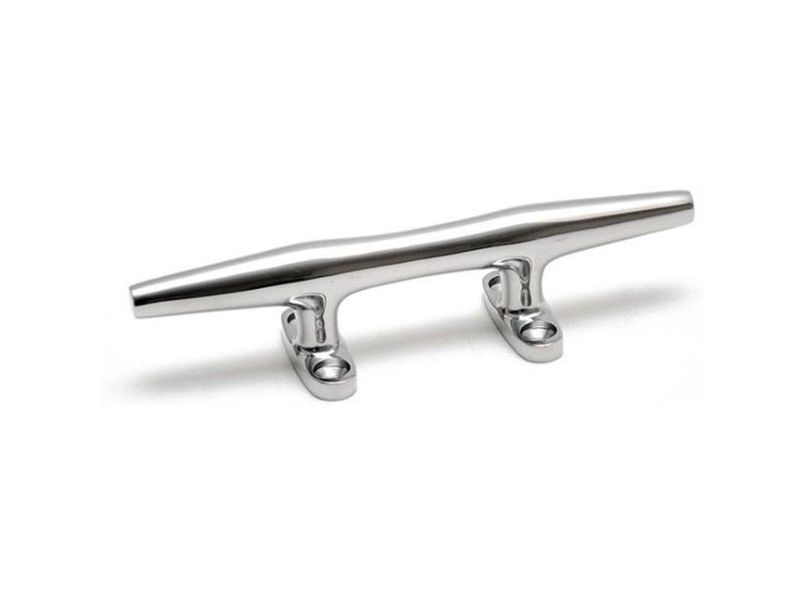
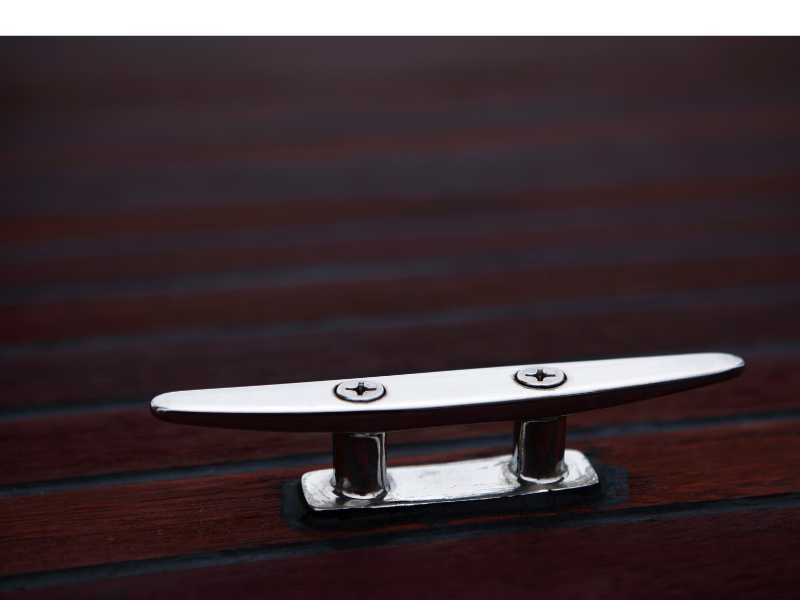
The horn cleat is the baseline against which everything else is measured. Two horizontal horns project from a raised body mounted to a flat base. Lines secure using a standard cleat hitch: a round turn around the body, a figure-eight over the horns, finished with a locking half hitch. No moving parts, no cam mechanisms, no maintenance beyond rinsing and periodic inspection of through-bolt integrity.
The geometry does two things well. The round turn around the body creates the primary friction zone, carrying the majority of peak dynamic load through surface contact rather than any mechanical lock. The figure-eight over the horns adds directional resistance. The result is a fitting that holds under surge loads, releases quickly when required, and has no mechanical failure mode beyond the structural integrity of the fitting and its mounting.
For dock lines, mooring lines, and anchor rode — the three primary cleat applications on any vessel — the horn cleat remains the industry default because nothing simpler achieves the same combination of holding power, reliable attachment, and single-handed release. When a cleat type is unspecified in a build or refit, this is the correct default choice.
Size selection follows the industry standard ratio: one inch of cleat length per 1/16 inch of dock line diameter. A vessel running 1/2-inch lines needs at least an 8-inch cleat; 5/8-inch lines require 10 inches; 3/4-inch lines require 12 inches. The ratio is a functional handling guideline that relates to the geometric requirements of the figure-eight wrap, not an arbitrary convention. Undersized cleats produce shallow wrap angles and reduced grip surface. Oversizing creates a different problem: when the horn geometry is too large for the line diameter, the locking half-hitch cannot seat properly and grip the horn — the hitch sits loose rather than cinching, which degrades the security of the final wrap under dynamic load. Proportionality matters in both directions.
Pop-Up and Flush-Mount Cleats: When Deck Space Is the Constraint
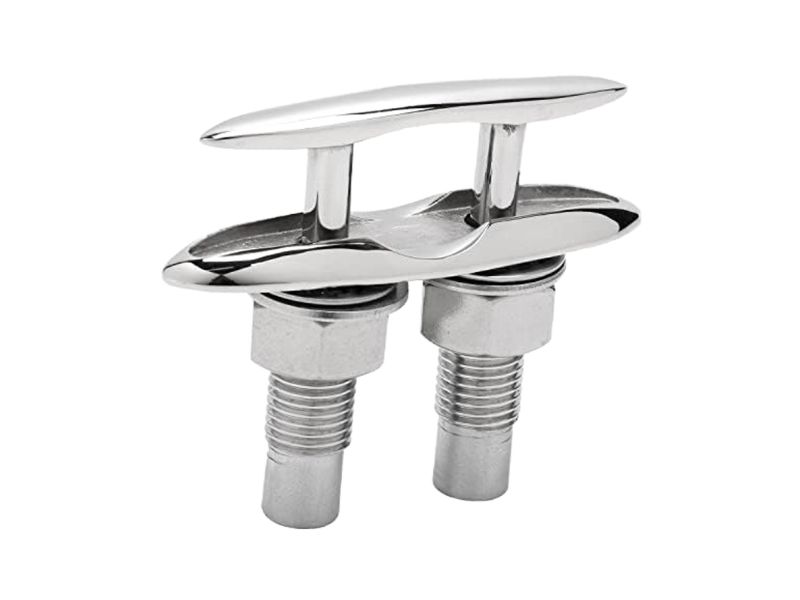
Pop-up and flush-mount cleats solve one specific problem: deck obstruction. When stowed, they sit at or below deck level, eliminating the tripping hazard and clearing the deck surface for crew movement. When deployed, the horn geometry and cleat-hitch mechanics are functionally identical to a fixed horn cleat. The spring mechanism is the operative difference, not the load-handling design.
The spring mechanism works as follows: the cleat body sits in a below-deck cavity with the spring compressed. Manual activation — typically a button or lever at the base — releases the spring, pushing the horns above deck level. Some designs use a simple pull-up mechanism without a spring. The important characteristic is that deployment is intentional and requires physical engagement; the cleat does not self-deploy or self-retract under load.
This type of cleat is the correct choice in several specific situations. Casting decks on flats and bay boats require clear standing surface; a protruding horn cleat in a casting area is a genuine safety hazard for anglers working the deck during a drift. High-performance sailing yachts with crew moving continuously on the foredeck during sail handling need the same clear-deck logic. Vessels where aesthetics drive specification — luxury yachts, custom builds — also specify flush-mount fittings for the cleaner deck profile.
The tradeoffs are mechanical. The spring mechanism adds complexity that a fixed cleat does not have. Sand, grit, and marine fouling accumulate in the cavity and can cause the mechanism to stick, require cleaning to deploy, or fail to retract cleanly. Below-deck installation introduces a deck penetration that must be properly waterproofed: an unsealed cavity above electronics, batteries, or flotation foam is a water infiltration path. Drainage provisions — either drain cups integrated into the cleat body or tubing that directs water overboard — are not optional.
Material grade is mandatory: 316 stainless steel only for saltwater and tidal applications. The moving parts of the spring mechanism are more susceptible to crevice and pitting corrosion than the solid geometry of a fixed horn cleat. 304 stainless in the cavity environment will corrode at the spring interface and seizing surfaces within a single season in coastal conditions. For vessels operating in freshwater only, 304 is acceptable but 316 remains the better long-term specification given the marginal cost difference. Those sourcing pop up boat cleats for saltwater-exposed vessels should confirm 316 grade with material documentation, not surface markings alone.
Pop-up cleat installation checklist:
- Material: 316 stainless steel — not 304, not anodized aluminum
- Waterproofing: drain cup or overboard tubing required for below-deck protection
- Through-bolt with backing plate — do not rely on self-tapping screws into GRP
- Identify what is below the installation point before cutting the deck cavity
- Periodic maintenance: clean cavity, lubricate spring mechanism annually
Cam Cleats and Clam Cleats: Not for Dock Lines
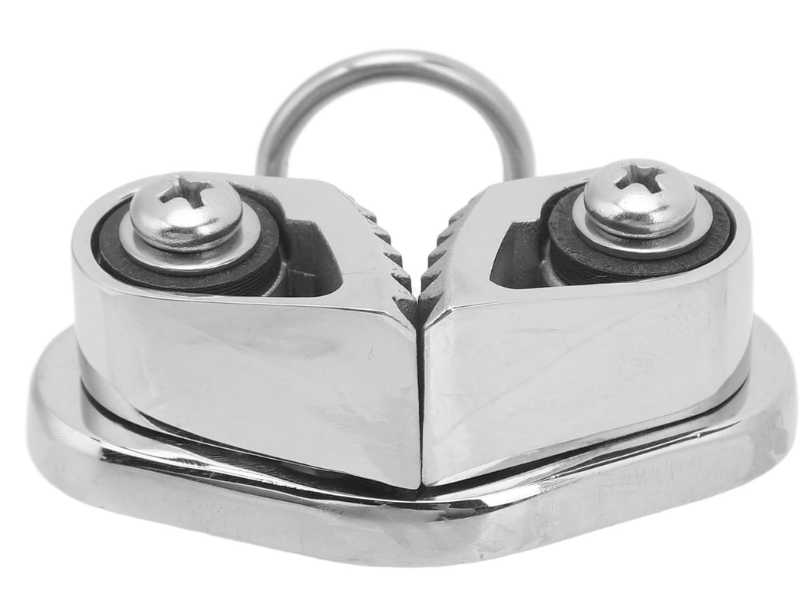
Cam cleats use spring-loaded ridged cams. A line fed through the cam jaw at the correct angle is gripped by the cam surfaces; an upward pull releases it. The release characteristic — one-handed, under tension, instantly — is the design’s purpose. Cam cleats excel in running rigging applications on sailing vessels: mainsheet, jib sheet, traveler control, any line where quick adjustment and release under load is the operational requirement. They are found across racing and cruising sailboats and on small performance powerboats where control line management demands quick-release hardware.
The application boundary is firm: cam cleats are not rated for dock line or mooring loads. The cams are designed for the dynamic, variable-tension loads of sailing sheet management, not the sustained static and surge loads of a vessel at a dock or on a mooring. Using a cam cleat as a mooring point is a misapplication; the load characteristics and failure modes are different from what the cam mechanism is designed to handle. This distinction is frequently misunderstood on vessels transitioning from racing use to cruising or liveaboard configurations.
Clam cleats operate on opposed ridged jaws. The line is pressed between the jaws; tension engages the ridges, and lifting the line clear releases it. The load range is lighter than cam cleats — typical applications include flag halyards, dinghy mainsheets, light control lines on small craft, and kayak rudder lines. The operating principle is correct for light-load quick-release applications. It is not a dock line fitting on any vessel type.
Jam Cleats: Control Line Hardware
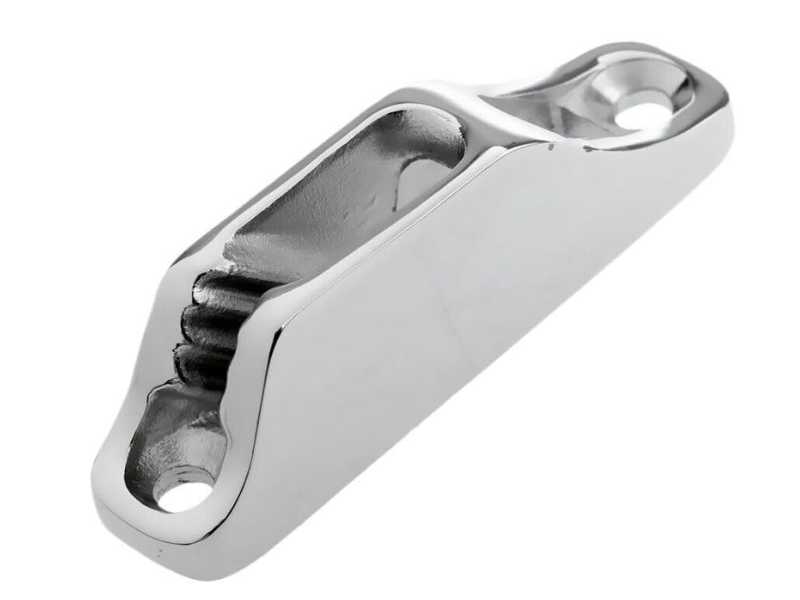
The jam cleat uses a V-shaped slot machined into the fitting body. A line of the appropriate diameter is pressed into the slot at the correct angle; the V-geometry creates friction that holds the line without knots. Releasing requires lifting the line out of the slot, which can be done under moderate tension. Jam cleats are found on halyards, boom vangs, cunninghams, and other sail control lines where a simple, low-profile line-holding solution is needed. Like cam and clam cleats, they are not dock line hardware. The friction-slot design is adequate for sail control tensions but is not dimensioned or rated for mooring or anchor rode loads.
Dock Cleats: Fixed Infrastructure
Dock cleats are heavy-duty horn cleats dimensioned for fixed installation on dock structures rather than vessel decks. The functional principle is identical to a standard horn cleat — same figure-eight geometry, same cleat-hitch technique — but the sizing and structural ratings are scaled for the loads imposed by multiple vessel types across a range of weather conditions. Commercial marina installations typically run 12-inch to 16-inch units; residential dock applications range from 8 inches upward depending on the largest vessel being accommodated.
Material selection in dock applications follows environment. Protected freshwater harbors commonly use galvanized steel, which performs adequately in low-chloride conditions with periodic inspection and maintenance. Tidal, coastal, and exposed dock locations require 316 stainless or equivalent marine-grade alloys. Galvanized steel in tidal saltwater environments will exhibit corrosion at the zinc depletion rate and eventually expose bare steel; the maintenance interval on coastal galvanized dock hardware is significantly shorter than many dock owners anticipate. For permanent coastal installations, 316 stainless is the lower-lifecycle-cost option.
According to the nautical cleat Wikipedia entry, the basic horn cleat design has remained in commercial dock and vessel use continuously for centuries, with the fundamental geometry unchanged across material and manufacturing evolution. The design’s persistence is a function of its reliability: no mechanism to maintain, no moving parts to fail, load transferred through simple geometry and friction.
Herreshoff Cleats: Classic Hull Applications
The Herreshoff cleat is a specific style of horn cleat with a distinctive profile: smooth curved horns that sweep upward, a streamlined body, and a four-hole flared base. The curved horn geometry distributes load differently from a straight-horn fitting — the line wraps along a curved contact surface rather than over a sharp horn tip, which reduces localized stress concentration at the point where the figure-eight sits. The flared base provides a larger mounting footprint that distributes fastener loads over a greater deck area. Note: the term “Skene” refers to a chock or fairlead used to guide a line to a cleat, not a cleat type itself — the two fittings are complementary, not synonymous.
Herreshoff cleats appear on classic and traditional vessels where the aesthetic is period-appropriate, and on vessels whose configuration requires securing lines from angled approaches that the standard straight-horn geometry handles less cleanly. They are functionally adequate for mooring and dock line loads when properly sized and through-bolted. The historical preference for bronze reflects both the period manufacturing context and bronze’s genuine corrosion resistance; modern Herreshoff cleats in 316 stainless deliver equivalent or superior corrosion performance with lower mass.
What Actually Drives Cleat Selection
Four variables determine which cleat type, size, and material is correct for a given application. Getting one wrong affects the other three.
Application: The first filter is what the cleat will hold. Dock lines, mooring lines, and anchor rodes require horn cleats (fixed, pop-up, dock, or Herreshoff variants). Running rigging, sheet control, and control lines on sailing vessels use cam, clam, or jam cleats. Misapplying rigging cleats to mooring applications is not a performance compromise — it is a failure waiting to occur under the load conditions the fitting was never designed to handle.
Vessel type and deck configuration: Performance fishing boats, high-end sailing yachts, and vessels with crew-critical deck areas are the correct application for pop-up and pull-up flush-mount fittings. Workboats, cruising sailboats, powerboats without deck-space constraints, and commercial dock infrastructure use fixed horn cleats or dock cleats. Classic and traditional hulls may specify Herreshoff designs for aesthetic consistency with the vessel’s character.
Load and sizing: Cleat length must be proportional to dock line diameter using the 1-inch-per-1/16-inch guideline. Size for worst-case conditions — storm loads, wake surge, strong tidal current — not typical fair-weather use. The marine industry standard practice is to size up when conditions allow, because undersized hardware under dynamic load is a known failure mode. Oversizing creates a different problem: when the horn geometry is too large relative to the line diameter, the locking half-hitch cannot grip the horn properly and sits loose under dynamic load. Both directions of mismatch reduce holding security.
Environment and material: For any saltwater, tidal, or coastal application, 316 stainless steel is the minimum specification. 304 performs adequately in freshwater and sheltered, low-chloride environments; in chloride-bearing water, the absence of molybdenum in the alloy composition allows pitting corrosion to initiate at stress concentrations before surface degradation becomes visible. The failure is structural, not cosmetic. Pop-up cleats with spring mechanisms are particularly vulnerable to 304’s corrosion behavior because the mechanism creates crevice environments where chloride concentration accelerates. Anodized aluminum is adequate for low-load applications in freshwater only.
Quick selection logic:
- Dock lines / mooring / anchor rode: horn cleat (fixed or pop-up) or dock cleat only
- Deck-space critical or crew-safety area: pop-up or flush-mount, 316 stainless mandatory
- Rigging / sheet control on sailboats: cam cleat or clam cleat
- Halyards / light control lines: jam cleat or clam cleat
- Fixed dock infrastructure: dock cleat, sized for largest vessel expected
- Classic/traditional hull: Herreshoff cleat
- Saltwater environment: 316 stainless for all mooring hardware without exception
Manufacturing method: Investment-cast cleats are formed by pouring molten alloy into a ceramic mold. The resulting grain structure can carry internal porosity and segregation defects that are not visible on the finished surface and are not eliminated by post-processing. Under sustained dynamic dock line load, these subsurface defects can initiate fatigue cracks at through-bolt holes and horn root cross-sections — the highest-stress locations on the fitting. CNC-machined cleats cut from solid bar stock produce a uniform grain structure without casting defects. For load-bearing mooring hardware on saltwater-exposed vessels, the manufacturing method distinction matters as much as the alloy grade.
For procurement teams and OEM builders sourcing precision-machined marine cleats with full material documentation, Profab Machine manufactures pop up boat cleats and fixed horn cleats in 304 and 316 alloys, CNC-machined from solid bar stock at its Ningbo facility, passivated to ASTM A967, with MTR documentation and dimensional traceability available on request.
Send Inquiry Now