Power transmission design comes down to torque, speed, direction, and how much noise and vibration a system can tolerate. Gears handle all four, but tooth geometry changes the trade-offs significantly. This comparison covers spur and helical gears across five areas that matter for selection: structure, load capacity, efficiency, noise and smoothness, and production complexity.
Structure
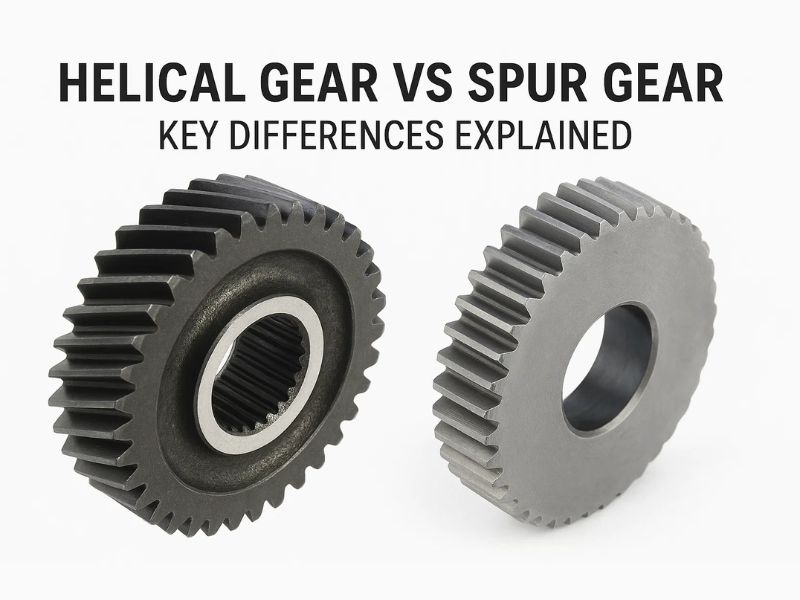
Spur gear teeth are cut straight, parallel to the gear's axis of rotation. Because the full face width of each tooth engages at once, contact is direct and load transfer is straightforward, which keeps the design simple to manufacture and maintain. Stainless steel gears hold up well in this configuration when the application needs corrosion resistance and mechanical strength; acetal or other engineered plastics work where reduced friction and low maintenance matter more than raw load capacity.
Helical gear teeth are cut at an angle to the axis, commonly in the range of roughly 20 to 45 degrees depending on the application, as noted in tec-science's overview of helical gear geometry. That angle lets each tooth enter and leave contact gradually instead of all at once, and because more than one tooth is typically in mesh at a given moment, the load is spread rather than concentrated. The same angled geometry that smooths engagement also generates axial thrust along the shaft, which means helical gear installations need thrust bearings the spur equivalent doesn't require.
Load Capacity
Spur gears generate a purely radial load, which keeps bearing selection simple. Because only one tooth carries load at any given instant, spur gears are well suited to moderate, steady loads rather than heavy or shock-loaded service.
Helical gears carry load across multiple teeth simultaneously, which distributes stress and raises torque capacity relative to a spur gear of the same size. Published comparisons generally put the advantage at roughly 20 to 30 percent higher torque capacity for a helical gear over an equivalent spur gear, though the exact figure depends heavily on tooth geometry and design optimization. The trade-off is the axial thrust force mentioned above, which requires thrust bearings sized for that additional load path.
Efficiency
Spur gears typically reach 98 to 99 percent efficiency. Straight-line contact with minimal sliding keeps friction losses low, which makes spur gears the more efficient choice when the application doesn't need helical gearing's other advantages.
Helical gears typically run 95 to 98 percent efficient. The angled tooth contact introduces a sliding component along with the pure rolling action, and that sliding, combined with the axial thrust, accounts for the small efficiency gap versus spur gears. In high-speed, high-load service, that modest efficiency trade-off is usually worth the smoother, quieter operation and higher torque capacity.
Noise and Smoothness
Spur gear teeth engage and disengage abruptly along their full face width, which produces sharper impact noise and vibration with each mesh cycle. That effect becomes more pronounced as rotational speed increases.
Helical gear teeth engage gradually across the angled contact line, which softens the impact at each mesh cycle and produces noticeably lower noise and vibration. That's the main reason helical gears show up in equipment where quiet operation matters as much as load capacity.
Production Complexity
Spur gears are comparatively simple to cut: straight teeth can be produced on standard gear-cutting equipment without special tooling. Helical gears require machines capable of cutting the tooth angle accurately and holding that angle consistently across the face width, which raises tooling requirements and machining cost relative to an equivalent spur gear.
Application Suitability
Spur gears remain common wherever cost and simplicity matter more than noise or top speed: conveyor and belt drives in general manufacturing, steering and drivetrain components in automotive systems, paper-feed mechanisms in printing equipment, wind turbine gearing, and power tools such as drills and saws.
Helical gears are the standard choice wherever smooth, quiet, high-load operation is the priority: automotive transmissions, medical equipment where noise is a design constraint, factory conveyors and mixers moving heavy loads, gearing in power plants and steel mills, turbomachinery, pumps and compressors running at high speed, elevators, and earth-moving equipment gearboxes.
Spur and helical gears solve different problems well. Spur gears deliver simplicity and slightly higher raw efficiency; helical gears trade a small efficiency loss for higher torque capacity, quieter operation, and smoother power transfer under load, as detailed in Gear Solutions' comparative analysis of spur and helical gears. Matching the gear type to the actual speed, load, and noise requirements of the application is what determines service life and maintenance frequency down the line.
Profab Machine manufactures custom stainless steel spur and helical gears machined to the tooth geometry, load rating, and material grade your application requires. Contact Profab Machine to work through gear selection for your system.
FAQ
What makes helical gears quieter than spur gears?
Helical gear teeth engage gradually across an angled contact line instead of all at once, which softens the impact at each mesh cycle and reduces the noise and vibration a spur gear produces at the same speed.
Can spur gears be used in high-speed machines?
Spur gears work best at low to moderate speeds. At higher speeds, the abrupt tooth engagement that's tolerable at low speed becomes a noise and wear problem, and helical gears are generally the better choice.
Do helical gears need special bearing support?
Yes. The angled tooth contact generates axial thrust along the shaft in addition to the radial load a spur gear produces, so helical gear installations need thrust bearings sized for that additional load path.
Where are spur gears used most often?
Spur gears are common in mechanisms like clocks, conveyor drives, and printing equipment, where cost and simplicity matter more than noise level or peak load capacity.