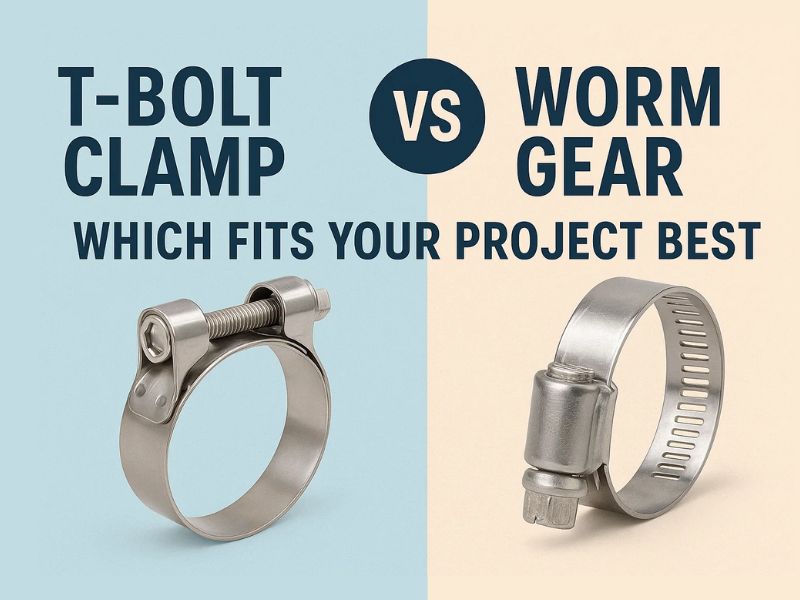
The choice between a T-bolt clamp and a worm gear clamp depends heavily on the application's pressure, space, and durability requirements. T-bolt clamps are generally superior for heavy-duty, high-pressure industrial use, while worm gear clamps are the standard, versatile choice for general-purpose applications.
T-Bolt Clamp vs Worm Gear: Advantages and Limitations
T-Bolt Clamp
T-bolt clamps are a heavy-duty option built for demanding conditions: high-performance automotive, industrial machinery, and hydraulic lines. They use a solid band and a T-shaped bolt secured with a nut.
Advantages
- Superior clamping force: T-bolt clamps tighten to much higher torque than standard worm gear clamps, holding securely under high pressure and vibration.
- Uniform pressure distribution: The solid band delivers consistent, 360° clamping pressure around the hose, essential for a leak-free seal.
- Heavy-duty durability: A robust bolt and thicker stainless band resist corrosion, high temperatures, and vibration well.
- Hose protection: The smooth, unslotted inner band avoids the cutting or "chewing" that perforated worm gear bands can cause.
Limitations
- Higher cost: Generally more expensive than standard worm gear clamps.
- Less flexible sizing: Smaller adjustment range, so accurate sizing to the hose diameter matters more.
- Bulkier design: The T-bolt and nut assembly can be difficult to install in tight or confined spaces.
- Risk of over-tightening: High-torque capability means careless installation can crush or distort softer piping.
Worm Gear Clamp
Worm gear clamps (also called worm drive or screw clamps) are the most common clamp type, recognized by their slotted band and screw mechanism. They're the go-to for general-purpose use: standard automotive hoses, plumbing, and DIY projects.
Advantages
- High versatility and adjustability: The slotted design covers a wide range of hose diameters with one clamp.
- Cost-effective: Significantly more affordable and widely available than T-bolt clamps.
- Ease of installation: Compact and needs only a screwdriver or nut driver, ideal for tight spaces and quick field fixes.
- Reusability: Easy to loosen and reuse without replacing the clamp.
Limitations
- Lower clamping force: Not suitable for high-pressure or high-boost applications; the screw mechanism can strip if over-torqued.
- Uneven pressure: The housing and screw create a localized flat spot, leading to uneven pressure distribution and a potential leak path.
- Hose damage: The perforated band can cut into soft hose materials like silicone if over-tightened.
- Loosening over time: Can lose tension under extreme temperature cycling or sustained vibration.
Application
Each clamp type earns its place in different jobs. T-bolt clamps handle the tough work: radiator hoses, turbo pipes, and large air tubes in trucks, performance cars, and industrial machinery that see real pressure and heat. Their corrosion resistance and leak-proof seal also make them a strong fit on boats and farm equipment.
Worm gear clamps cover home and light repair work: garden hoses, small pipes, and routine car maintenance, anywhere the clamp needs to come off and go back on repeatedly without specialized tools.
| Industry/Application | Key Features and Benefits | Recommended Clamp Type |
|---|---|---|
| Commercial Vehicles and Heavy-Duty Trucks | Holds radiator and turbo hoses, handles large temperature swings, resists vibration | Heavy-Duty Spring-Loaded T-Bolt Clamp |
| Marine and Offshore Applications | Corrosion resistant, seals water hoses reliably | T-Bolt Clamp with Floating Bridge |
| Industrial Machinery and Ducting | Moves high-pressure fluids, strong grip, less downtime | T-Bolt Clamp with Fixed Bridge |
| Charge Air Cooling Systems | Stops leaks in cooling systems, long service life | Spring-Loaded T-Bolt Clamp |
| Irrigation and Agricultural Equipment | Keeps hoses tight, reduces leaks and water loss | Customized T-Bolt Solutions |
Conclusion
The choice between a T-bolt clamp and a worm gear clamp comes down to the pressure, vibration, and service requirements of your assembly. Use T-bolt clamps for high-load, fixed installations where maximum sealing strength matters. Use worm gear clamps for smaller, flexible connections that need adjustability and ease of use. Evaluate your system's torque, temperature, and maintenance needs before deciding.
Contact Profab Machine for precision-engineered stainless steel clamping solutions matched to your application.
FAQ
What clamp should you use for high-pressure hoses?
Use a T-bolt clamp for high-pressure hoses. Its 360° uniform clamping force and higher torque rating hold securely and prevent leaks. Worm gear clamps are better suited to low-pressure applications.
Do worm gear clamps damage soft hoses?
They can, if over-tightened. The perforated band can cut into soft materials like silicone. Choosing a clamp with a smooth inner edge and avoiding over-tightening reduces this risk.