
- By Profab /
- February 26, 2026
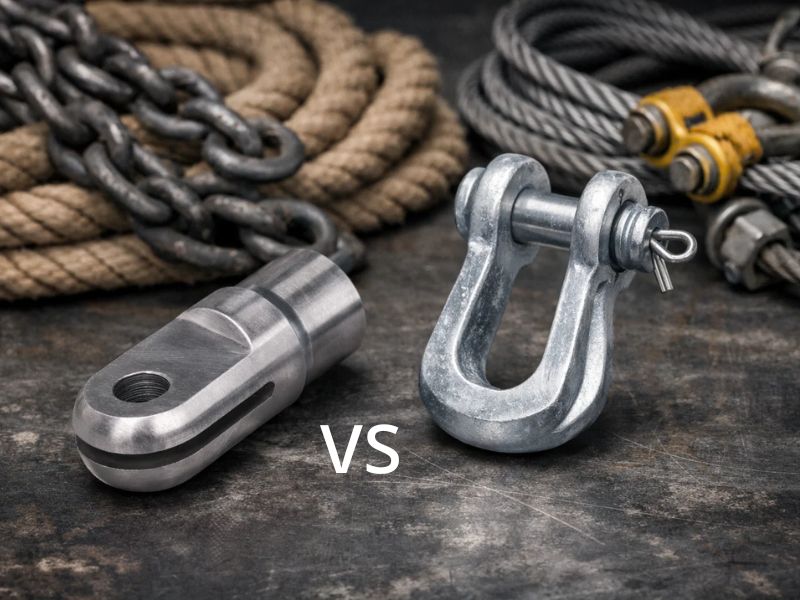
Table of Contents
In industrial equipment procurement or rigging configuration, this confusion often arises: shackles and clevises both look like U-shaped connectors with seemingly similar purposes—what’s the difference? Which should I choose?
This question seems simple, but choosing wrong can lead to serious consequences. In lifting accident investigation reports, there are many cases of connection failure caused by confusing shackles and clevises or improper selection. From industry data, although these two have similar shapes, there are fundamental differences in design philosophy, manufacturing process, load capacity, and application scenarios.
Today we’ll analyze the differences between these two connectors from an engineering perspective to help you make the right choice.
Fundamental Difference in Design Philosophy
Though both shackles and clevises are U-shaped connectors, their design purposes are completely different, determining their application boundaries.
Shackle: Independent Removable Connector
According to industrial rigging supplier definitions, a shackle is a complete independent U-shaped metal ring closed by a removable pin, specifically designed to connect different rigging elements (like slings, wire ropes, chains).
The key characteristic is “independence”: shackle itself is a complete connection link, not dependent on other components. You can think of it as a “temporary movable connection point”—installed when needed, removable anytime when not.
From appearance, shackles have two basic types:
- Anchor Shackle (bow shackle): O-shaped, wider opening, suitable for multi-directional loads and multi-point connections
- Chain Shackle (D shackle): Shaped like a chain link, narrower and longer, mainly bears unidirectional tension
Clevis Rod End: Fixed Connection End of Components
In contrast, clevises are usually part of some component, not independent. Clevis rod ends always exist as the connection end of some assembly.
In mechanical design, a clevis is more like a “fixed connection interface,” typically used for:
- Connection ends of hydraulic cylinders and actuators
- Traction connections on agricultural tractors
- Adjustment points in sailboat rigging
- Rotating joints in robotic arms and linkage mechanisms
Identification Points: Independent vs Integrated
• Shackle: Independent U-shaped ring, can be installed/removed anytime, not belonging to any equipment
• Clevis: Connection end of a component, part of equipment, usually semi-permanently installed
• Shackle is like a “temporary connector,” Clevis is like a “fixed interface”
Manufacturing Process Determines Performance Difference
If design philosophy determines purpose, then manufacturing process determines the performance ceiling. Shackle and clevis have significant differences in manufacturing processes.
Shackle Forging Process: Strength Advantage from Grain Flow
High-quality lifting shackles almost all use forging manufacturing process. According to Columbus McKinnon research data, forged shackles have overwhelming advantages over cast versions:
- 26% higher tensile strength
- 37% higher fatigue strength
- 6 times longer fatigue life
- 58% reduction in area (forged) vs 6% (cast)
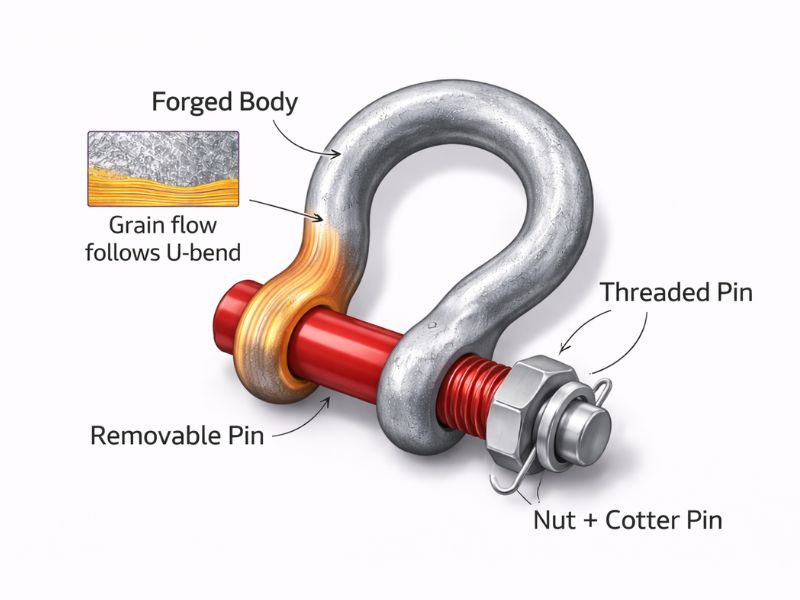
These astonishing differences come from grain flow. During forging, metal is hammered into shape at high temperature, internal grains extend and align along component contours, forming a continuous fiber-like structure—just like wood grain along the trunk direction has highest tensile strength.
In the U-shaped bent portion of shackle, grain flow extends along the bending direction, avoiding grain boundaries perpendicular to stress direction, greatly improving resistance to fatigue cracking. Cast shackles lack this directional grain structure, grains are randomly distributed, and may contain porosity and shrinkage defects, easily cracking from defects under high stress.
Clevis Diversified Manufacturing: Machining vs Forging vs Casting
Clevis manufacturing processes are relatively diverse, depending on application scenarios:
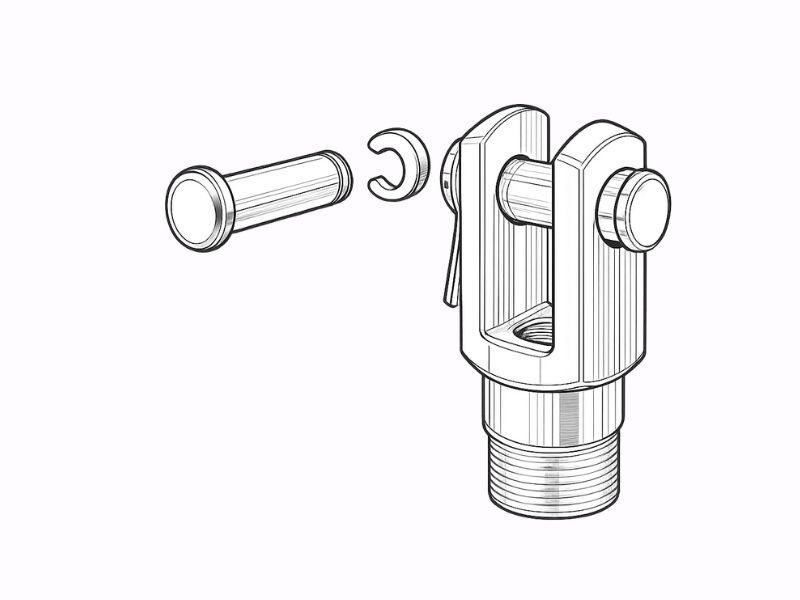
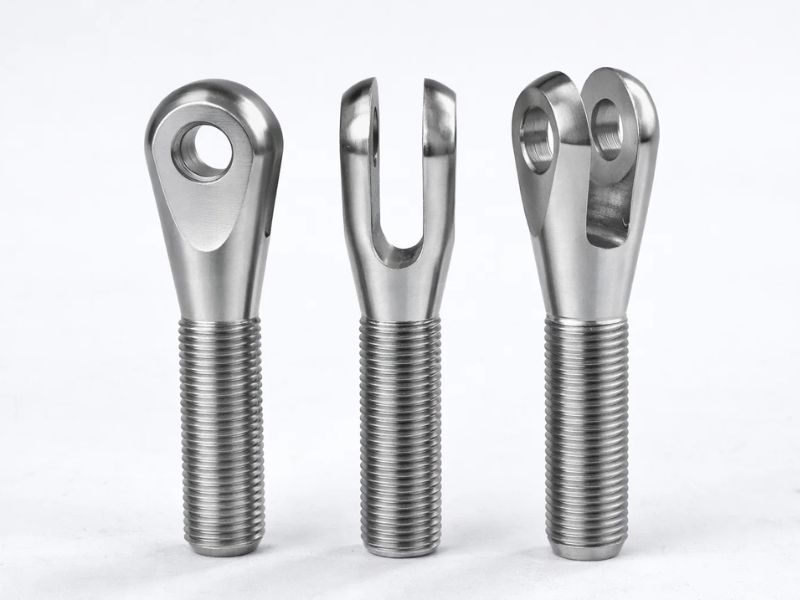
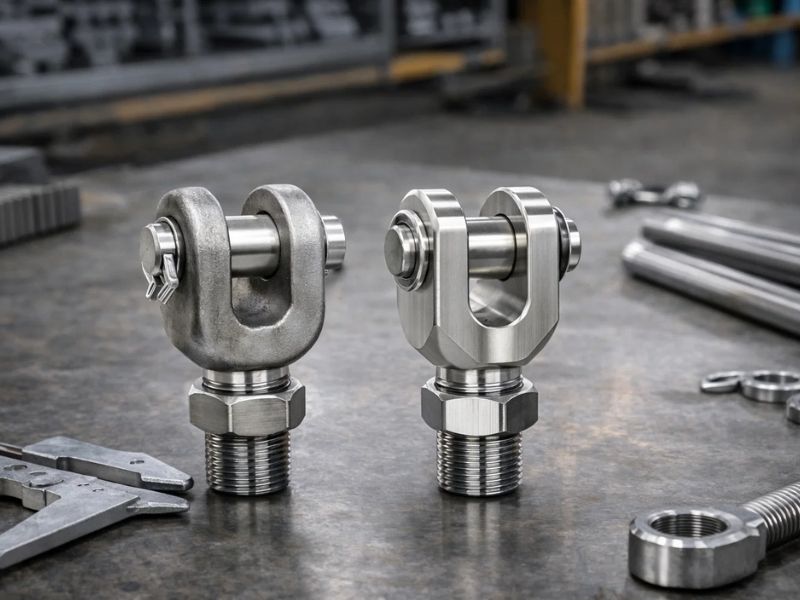
Machined clevis: For small batches, customization, or applications requiring precision fit, clevises are often machined from bar stock. U-shaped yokes are directly milled from stainless steel bar stock, with high machining precision (hole diameter tolerance achievable to H7) and good surface quality, but higher cost, and grain flow is cut, strength not as good as forgings.
Forged clevis: For high-volume and high-strength requirements (like heavy-duty hydraulic cylinder clevis rod ends), forging is also used. But since clevises are usually part of a component (like rod ends), the entire assembly is forged, not just the clevis alone.
Cast clevis: In agricultural machinery and other light-load, cost-sensitive fields, cast iron or cast steel clevises are also used, but strength is significantly lower than forgings.
From market observation, professional lifting shackle suppliers basically all label “forged,” while clevis product material descriptions are more diverse: machined from bar stock, forged alloy steel, cast steel, etc.
Shackle Bending Stress Challenge
Beyond the grain flow advantage, shackles also face bending stress problems that clevises rarely encounter.
Unlike clevis’ straight arm structure, the U-shaped bent portion of shackle produces significant bending moment when bearing tensile loads. When both ends of shackle are pulled, the U-shaped bottom not only bears tensile stress but also tends to bend due to geometric shape. This combined stress state requires the material to have:
- High toughness: Can absorb impact energy before deformation
- High yield-to-tensile ratio: Won’t excessively plastically deform before reaching ultimate strength
- Good impact absorption: Handle dynamic loads in lifting operations
This is precisely why industrial-grade shackles must use high-toughness forged steel rather than cast iron or ordinary cast steel—cast materials’ low toughness cannot handle the combination of bending stress and impact loads. In comparison, clevis’ straight arm structure mainly bears unidirectional tension, stress state is relatively simple, requirements for material toughness are slightly lower.
Material Selection and Grade Standards
Material grade is another key dimension distinguishing shackles and clevises.
Shackle Strict Grade System
Industrial lifting shackles have clear grade standards, commonly including:
- Grade 2: Carbon steel forging, suitable for general industrial lifting
- Grade 6: Alloy steel, surface quenching treatment, higher tensile strength and wear resistance
- Grade 8: High-strength alloy steel, for extreme conditions or overload situations
Each grade has corresponding Working Load Limit (WLL) standards, and must be stamped on the shackle. For example, a 3/4″ (19mm) Grade 6 shackle’s WLL might be 4.75 tons, while the same size Grade 2 is only 3.25 tons.
Additionally, special environments have dedicated materials:
- 316 stainless steel shackle: For marine, chemical and other corrosive environments
- Galvanized shackle: Low-cost anti-corrosion solution, but slightly lower strength than bare steel
Clevis Material Diversity
Clevis material selection is more flexible because application scenarios vary greatly:
For light-load agricultural clevises, may only use Q235 ordinary carbon steel or aluminum alloy, even galvanized steel sheet stamping.
For industrial hydraulic system clevis rod ends, typically select:
- 42CrMo alloy steel (quenched and tempered, tensile strength ≥900MPa)
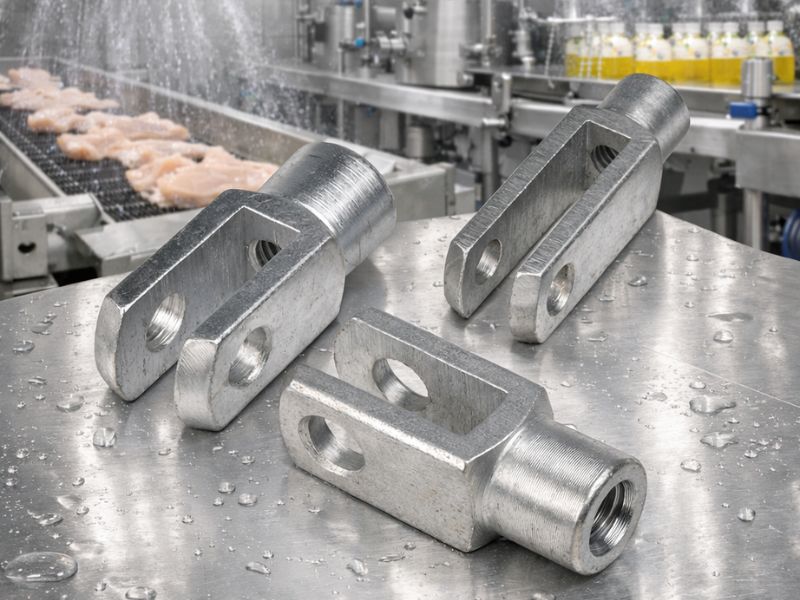
- 304 or 316 stainless steel (corrosive environments)
- 17-4PH stainless steel (precipitation hardening, balances strength and corrosion resistance)
But clevises generally don’t have a unified grade system like shackles, more based on specific application strength calculations and safety factors for material selection.
Load Capacity and Safety Factor Differences
From load-bearing capacity perspective, shackles and clevises have fundamentally different design philosophies.
Shackle: Designed for Ultimate Loads
According to industrial rigging standards, industrial shackle design safety factors are typically 5:1 or 6:1, meaning Minimum Breaking Load (MBL) is 5-6 times the Working Load Limit (WLL).
This means if a shackle is rated WLL 2 tons, its actual breaking load must be at least 10-12 tons. Such high safety factors account for:
- Potential impact loads in lifting operations (sudden braking, swinging)
- Material fatigue from long-term use
- Environmental factors like corrosion and wear
- Human errors (like side loading, overloading)
Additionally, shackle load capacity is rigorously tested and certified. US ASME B30.26 standard and EU EN 13889 standard both specify shackle testing methods, marking requirements, and traceability.
Clevis: Designed by Specific Application
In contrast, clevis load capacity depends more on engineering calculations for specific applications. Taking hydraulic cylinder clevis rod ends as example, design engineers calculate based on:
- Maximum thrust of hydraulic cylinder
- Shear strength of pin
- Tensile and bending strength of clevis yoke ears
- Bearing stress at pin holes
To determine required cross-section dimensions and material strength, safety factor might only be 2:1 to 3:1, not shackle’s 5:1.
This doesn’t mean clevises are unsafe, but because clevises are typically used in controlled, clearly defined load situations (like hydraulic systems where load is determined by pressure and cylinder diameter, won’t have unexpected overload), while shackles are used in highly variable, uncertain load situations (like construction site lifting where load weight may be incorrectly estimated, plus wind and dynamic loads).
Load Design Philosophy Comparison
• Shackle: Design safety factor 5-6:1, expected to handle extreme conditions and operational errors
• Clevis: Design safety factor 2-3:1, for controlled environments with defined loads
• Shackle has standard WLL certification, Clevis relies on engineering calculations
• Don’t use clevis to substitute shackle in lifting operations!
Technical Comparison Table
For quick decision-making, here’s a comprehensive technical comparison of shackles and clevises:
Feature | Shackle | Clevis |
Primary Function | Independent removable rigging connector | Integrated connection interface of mechanical component |
Design Position | Temporary/movable connection point | Fixed connection end of equipment |
Standard Safety Factor | 5:1 or 6:1 | Usually 2.5:1 to 4:1 |
Manufacturing Process | Must be forged | Machining, casting, or forging all available |
Material Grade Certification | Grade 2/6/8, must have WLL stamp | Certified with complete machine, usually no independent grade |
Side Loading | Bow type supports (with WLL discount) | Prohibited (only single-axis tension) |
Stress Type | Tensile + bending + impact | Mainly unidirectional tensile stress |
Pin Design Focus | Safe locking, anti-detachment | Quick removal, wear resistance |
Vibration Environment | Needs safety wire anti-loosening | Cotter pin provides physical anti-detachment |
Industry Certification Requirements | Lifting operations must comply with ASME/EN standards | Depends on specific application |
Typical Applications | Lifting, rigging connection, unknown loads | Hydraulic cylinders, mechanical linkages, tractor traction |
Replaceability | Independent component, replaceable anytime | Usually integrated with equipment, not replaced separately |
Application and Selection Guide
Understanding so many differences, the key question is: when to use shackle, when to use clevis?
Must Use Shackle Situations
Lifting operations: All overhead lifting must use certified lifting shackles, not clevises. Reason is shackles have clear WLL markings and safety factors, while clevises don’t. OSHA (Occupational Safety and Health Administration) and similar agencies’ regulations clearly require lifting rigging to have load certification.
Rigging connections: When connecting slings, wire ropes, chains and other flexible rigging, shackle’s bow design (especially anchor shackle) can adapt to multi-directional loads and rigging angle changes, avoiding failure from side loading.
Temporary connections: For applications requiring frequent connection/disconnection, shackle’s threaded pin design provides quick and safe solutions.
Unknown loads or impact loads: When unable to precisely predict load magnitude or direction, shackle’s high safety factor provides greater error tolerance.
Suitable for Clevis Situations
Mechanical linkages: In four-bar suspensions, robotic arms and other mechanisms, clevis as rotating joint provides single-axis rotational freedom, is standard design.
Hydraulic/pneumatic actuators: Mounting ends of hydraulic and pneumatic cylinders are usually designed as clevis rod ends, providing simple connection and required rotational freedom.
Agricultural tractor traction: Agricultural machinery traction connections almost all use clevis, because need quick connection/disconnection of various implements, and load is relatively defined (tractor’s traction force is known).
Sailboat rigging adjustment: In sailboat rigging systems, clevis connects turnbuckles and other adjustment devices, facilitating fine adjustment of rigging tension.
Low-load fixed connections: For small loads and long-term stationary connections, clevis can provide more compact, lower-cost solutions than shackles.
Selection Decision Tree
Is it for lifting operations?
├─ Yes → Must use Shackle (compliant with ASME/EN standards)
└─ No → Continue evaluation


Requires frequent removal and uncertain loads?
├─ Yes → Recommend Shackle (higher safety factor)
└─ No → Continue evaluation


Is it a fixed connection end of mechanical component?
├─ Yes → Recommend Clevis (integrated design, compact)
└─ No → Choose based on load and environment


Has reciprocating motion or long-term wear?
├─ Yes → Clevis + hardened pin + bushing
└─ No → Either works, consider cost and installation convenience
Though shackles and clevises have similar shapes, they are essentially two different types of connectors with significant differences in design philosophy, manufacturing process, material standards, and application scenarios.
For customized clevis needs (special sizes, materials, or surface treatments), consider purchasing from professional stainless clevis joints manufacturer, which can provide complete service from design consultation to quality traceability, ensuring connection reliability and safety.
Remember: In industrial connections, there’s no “universal” solution, only “appropriate” choices. Understanding the essential differences between shackles and clevises, selecting based on actual application’s load characteristics, motion patterns, and safety requirements is key to ensuring long-term reliable equipment operation.
Send Inquiry Now
Related Resource
Shackle or Clevis? Complete Comparison from Design to Application
Forged vs. Machined Stainless Clevis Rod Ends
How Stainless Clevis Support Washdown Requirements in Food Processing Lines