
- By Profab /
- March 4, 2026
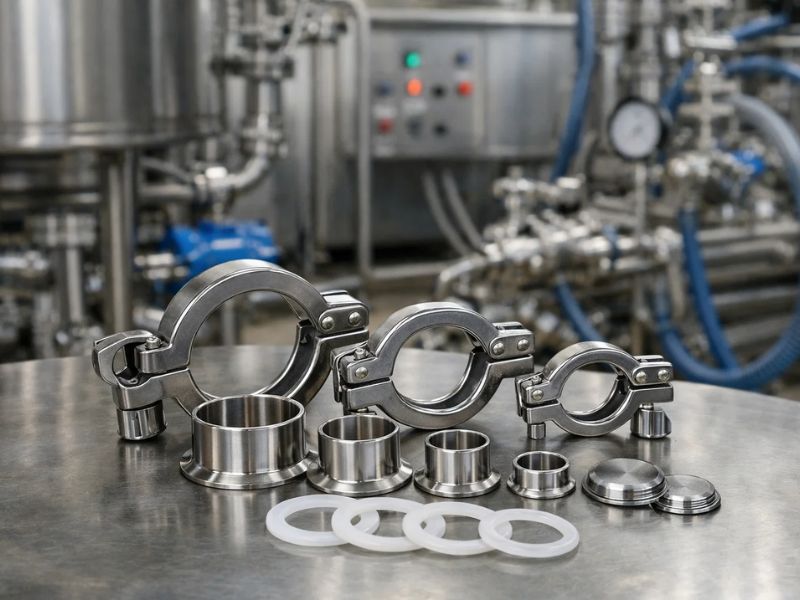
Table of Contents
In piping system installations at food, pharmaceutical, and biotech facilities, this scenario is common: An engineer orders “1.5-inch tri-clamps” based on nominal pipe size, but during onsite installation discovers they don’t fit at all. After unpacking and measuring, the pipe outer diameter is 1.5 inches, but the ferrule outer diameter is nearly 2 inches—what size clamp should have been ordered?
From experience in purchasing and installing sanitary piping systems, “wrong clamp size selection” is one of the most common elementary mistakes, yet consequences are severe: rework delays schedules, emergency airfreight increases costs, and even forcing mismatched parts leads to leakage and contamination.
Today we’ll explain sanitary clamp selection methods from perspectives of tri-clamp standard systems, sizing logic, measurement methods, and common pitfalls.
Tri-Clamp Sizing Logic
What Does "Size" Mean in Tri-Clamps
Many assume that “1.5 inch” in a 1.5″ tri-clamp refers to the clamp itself or the ferrule outer diameter.
Wrong!
The size of a tri clamp is determined by the outer diameter (OD) of the pipe, not the outer diameter of the flange.
Example:
- Tube outer diameter: 1.5″ (38.1mm)
- Ferrule outer diameter: approximately 2″ (50.5mm)
- Clamp inner diameter: Must match ferrule OD, approximately 2″
- Nominal size: Still called “1.5-inch tri-clamp”
The reason for this logic: Sanitary piping systems are designed around tube sizes, and all fittings (ferrules, clamps, gaskets) use tube OD as the reference to ensure compatibility.
Why Ferrules Are Larger Than Tubes
Tri-clamp ferrule outer diameters are typically about 0.5 inches larger than tube OD:
- 1.5″ tube → Ferrule OD approximately 2″
- 2″ tube → Ferrule OD approximately 2.5″
- 3″ tube → Ferrule OD approximately 3.5″
Reasons:
- Welding requirements: Ferrule needs sufficient annular area to weld to tube
- Gasket sealing: Gasket needs sufficient compression area to seal
- Strength requirements: Ferrule bears clamping force, needs sufficient cross-section
- Standardization: Uniform ferrule sizes facilitate interchangeability
Key Rules for Tri-Clamp Sizing
• Nominal size = Tube outer diameter (Tube OD)
• Ferrule OD ≈ Tube OD + 0.5″
• Clamp size = Nominal size (not ferrule OD)
• Gasket size = Nominal size
Special Rules for Small Sizes
In small-diameter tubing, standards are more complex.
1/2" and 3/4" Share Ferrules
According to tri-clamp standards, 1/2″ and 3/4″ tubes use the same ferrule size:
- 1/2″ tube OD: 0.5″ (12.7mm)
- 3/4″ tube OD: 0.75″ (19.05mm)
- Shared ferrule OD: approximately 1″ (25mm, precisely 0.984″)
- Clamp and gasket: Interchangeable
Why this design:
- Small-diameter tubes have low flow, not sensitive to ID differences
- Unified ferrule size reduces inventory and costs
- Facilitates system flexibility (can transition from 1/2″ to 3/4″ without reducers)
Practical application:
- If you have systems mixing 1/2″ and 3/4″ tubing, only need one size of clamps and gaskets
- But note: Use the larger gasket (select for 3/4″)
1" and 1.5" Share Ferrules
Same logic:
- 1″ tube OD: 1.0″ (25.4mm)
- 1.5″ tube OD: 1.5″ (38.1mm)
- Shared ferrule OD: approximately 2″ (50.5mm, precisely 1.984″)
- Clamp and gasket: Interchangeable
Considerations:
- Flow difference between 1″ and 1.5″ is significant (area ratio about 1:2.25)
- When mixing, select gasket for larger diameter (1.5″)
- If transitioning from 1″ to 1.5″, use concentric reducer
Mini Size Specifics
In biopharmaceutical and laboratory applications, there’s also a Mini size series:
- Covers 1/8″, 1/4″, 3/8″, 1/2″, 3/4″ tubing
- All these tubes have the same ferrule OD: approximately 1″ (0.992″)
- Clamps and gaskets completely interchangeable
Mini series advantages:
- Minimal inventory: One clamp fits all small-diameter tubing
- Flexible transitions: Any combination from 1/8″ to 3/4″
- Suitable for small-batch, multi-variety laboratory and small-scale production
How to Determine What Size You Need
How to measure quickly and accurately onsite?
Known Tube Specification
If you know the tube standard specification, directly select accordingly:
Common tube specifications:
Nominal Size | Tube OD | Tube ID (Schedule 5) | Ferrule OD | Tri-Clamp Size |
1/2″ | 0.840″ | 0.710″ | ~1″ | 1/2″ |
3/4″ | 1.050″ | 0.920″ | ~1″ | 3/4″ |
1″ | 1.315″ | 1.185″ | ~2″ | 1″ |
1.5″ | 1.900″ | 1.770″ | ~2″ | 1.5″ |
2″ | 2.375″ | 2.245″ | ~2.5″ | 2″ |
2.5″ | 2.875″ | 2.709″ | ~3″ | 2.5″ |
3″ | 3.500″ | 3.334″ | ~3.5″ | 3″ |
4″ | 4.500″ | 4.334″ | ~4.5″ | 4″ |
Note:
- Tube specifications refer to Schedule 5 (thin-wall sanitary tubing), not Schedule 40 (standard industrial pipe)
- Schedule 5 OD doesn’t perfectly match nominal size (e.g., 1″ tube OD is 1.315″, not 1.0″)
- But tri-clamp nominal size still labeled by tube nominal designation (1″)
Onsite Measurement of Tube OD
If unsure of tube specification, use calipers or tape to measure tube OD:
Steps:
- Use vernier calipers or OD micrometer to measure tube OD
- Read value (e.g., 38.5mm or 1.52″)
- Reference standard size chart, find closest nominal size
Examples:
- Measured 38.5mm → Close to 1.5″ (38.1mm) → Select 1.5″ tri-clamp
- Measured 60.3mm → Close to 2.5″ (63.5mm) → Select 2.5″ tri-clamp
Common errors:
- Tube OD may have ±0.5mm tolerance
- Weld areas may be distorted
- Use nominal size as reference, don’t be overly precise
Measuring Ferrule OD
If tube already has welded ferrule, measure ferrule OD:
Formula:
- Nominal size ≈ Ferrule OD – 0.5″
Examples:
- Ferrule OD 50mm (approximately 2″) → Tube nominal size approximately 1.5″
- Ferrule OD 64mm (approximately 2.5″) → Tube nominal size approximately 2″
Note:
- This method is estimation, as ferrule OD has tolerances
- Best to combine with tube OD measurement for cross-verification
Reverse Engineering from Existing Gasket or Clamp
If existing gaskets or clamps are available onsite:
- Measure gasket OD and ID
- Reference standard size chart
- Determine corresponding nominal size
Gasket size chart (OD × ID):
- 1/2″/3/4″ → 25.4mm × 20.6mm (or 12.7mm)
- 1″/1.5″ → 50.5mm × 41.9mm (or 25.4mm)
- 2″ → 64mm × 54mm
- 3″ → 91mm × 78mm
Common Selection Mistakes and Solutions
Mistake 1: Selecting by "Nominal Size" Rather Than OD
Error scenario:
- Pipe labeled “1-inch pipe,” directly buy 1″ tri-clamp
- But actual pipe is Schedule 40 (thick-wall industrial pipe), OD 1.315″
- 1″ tri-clamp is designed for Schedule 5 (thin-wall sanitary tubing), OD also 1.315″
- Result: Barely usable, but ferrule welding difficult, poor sealing
Correct approach:
- Confirm pipe type: Schedule 5 (sanitary) or Schedule 40 (industrial)
- Measure actual tube OD
- Select clamp based on OD, not nominal size
Mistake 2: Treating Ferrule OD as Clamp Size
rror scenario:
- Measure ferrule OD approximately 2″
- Assume need 2″ clamp
- Actual tube OD is 1.5″
- Buy 2″ clamp back, ferrule won’t fit at all
Correct approach:
- Ferrule OD – 0.5″ ≈ Nominal size
- Or directly measure tube OD
Mistake 3: Ignoring Gasket Size
Error scenario:
- Connecting 1″ and 1.5″ tubes (share 2″ ferrule)
- Use 1″ gasket (smaller)
- Result: Gasket cannot cover 1.5″ tube ID, leakage
Correct approach:
- When connecting different size tubes, use larger gasket
- 1″ and 1.5″ connection → Use 1.5″ gasket
Mistake 4: Mixing Different Standard Components
Error scenario:
- Ferrules are ASME BPE standard
- Clamps are DIN standard
- Sizes close but not perfectly matched, forced assembly causes leakage or stress concentration
Correct approach:
- Use uniform standard for entire system (all 3-A, or all ASME BPE, or all DIN)
- If must mix, use special adapters
- Consult sanitary stainless clamp manufacturer about compatibility
Mistake 5: Not Considering Ferrule Weld Length
Error scenario:
- Using thin-wall tubing (1mm wall thickness)
- Paired with long weld ferrule (50mm length)
- During welding, tube too thin, burns through or deforms
Correct approach:
- Thin-wall tubing with short weld ferrule (12.7mm)
- Thick-wall tubing with medium or long weld ferrule
- Select appropriate ferrule length per ASME BPE requirements
Selection Checklist (Avoid Common Mistakes)
• ✓ Measure tube outer diameter (OD), not ID or nominal size
• ✓ Confirm tube type (Schedule 5 vs 40)
• ✓ Verify nominal size with ferrule OD – 0.5″
• ✓ Use larger gasket when connecting different sizes
• ✓ Unify standards (3-A/BPE/DIN), avoid mixing
• ✓ Thin-wall tube with short weld ferrule, thick-wall with long weld
Special Application Sizing Considerations
High Pressure Applications (>10 bar)
Problem:
- Standard tri-clamps designed for about 6-10 bar (90-150 psi)
- At high pressure, gasket may extrude, causing leakage
Solutions:
- Reinforced clamps:
- Heavy-duty tri-clamps
- With reinforcing ribs, greater clamping force
- Suitable pressure up to 15-20 bar
- Flanged connections:
- Above 20 bar, consider bolted flanges
- Multiple bolts uniformly clamp, pressure >50 bar
- Gasket selection:
- High-pressure use metal-encapsulated gaskets (PTFE-encapsulated silicone)
- Or graphite gaskets
Vacuum Applications (<-0.8 bar)
Problem:
- Under vacuum, gasket may be sucked into pipe
- Ferrule may deform under negative pressure
Solutions:
- Vacuum gaskets:
- Higher hardness EPDM or silicone
- Gasket design with support ring
- Reinforced ferrules:
- Thick-wall ferrules, not easily deformed
- Vacuum rating marked (-1 bar or higher)
High Temperature Applications (>150°C)
Problem:
- Ordinary EPDM gaskets temperature resistance <150°C
- Stainless steel thermal expansion, preload changes
Solutions:
- High-temperature gaskets:
- PTFE gaskets (temperature resistance 260°C)
- Graphite gaskets (temperature resistance 400°C)
- Metal seal rings (temperature resistance >500°C)
- Spring clamps:
- Built-in springs compensate for thermal expansion
- Maintain stable preload
Low Temperature Applications (<-40°C)
Problem:
- Ordinary rubber gaskets become brittle at low temperature
- Stainless steel toughness decreases at low temperature
Solutions:
- Low-temperature gaskets:
- Silicone gaskets (low-temperature resistance -60°C)
- PTFE gaskets (low-temperature resistance -200°C)
- Material selection:
- 316L stainless steel (low carbon, good low-temperature toughness)
- Avoid 304 (may embrittle at low temperature)
Sanitary piping system reliability largely depends on connection quality. And the first step in connection quality is selecting the right size. In sanitary systems, details determine success or failure. Spending 5 minutes to figure out sizing can avoid 5 days of rework and $5,000 in losses. That’s a worthwhile calculation.
Send Inquiry Now
Related Resource
How to Select Sanitary Clamp Sizes?
Can You Use Automotive Hose Clamps on a Boat?
Can Stainless Steel Clamps Be Used in Food Processing?