
- By Profab /
- November 10, 2025
Choosing the right stainless steel rod end bearings is critical to the performance and longevity of mechanical equipment. Correctly selecting the right rod end bearing for your industry will keep your project running smoothly. This article will provide you with a complete selection guide from application environment, load type, size specification to performance requirements. Profab Machine aims to help engineers and equipment purchasers quickly find the most suitable stainless steel rod end bearing solutions.
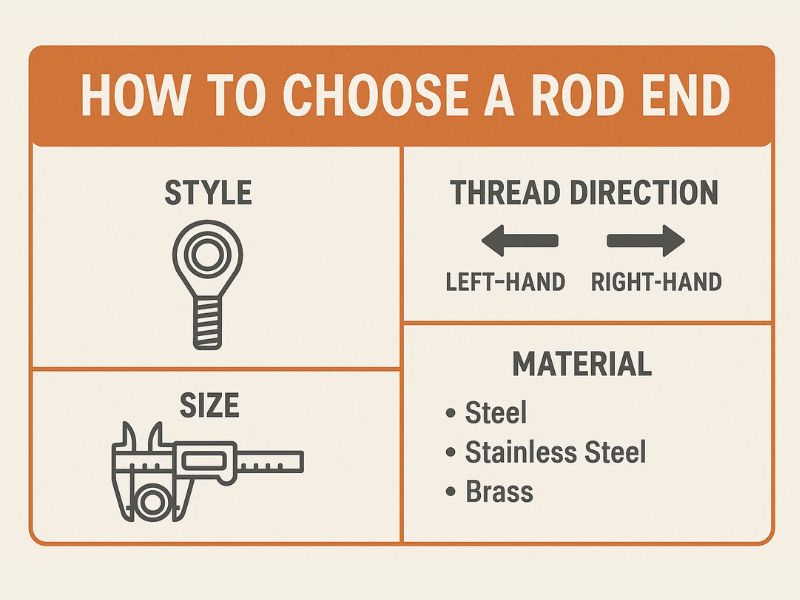
Table of Contents
Step 1: Understand the Application Environment
Consider whether the application environment is humid, exposed to salt spray, or contains chemicals. If so, consider stainless steel rod ends. Carbon steel rod ends will rust quickly and lose performance.
- Humid or mildly corrosive environments: 304 stainless steel rod end bearing is typically sufficient.
- Salt spray, marine, or highly corrosive environments: 316 stainless steel rod end is usually selected, as its molybdenum content provides superior corrosion resistance.
- Food or medical equipment: 316 stainless steel heimk joints is a common choice due to its ease of cleaning.
Consider whether the rod end will be subjected to deep freezing or extremely high temperatures. Stainless steel rod ends offer a very wide temperature tolerance range.
- 304 and 316 stainless steel: Typically maintain good performance within a temperature range of -196°C to +870°C.
- 440C Stainless Steel: Typically operates within -50°C to +250°C.
Consider whether the working environment is generally rough or uneven. Stainless steel rod ends maintain smooth operation under high vibration and impact.
- Metal-to-metal rod ends are suitable for off-road vehicle suspension systems, racing steering linkages, tractor booms, etc.
- PTFE-Lined Heim Joints are ideal for equipment experiencing prolonged vibration but with limited maintenance access, such as agricultural machinery, construction equipment, and mining haulers.
Step 2: Determine Load Type
Static loads maintain consistent direction and magnitude.
Spherical Plain Rod Ends feature simple construction and lower cost.
- Rod ends with self-lubricating bushings suit low-frequency or long-term static positions requiring no maintenance.
- Solid steel rod ends support structural components like support arms or positioning mechanisms subjected to sustained pressure.
Dynamic loads vary over time.
- Ball Bearing Rod Ends/High-Speed Ball Bearing Rod Ends suit moderate loads, high-speed rotation, or frequent reciprocating motion.
- Roller Bearing Rod Ends suit high-speed and heavy-load applications.
- Self-lubricating rod ends suit low-to-medium speed reciprocating motion, vibration, or dusty environments.
Consider whether the component primarily experiences radial or axial forces. Most rod end bearings are designed for radial loads.
- Solid rod ends primarily handle axial loads.
- Roller bearing rod ends primarily handle radial loads.
- Spherical plain rod ends are suitable for combined loads.
Below are examples of various types of rod-end applications:
Operating Conditions | Load type | Motion State | Recommended Rod End | Description |
Hydraulic Cylinder Pivot | Static Axial | Slowly push and pull | Sliding spherical rod end | Absorbing centering errors and withstanding axial compression and tension |
Robotic Arm Joint | Dynamic composite | medium speed rotation | Ball bearing rod end | Smooth rotation and fatigue resistance |
Suspension Link | Dynamic impact | Low speed heavy load | Sliding heavy-duty pole end | Strong impact resistance |
Motor Output Link | Dynamic radial | High-speed light load | Ball bearing rod end | Low friction, high precision |
Compressor Connecting Rod | Dynamic radial | High-speed heavy load | Roller bearing rod end | High load + high speed reliability |
Step 3: Selecting the Appropriate Size and Ball Type
The thread type not only determines the mounting strength of the rod end but also affects the overall load capacity and vibration resistance. Generally, fine-pitch threads offer greater reliability in high-load or high-vibration environments, while coarse-pitch threads enable faster assembly and provide better damage resistance.
The bore diameter must match the shaft size while ensuring the ball wall thickness is sufficient to support the load. This prevents deformation or damage during use.
Ball type selection depends on the operating environment and motion characteristics.
- Self-lubricating rod ends suit applications requiring maintenance-free operation or light motion.
- Rod ends with lubrication nipples are suitable for applications requiring periodic maintenance and high loads.
- All-metal balls are ideal for applications demanding high hardness and wear resistance. External lubrication is typically required.
Step 4: Consider Precision and Performance Requirements
The medical and aerospace industries demand extremely high precision. Profab offers aerospace rod ends with tight tolerances and precision manufacturing processes.
For mechanisms requiring smooth, friction-free motion, rod end bearings with PTFE liners reduce friction.
Conclusion
You can select the most suitable rod end bearing for your application based on the above information. Stainless steel rod end bearings have become the preferred choice across various precision industries, including automotive, due to their corrosion resistance, high-temperature tolerance, and high strength. Profab Machine possesses extensive experience in manufacturing stainless steel rod ends. We not only provide customized rod end solutions but also serve as your one-stop supplier for complete rod end sets. Contact Profab professional engineering designers to get started on enhancing your project today!
FAQ
How do I determine if a rod end bearing needs to be a ball or sliding design?
Depands on the motion characteristics and load requirements:
High speed or frequent reciprocating motion → Ball Bearing Rod End
Low speed or heavy load impact environment → Spherical Plain Rod End
Send Inquiry Now
Related Resource
Advantages of Maintenance-Free Rod Ends in Hydraulic Applications
The 3 Most Corrosion-Prone Parts of Hydraulic Cylinder
Chromoly Heim Joints vs Stainless Steel Heim Joints