
- By Profab /
- March 3, 2026
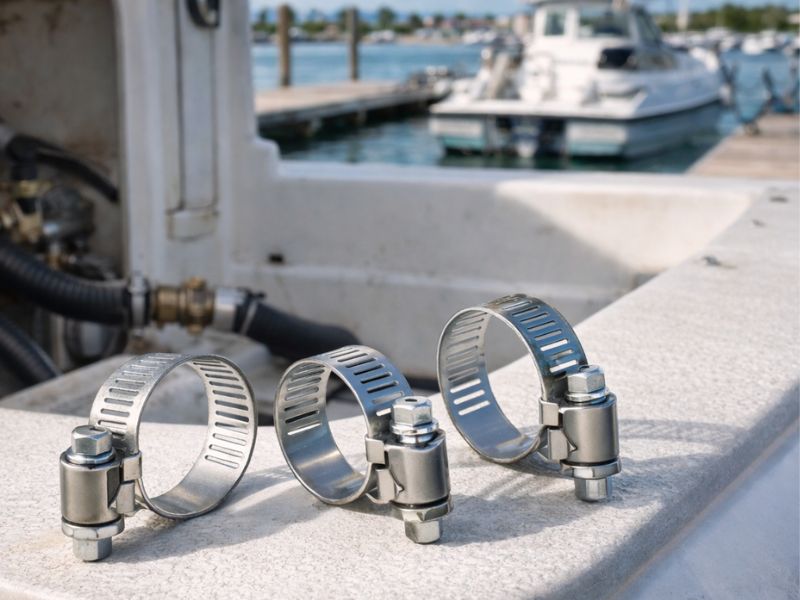
Table of Contents
At a marine hardware store, a seemingly ordinary stainless steel hose clamp might cost $3-5, while at a hardware store or auto parts shop, an almost identical-looking clamp costs only $0.5-1. With prices differing by 5-10 times, many boat owners wonder: aren’t automotive clamps also metal? Can’t we use them on boats and save some money?
The answer is: Absolutely not.
From marine equipment maintenance records and marine accident analyses, using automotive-grade clamps is one of the common causes of marine hose system failures. In saltwater environments, ordinary automotive clamps can exhibit severe corrosion within just weeks to months, and once clamps on fuel lines, cooling water lines, or exhaust systems fail, consequences can be catastrophic—fires, flooding, even sinking.
Today we’ll dive deep into why automotive clamps cannot be used on boats from perspectives including materials science, corrosion mechanisms, industry standards, and real-world cases, plus how to correctly select marine clamps.
Differences Between Automotive and Marine Clamps
Similar appearance, completely different internals.
Critical Material Composition Differences
Typical Automotive Clamp Construction:
- Band: Galvanized steel or ordinary stainless steel (typically Type 201 or 430, non-marine grade)
- Screw: Galvanized or chrome-plated carbon steel
- Worm gear: Galvanized steel or low-grade stainless steel
- Cost-driven: In dry automotive engine compartments, this configuration lasts 10-20 years
Qualified Marine Clamp Construction:
- Band: 316 stainless steel (containing 2-3% molybdenum), chloride-corrosion resistant
- Screw: 316 stainless steel, fully threaded, unplated
- Worm gear: 316 stainless steel
- All components: “All Stainless”—the gold standard for marine clamps
From compositional analysis, this isn’t merely a matter of “better materials” but a fundamental difference in design philosophy:
- Automotive clamp design life: Matched to vehicle lifespan (10-15 years)
- Marine clamp design life: Reliable operation in extreme corrosive environments (15-25 years)
Manufacturing Standards: Worlds Apart
Automotive Clamps:
- Follow automotive industry standards (such as SAE)
- Focus on dimensional accuracy, clamping force, cost
- Don’t consider salt spray, seawater immersion, heat-humidity, or other extreme environments
Marine Clamps:
- Must meet ABYC (American Boat and Yacht Council) standards
- Require salt spray testing (minimum 240+ hours)
- Must pass seawater immersion tests
- Documented material certification and traceability
This standards gap is crucial—automotive clamps have never been tested in marine environments, so their reliability in such conditions is completely unknown.
Saltwater's Devastating Attack on Automotive Clamps
Seawater is one of the most aggressive corrosive media on Earth.
Chloride Ion Concentration: 300 Times That of Freshwater
Seawater contains approximately 3.5% salt, with chloride ion (Cl⁻) concentration reaching 19,000 ppm—about 300 times that of typical freshwater. Chloride ions are natural enemies of metal passivation films.
For galvanized steel automotive clamps, corrosion in saltwater accelerates dramatically:
Week 1-2: Zinc coating begins dissolving, white zinc corrosion products appear on the surface Week 3-4: Zinc layer depletes in high-stress areas (screw threads, band edges), exposing carbon steel substrate Month 2-3: Carbon steel rapidly rusts, generating voluminous iron oxide that loses clamping force Month 3-6: Band fractures or screw seizes, clamp completely fails
From marine maintenance case studies, galvanized automotive clamps in saltwater typically last only 1-3 months before requiring replacement.
The "Stainless Steel" Deception in Automotive Clamps
Many automotive clamps claim to be “stainless steel,” but most use Type 201 or 430 stainless steel:
Type 201 Stainless (nickel-saving substitute):
- Contains only 1-1.5% nickel (vs. 8% in 304)
- Weak corrosion resistance, rapid rusting in chloride environments
- Designed for low-cost consumer products, unsuitable for marine use
Type 430 Stainless (ferritic stainless):
- Lacks molybdenum, poor pitting resistance
- Magnetic (easily verified with a magnet)
- Acceptable in freshwater but quickly fails in saltwater
In contrast, marine-grade 316 stainless steel:
- Contains 16-18% chromium + 10-14% nickel + 2-3% molybdenum
- Molybdenum dramatically improves chloride corrosion resistance
- Non-magnetic or weakly magnetic
- Can reliably serve 15-20 years in marine environments
Quick Test for Marine-Grade Clamps:
• Use a magnet: 316 stainless is non-magnetic or very weakly magnetic
• Check markings: Qualified marine clamps are stamped “316 SS” or “All Stainless”
• Weight comparison: 316 stainless clamps are slightly heavier than galvanized/201 versions
• Price verification: True 316 marine clamps cost 3-10x more than automotive clamps
Real-World Failure Cases
Theoretical analysis aside, let’s examine actual marine accidents.
Case 1: Fuel Line Failure Leading to Fire
Incident Overview: A 30-foot recreational boat in Florida, owner used automotive clamps to save costs
Failure Timeline:
- Boat operated in saltwater for 4 months
- Automotive clamps on fuel lines corroded, losing clamping force
- Vibration caused fuel hose to slip off, spraying gasoline onto hot exhaust manifold
- Resulted in engine compartment fire, boat total loss
- Fortunately, all crew evacuated safely
Investigation Findings: Clamps were galvanized steel automotive-grade, with zinc coating completely corroded and carbon steel severely rusted
Economic Loss: ~$85,000 (boat value) + trauma and near-miss of lives
Case 2: Cooling System Failure Causing Engine Damage
Incident Overview: Offshore fishing boat, owner replaced corroded clamps with “stainless steel” automotive clamps from local hardware store
Failure Process:
- Clamps were Type 430 stainless (non-marine grade)
- After 6 months, pitting corrosion caused band fracture
- Cooling water hose detached, seawater flooded engine compartment
- Engine overheated and seized before crew noticed
Economic Loss: ~$25,000 (engine replacement) + lost fishing season income
Case 3: Exhaust System Clamp Failure
Incident Overview: Sailboat, exhaust system wet exhaust section used automotive clamps
Consequences:
- Clamps failed after 2 months, exhaust hose detached
- Exhaust gases and hot water sprayed into engine compartment
- Caused extensive damage to surrounding equipment
- Carbon monoxide risk to crew (fortunately detected early)
Root Cause: Wet exhaust systems experience extremely harsh conditions (high temperature + saltwater + exhaust acidity), only marine-grade 316 clamps can withstand
How to Select Qualified Marine Clamps
Verify "All Stainless" Construction
Must confirm:
- Band: 316 stainless steel
- Screw: 316 stainless steel
- Worm gear: 316 stainless steel
- No exceptions: Even one galvanized component disqualifies it as marine-grade
Verification Methods:
- Check markings: Qualified clamps stamped “316 SS” or “All SS”
- Magnet test: True 316 is non-magnetic or very weakly magnetic
- Request certifications: Professional suppliers provide material test reports
- Weight comparison: 316 stainless is denser and heavier
Size and Type Selection
Band Width:
- Standard applications: 1/2″ (12.7mm) width
- High-pressure or critical systems: 5/8″ (15.9mm) or wider
- Automotive clamps often only 3/8″ (9.5mm), insufficient clamping force
Clamp Types:
- Worm-drive clamps: Most common, suitable for most applications
- T-bolt clamps: Higher clamping force, for high-pressure systems
- Spring clamps: Constant tension, for high-vibration environments (but must be marine-grade stainless)
Can automotive hose clamps be used on boats? The answer is clear: No.
This isn’t about brands or prices—it’s about fundamental material science and engineering principles. Automotive clamps weren’t designed, tested, or certified for marine environments. Using them on boats is gambling with safety.
Send Inquiry Now
Related Resource
Can You Use Automotive Hose Clamps on a Boat?
Can Stainless Steel Clamps Be Used in Food Processing?
5 Types of Vehicles that Use Stainless Clamps