
- By Profab /
- February 27, 2026
Table of Contents
On the equipment procurement list of food, beverage, and dairy plants, hose clamps seem like an insignificant component. But this $5 clamp could become the source of microbial contamination across an entire production line, leading to product recalls, brand reputation damage, and even lawsuits.
From food safety audits and FDA warning letter cases, “use of non-compliant clamps and fittings” is one of the most frequently cited issues. Many facilities assume “buying stainless steel is enough,” but in reality, not all stainless steel clamps can be used for food contact.
Today, we’ll analyze food-grade clamp selection and usage requirements from the perspectives of FDA regulations, 3-A sanitary standards, material requirements, design principles, and CIP cleaning compatibility.
Not All "Stainless Steel" Is "Food-Grade"
FDA Requirements for Food Contact Materials
According to FDA 21 CFR 175.300 and 177.1520 regulations, food contact materials must meet:
- Non-toxic: Will not release harmful substances into food
- Corrosion-resistant: Does not corrode or degrade in food and cleaning agent environments
- Cleanable: Smooth surface, no dead legs, can effectively remove residues and microorganisms
- Traceable: Has material certificates proving FDA compliance
While FDA provides baseline requirements, the food industry typically follows the stricter 3-A Sanitary Standards:
3-A SSI (Sanitary Standards Inc.) is a standards organization established jointly by sanitary experts, equipment manufacturers, and food processors. Its standards include:
- 3-A 73-03: Design and material requirements for clamps used in sanitary hose connections
- 3-A 63-04: Standards for Tri-Clamps
- ASME BPE: Bioprocessing equipment standards (also widely used in food industry)
Core requirements of 3-A standards:
- Material: AISI 300 series stainless steel (304, 316, 316L)
- Surface finish: Polished surfaces Ra≤0.8μm (32 microinches), unpolished ≥2B industrial finish
- Design: No dead legs, no pooling areas, fully disassemblable for cleaning
- Cleanability: Can undergo CIP (Clean-in-Place) or disassembly cleaning
Hygienic Design Principles
Meeting material requirements is just the first step; design details are more critical.
Principle 1: No Dead Legs
“Dead legs” refer to areas where fluids cannot adequately reach, easily accumulating residues and harboring microorganisms.
Common dead leg problems:
- Blind threaded holes: Threads create pooling areas at the bottom
- Crevices: Microscopic gaps between clamp band and pipe contact surfaces
- Perforations: Inside edges of holes in perforated clamp bands
3-A compliant designs:
- Tri-Clamp: No threads entering the food zone, clamping force applied through external wing nut
- Solid bands: Avoid perforated designs, use embossed or solid bands
- Smooth inner surface: Food-contact side must be polished, no burrs
Principle 2: Fully Disassemblable
According to 3-A standards, food contact components must be fully disassemblable to allow:
- Visual inspection: Check for residues, damage, corrosion
- Manual cleaning: For areas that cannot undergo CIP, can be disassembled and brushed
- Sterilization: High-temperature steam or chemical sterilization
Non-compliant designs:
- Automotive worm clamps: Screw and worm gear cannot separate, crevices difficult to clean
- Spring clamps: Spring coil interior pools liquid, cannot be disassembled
- Crimp clamps: Single-use, cannot be reused after damage
Compliant designs:
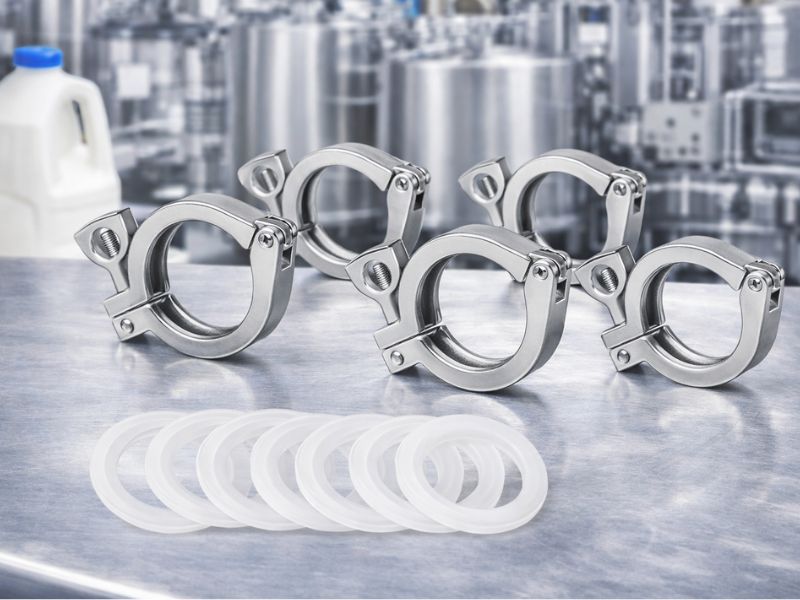
- Tri-Clamp: 3 components (2 flanges + 1 clamp + 1 gasket), fully separable
- Double Ear Clamp: Although single-use, suitable for permanent connections requiring infrequent disassembly
- Sanitary worm clamp: Screw and band fully separable, smooth inner surface
Principle 3: Surface Finish Requirements
Surface roughness directly affects microbial attachment and cleaning effectiveness:
3-A standard requirements:
- Food contact surfaces: Ra≤0.8μm (32 microinches), equivalent to 180-320 grit polish
- Non-food contact surfaces: Ra≤3.2μm, or at least 2B industrial finish
Why so strict:
- Surfaces with Ra>1.6μm have microscopic pits that harbor bacteria
- Pathogens like E. coli and Salmonella form biofilms more easily on rough surfaces
- Once biofilms form, routine CIP is very difficult to remove
Practical applications:
- Dairy plants: All clamps contacting milk must have electropolished inner surfaces
- Beverage plants: Clamps contacting juice and carbonated beverages polished to mirror finish
- Meat processing: Although not directly contacting product, cleaning water may splash, still requires smooth surfaces
Principle 4: Self-Draining Design
Pooled water is a breeding ground for microorganisms; hygienic design requires:
- Horizontal pipe slope ≥1% for drainage
- Clamp installation positions should avoid low points where water pools
- After disassembly, must drain completely with no residual moisture
Case: A dairy plant used ordinary worm clamps installed screw-down, resulting in water pooling in threads after cleaning. After 36 hours, total colony count exceeded standards, entire batch scrapped. Switched to tri-clamps with nut facing up, problem solved.
CIP Cleaning Compatibility—Core of Daily Operations
Food plants cannot disassemble all clamps for cleaning daily; CIP (Clean-in-Place) is the primary method for routine cleaning.
What Is CIP Cleaning
CIP is a method of cleaning system interiors without disassembling equipment, using circulating cleaning solutions:
- Pre-rinse: Water flushes away most residues
- Alkaline wash: Hot alkaline solution (1-2% NaOH, 70-80°C) removes proteins and fats
- Intermediate rinse: Removes alkaline solution
- Acid wash: Acid solution (1-2% HNO₃ or H₃PO₄) removes mineral deposits
- Final rinse: Removes residual chemicals
- Optional sterilization: Hot water (>85°C) or steam sterilization
CIP Compatibility Requirements for Clamps
Fluid dynamics design:
- Clamp inner surface flush with pipe, no protrusions
- Avoid vortices and dead zones
- Flow velocity ≥1.5 m/s, Reynolds number >10,000 (turbulent flow)
Chemical compatibility:
- Alkali resistance: NaOH concentration ≤3%, temperature ≤90°C
- Acid resistance: HNO₃ concentration ≤2%
- 316 stainless steel superior to 304 (pitting resistance)
- Avoid chloride cleaners (cause stress corrosion cracking)
Temperature tolerance:
- Withstand hot water rinse (85-95°C)
- Steam sterilization (SIP, Steam-in-Place, 121-134°C)
- Gasket materials: EPDM or silicone, temperature resistance >150°C
Critical importance of gasket selection:
- Non-compliant gaskets (like NBR nitrile rubber): Temperature resistance <100°C, ages after alkaline wash
- Compliant gaskets (EPDM, silicone, PTFE): Temperature resistance >150°C, acid/alkali resistant
- FDA certification: Gasket materials must comply with FDA 21 CFR 177.2600
CIP Validation Requirements
Food plants must validate CIP effectiveness:
- ATP testing: Adenosine triphosphate test, detects organic residues
- Colony count: Surface sampling, CFU/cm²<10
- Visual inspection: No visible residues after disassembly
- Record keeping: Temperature, concentration, time curves, traceable
Failure case: A juice plant used non-CIP compatible ordinary worm clamps, threads cleaned inadequately, resulting in yeast residue. Products swelled during shelf life, recall loss $200,000.
CIP-Compatible Clamp Checklist
• Inner surface polished, Ra≤0.8μm, flush with pipe
• No blind holes, no threads entering fluid zone
• Gasket material FDA-certified, temperature resistance >150°C
• Can withstand 3% NaOH and 2% HNO₃
• Disassemblable for cleaning validation
Inadequate CIP is a major cause of food recalls
Special Requirements for Different Food Industries
Different industries have varying clamp requirements.
Dairy Industry
Strictest requirements:
- Must have 3-A certification (3-A 73-03 or 63-04)
- Prioritize tri-clamps
- Pasteurization systems: Temperature resistance >95°C
- UHT (Ultra-High Temperature) systems: Temperature resistance >140°C
- Daily CIP, weekly or monthly SIP
Special considerations:
- Milk protein easily forms heat-denatured deposits (milk stone)
- Requires periodic acid washing to remove minerals
- Gaskets must withstand high temperature and pressure
Meat and Poultry Processing
USDA/FSIS requirements:
- Although not directly contacting meat, cleaning water and blood may contact clamps
- Stainless steel surfaces easily cleaned, prevent cross-contamination
- Chloride resistant (cleaning commonly uses chlorine-based disinfectants)
- 316 stainless steel superior to 304
Sanitary oversight:
- HACCP plans require documented cleaning validation
- SSOP (Sanitation Standard Operating Procedures) specify cleaning frequency
Beverage Industry
Acidic products (juice, carbonated beverages):
- Prioritize 316 stainless steel, good acid resistance
- Avoid pitting (organic acids in juice + chloride ions)
- Sugar residues easily breed yeast, CIP must be thorough
Beer and brewing:
- Fermentation tank and pipeline connections: Tri-clamps are standard
- CO₂ pressure resistant, good sealing
- Resistant to cleaners (alternating alkaline and acidic)
Common Mistakes and Risks
Many food plants have misconceptions about clamp usage.
Mistake 1: Mixing Industrial and Food-Grade Clamps
Scenario: To save money, use industrial-grade clamps in non-direct contact areas.
Risks:
- Cleaning water may splash anywhere
- During disassembly and maintenance, may be incorrectly installed
- During audits, cannot prove “which are food contact, which are not”
- FDA or third-party audits will require complete replacement
Correct approach: Within food zones, all clamps uniformly use 3-A certified products to ensure consistency.
Mistake 2: Ignoring Gasket Food-Grade Certification
Scenario: Clamp is 316 stainless steel, but gasket uses ordinary rubber.
Risks:
- Gasket may release harmful substances (plasticizers, vulcanizing agents)
- Fragments fall off after aging, entering product
- Not resistant to cleaners, frequent replacement needed
Correct approach:
- Gaskets must be FDA 21 CFR 177.2600 certified
- Prefer EPDM, silicone, or PTFE
- Regular replacement (per manufacturer recommendations, typically every 6-12 months)
Mistake 3: Improper CIP Parameter Settings
Scenario: To “save time,” shorten CIP cleaning time or lower temperature.
Risks:
- Incomplete cleaning, microbial residues
- Long-term accumulation leads to biofilm formation
- Product microbial counts exceed standards, recall
Correct approach:
- Strictly follow validated CIP procedures
- Monitor and record temperature, concentration, flow rate
- Periodically disassemble for inspection, validate CIP effectiveness
Mistake 4: Non-Standard Installation and Maintenance
Scenario: Clamp is correct, but during installation hands touch inner surface, or equipment used without cleaning after maintenance.
Risks:
- Hand contact causes microbial contamination
- Installation tool debris (metal shavings, lubricants) enters system
- Improper tightening torque leads to seal failure or gasket damage
Correct approach:
- Before installation:
- Wear sterile gloves or use sterile tools
- Pre-clean with 70% alcohol or CIP solution
- Check gasket integrity
- During installation:
- Tighten to specified torque (tri-clamps typically 15-25 N·m)
- Ensure gasket is centered, not offset
- After installation:
- Run CIP program
- Pressure test, check seal integrity
- Record installation date and personnel
Returning to the initial question: Can stainless steel clamps be used in food-grade applications?
The answer: Only stainless steel clamps meeting specific requirements can be used.
It’s not just buying any “stainless steel” clamp; they must meet a series of requirements for materials, design, surface finish, cleaning, and certification.
Send Inquiry Now
Related Resource
Can Stainless Steel Clamps Be Used in Food Processing?
5 Types of Vehicles that Use Stainless Clamps
T Bolt Clamp Vs Worm Gear Which Fits Your Project Best