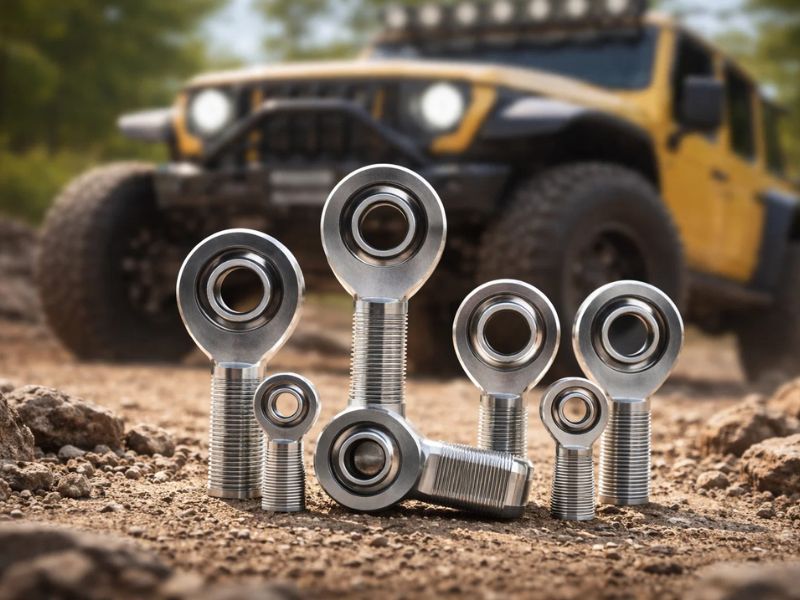
Carbon-steel and chromoly heim joints dominate daily road vehicles, and for good reason: they're strong and inexpensive, which makes them a reasonable default for suspension and steering systems that stay out of the mud. That default breaks down the moment a vehicle leaves pavement. Off-road and modified vehicles put heim joints through sand, standing water, salt spray, and constant vibration, and that's exactly the environment where carbon steel and chromoly start to seize, rust, and lose adjustment. Stainless steel heim joints, particularly three-piece construction with a self-lubricating PTFE liner, hold up where the standard hardware doesn't.
Where Heim Joints Take the Most Abuse Off-Road
Exhaust System
Heim joints connect exhaust valve actuators, wastegates, and turbo actuator rods, and this is one of the hardest environments in the vehicle: heat cycling, moisture, and corrosion all hit at once. Carbon steel rusts and sticks under those conditions, which on an exhaust valve actuator means the valve stops responding cleanly, and on a wastegate actuator rod means boost control gets erratic as rust adds play to a linkage that depends on precise micro-movement. Stainless steel resists all three failure paths at once, which is why it holds up on turbo and wastegate linkages where carbon steel wears out fastest.
Suspension System
Suspension heim joints see large articulation angles, heavy impact loads, and constant exposure to mud and water, all at the same time. They show up at control arm and A-arm ends, where they provide the fine adjustment that lets a suspension system reach its full range of travel; at toe and camber links, where precise alignment can't come at the cost of restricted movement; at sway bar end links, where they resist torsional deflection and don't age or crack the way a rubber bushing does; and at shock and bump-stop mounts and suspension limit-strap hardware, where they absorb impact and extension loads without seizing. Mud and water drive thread seizure in all of these positions, and stainless steel's corrosion resistance is what keeps the joint articulating freely instead of locking up mid-season.
Steering System
Steering is the one system on this list where a stuck joint is a safety problem, not just a maintenance one. Steering links transfer input from the wheel to the tires, and any mud, water, or salt-spray contamination that causes sticking shows up directly as sloppy or unpredictable steering response. Drag links carry the same risk on lifted vehicles, where the larger misalignment angles needed to correct steering geometry after a lift kit put even more load on the joint. Stainless steel's resistance to impact damage and corrosion keeps steering response consistent in rocky, muddy, or wet conditions where a corroded joint would otherwise bind.
Chassis, Axle Location, and Control Linkages
Track bars and Panhard bars carry some of the heaviest lateral loads on the vehicle, stabilizing axle position during high-speed driving and off-road impacts, and a salt-seized joint here shows up as axle wander. Shifter linkages and winch fairlead bracket linkages take a lower load but a similar contamination risk: mud and sand degrade movement quality over time in both, and stainless steel resists the buildup that causes binding.
Why Stainless Steel Wins on Material
Stainless vs. Carbon Steel
Carbon steel rod ends rust quickly when exposed to salt spray, moisture, heat, and mud, and once corrosion starts, the joint seizes, ball wear accelerates, and failure follows. Profab uses 304 and 316 stainless steel, both suited to high-heat and high-corrosion off-road environments. Carbon-steel rod ends also need frequent external lubrication, which is impractical once a vehicle is regularly covered in mud, and near the exhaust system, carbon-steel lubricants evaporate under sustained heat and accelerate seizure. Stainless steel holds up under continuous high-temperature exposure without that problem.
Stainless vs. Chromoly Steel
Chromoly has excellent strength, but it needs plating or coating for corrosion protection, and those coatings wear through fast in off-road use, at which point chromoly corrodes like any other carbon alloy. Stainless steel's corrosion resistance is inherent rather than coated on, so there's no protective layer to wear through in the first place. Chromoly rod ends are built for track conditions where frequent maintenance is assumed; off-road environments destroy coatings faster than track use does, which means more upkeep, not less. Stainless rod ends with self-lubricating liners are the better fit for vehicles that don't get serviced on a fixed schedule.
Stainless steel heim joints have become a standard component in serious off-road builds, not because they resist harsh environments in the abstract, but because they keep exhaust, steering, suspension, and chassis linkages moving smoothly under conditions that quickly seize carbon-steel or chromoly hardware. Profab Machine manufactures stainless steel heim joints with full customization of size, thread type, surface finish, and packaging. Contact Profab Machine to work through the right heim joint specification for your build.
FAQ
Can stainless steel heim joints reduce noise or vibration?
Yes. Stainless heim joints with a PTFE liner maintain smoother articulation for longer, which keeps play and the associated noise from developing as the joint wears.
Are stainless steel heim joints worth the higher cost?
In most off-road and modified-vehicle applications, yes. The initial cost is somewhat higher than carbon steel or chromoly, but the extended service life, low maintenance, and corrosion resistance offset that over the life of the build by avoiding repeat replacements.