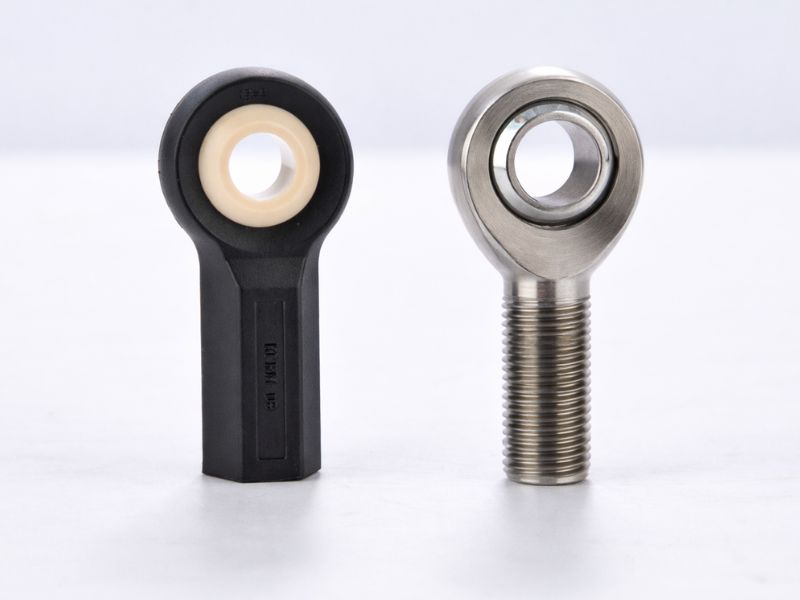
A rod end bearing connects a rod to a pivoting structure while letting the joint articulate under load. The two dominant material choices, engineered plastic and stainless steel, aren't interchangeable options that differ only in price. They're built for different jobs: plastic rod ends trade load capacity for weight and self-lubrication, while stainless rod ends trade weight for strength and long-term durability under real mechanical load. Picking the wrong one for the application is what leads to premature wear, excessive play, or an outright failure under a load the part was never rated for.
Construction and Lubrication
Plastic rod end bearings use a self-lubricating polymer bushing, commonly PTFE-based or acetal, pressed into a metal or plastic housing. The polymer surface transfers a microscopically thin film onto the mating ball as it moves, which is what keeps friction low without added grease. No scheduled lubrication, no grease fitting, no maintenance interval to track.
Stainless steel rod ends split into two construction types, and the lubrication requirement depends entirely on which one you're specifying. Two-piece construction has no liner between the ball and housing; it's metal directly against metal, and it needs regular lubrication to keep friction and wear in check. Three-piece construction adds a PTFE liner between the ball and race, which makes the joint maintenance-free in the same sense as a plastic rod end. For equipment that's hard to reach for routine service, that liner is the difference between a joint that gets greased on schedule and one that gets ignored until it fails.
Load Capacity and Wear
Plastic rod ends wear through adhesion and abrasion: the polymer transfers minute particles onto the steel ball, building the same low-friction surface that gives the joint its self-lubricating property. That mechanism is also its ceiling. Polymer bushings have meaningfully lower static load capacity than steel, and the acceptable radial clearance in the joint widens as the bushing wears, so plastic rod ends are sized for light to moderate loads rather than heavy structural service.
Stainless steel rod ends handle load differently. Unlined (two-piece) construction is metal-on-metal, which means higher friction and faster wear if lubrication lapses, but it tolerates higher loads than plastic. PTFE-lined (three-piece) construction combines the maintenance-free behavior of a self-lubricating joint with steel's load capacity, and its service life tracks load and cycle count rather than lubrication discipline. For any application where the joint sees real structural or shock load, stainless is the only one of the two that's rated for it.
Vibration, Noise, and Environment
Polymers naturally damp vibration and shock, which is why plastic rod ends show up in linkages where noise and vibration isolation matter as much as load. Steel transmits vibration through the assembly instead of absorbing it, so a stainless rod end in the same linkage runs louder and passes more vibration downstream, even though it's the stronger part.
Environment cuts the other way. Stainless resists corrosion, UV degradation, and a wide temperature range without the dimensional drift some plastics show as they age or absorb moisture. For outdoor, washdown, or chemically exposed applications, stainless is the more dimensionally stable choice over years of service, even where the load itself is light enough that plastic could technically carry it.
Applications
Where Stainless Steel Rod Ends Are Used
Industrial machinery: filling and packaging lines, conveyor systems, mixing and dosing equipment, valve and pump actuators, robotic and automation linkages. Automotive and off-road: suspension linkages, steering tie rods, sway bar end links, throttle linkages, turbo and exhaust actuator components. Agricultural machinery: air seeders, fertilizer spreaders, hydraulic linkages, control arms. Food and beverage equipment: washdown machinery, carton and tray forming, sorting and grading lines, packing equipment exposed to wash-down cycles.
Where Plastic Rod Ends Are Used
Light-duty machinery: small packaging equipment, light conveyors, sensor arms and small linkages. Food and pharma equipment: low-load transfer arms, detection and inspection equipment. Electronics and semiconductor: pick-and-place automation, cleanroom machinery where metal particulate is a contamination risk. HVAC systems: damper controls, airflow regulator linkages.
Trade-offs at a Glance
Plastic rod end bearings: self-lubricating, roughly 50% lighter than an equivalent metal rod end, effective vibration damping, resistant to dirt, dust, and corrosion. The trade-offs: lower static load capacity, a wider manufacturing tolerance class (typically ISO E10) than steel's tighter H7, more heat buildup under sustained load, lower allowable tightening torque, and the ball typically needs a metal sleeve insert rather than being clamped directly by a screw.
Stainless steel rod end bearings: high strength-to-weight ratio for a metal part, broad temperature tolerance, corrosion resistance, and (in PTFE-lined construction) low maintenance. The trade-offs: higher cost than plastic, no vibration damping, and unlined construction needs scheduled lubrication.
Selecting between plastic and stainless steel rod end bearings comes down to load, environment, and maintenance access, not just upfront cost. Profab Machine manufactures stainless steel rod end bearings in both two-piece and PTFE-lined three-piece construction, machined to the load rating and tolerance your application requires. Contact Profab Machine to work through the right rod end specification for your project.