Wheel bearings are engineered to run for the life of the vehicle under normal conditions, so when one fails early, the cause is almost never bad luck. Bearing-industry failure analysis consistently attributes more than 70% of premature bearing failures to a small set of causes: improper fitting, inadequate lubrication, and contamination. Knowing which of these is at play is what turns a wheel bearing replacement from a recurring expense into a one-time fix.
What a Wheel Bearing Actually Does
A wheel bearing is a sealed set of hardened steel balls or rollers, held between two rings and packed with grease, mounted inside the wheel hub assembly that connects the wheel and tire to the suspension. It lets the wheel spin with minimal friction while carrying the vehicle's weight through every turn and bump. Under normal driving conditions, a wheel bearing typically lasts 75,000 to 150,000 miles; where it lands in that range depends heavily on part quality, installation, and the roads it runs on.
What Actually Causes Premature Failure
Poor-Quality Parts
A cheap bearing usually cuts corners in two places that matter most: the seals and the heat treatment. Weak seals let dirt and water reach the rolling elements, and inconsistent heat treatment leaves the raceway softer than it should be, so it wears and pits faster under the same load a quality bearing handles for years.
Improper Installation
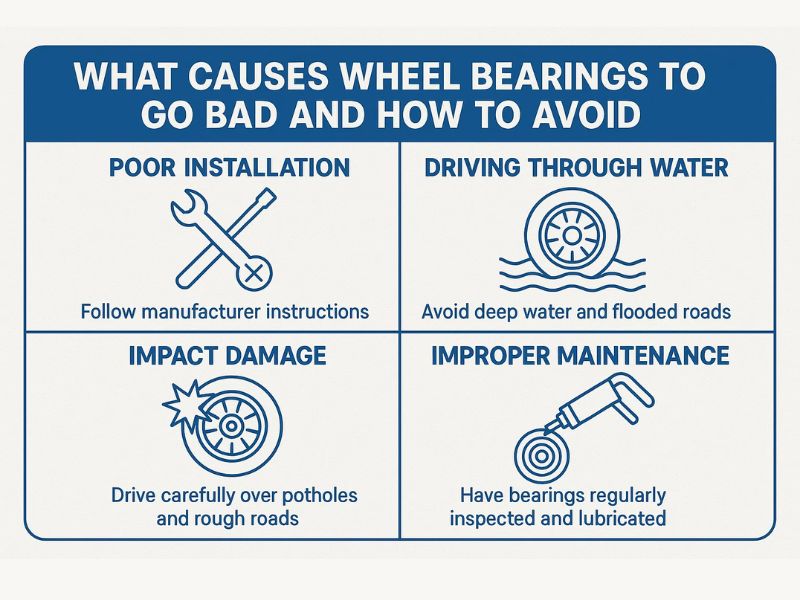
A bearing pressed on the wrong race, seated too loosely, or driven in too tight can be damaged before the car ever leaves the shop. Pressing force applied to the wrong ring transmits shock loads through the balls or rollers themselves, which can leave microscopic denting (brinelling) that shows up as noise and early fatigue months later — not immediately, which is what makes bad installs hard to trace back to their real cause.
Road Environment and Load
Potholes and rough terrain load a bearing well beyond its steady-state rating in short, repeated shocks. Larger or off-road tires compound this by adding rotating mass and leverage the bearing wasn't necessarily sized for, and aggressive tread patterns add vibration on top of that.
Contamination and Moisture
Dirt, water, and road salt are what turn a mechanical wear problem into a corrosion problem. Once contamination gets past the seal, it drives pitting and abrasive wear at the same time, and the effect compounds: pitted surfaces trap more moisture and debris than smooth ones. Stainless steel wheel bearings address the corrosion half of that equation directly, which matters most in wet, salted, or coastal driving conditions.
Overloading and Unbalanced Tires
Carrying loads beyond the vehicle's rating puts sustained extra force through the bearing race, and unbalanced tires add a cyclic vibration load on top of the normal rotating load. Neither failure mode announces itself quickly, but both shorten service life measurably over time.
Lack of Lubrication
Grease does two jobs at once: it keeps the rolling elements from running metal-on-metal, and it helps seal out contamination. Once grease breaks down or runs low, friction and heat climb together, and the bearing surfaces start scoring well before the bearing seizes outright.
Warning Signs Worth Acting On
Noise and Vibration
A humming, growling, or grinding noise that builds with speed is the most common early symptom. A clicking or snapping sound specifically during turns points more toward the bearing than other suspension components, and noise paired with vibration through the steering wheel is a stronger signal than either alone.
Uneven Tire Wear
A worn bearing lets the wheel run slightly out of its intended position, which shows up as an uneven wear pattern that's easy to misattribute to alignment or tire pressure alone. If alignment and pressure check out and the wear pattern persists, the bearing is worth inspecting.
ABS Light
Many wheel bearings integrate the ABS wheel-speed sensor, so a failing bearing can trigger the ABS light directly through sensor signal disruption, not just through mechanical symptoms. An ABS light with no other obvious cause is a reasonable trigger to check the bearings.
Preventing Premature Failure
Most of the causes above are preventable with three habits: inspect on a schedule (many manufacturers recommend every 50,000 miles or annually, some extending to 100,000 miles), have bearings installed by someone following the press sequence and torque spec exactly rather than by feel, and don't defer regreasing on serviceable bearings, since old grease breaking down is what lets moisture and contamination in.
Specifying the right material for the driving environment matters as much as maintenance discipline. In wet, salted, or coastal conditions, a stainless wheel bearing removes the corrosion pathway that shortens the service life of a standard bearing regardless of how well it's otherwise maintained. Profab Machine manufactures stainless steel wheel bearings built for corrosion resistance and long service life in demanding environments. Contact Profab Machine to work through the right specification for your application.
FAQ
How long do wheel bearings usually last?
Most wheel bearings last between 75,000 and 150,000 miles under normal driving conditions. Quality parts, correct installation, and regular maintenance push service life toward the higher end of that range.
What happens if you ignore a bad wheel bearing?
A failing bearing gets progressively worse, not better. Left unaddressed, it can lead to loss of steering control, damage to adjacent suspension components, and in advanced cases, wheel lock-up. It should be inspected as soon as symptoms appear, not scheduled around convenience.
Can you drive with a noisy wheel bearing?
Driving on a noisy bearing is not advisable. The noise indicates active wear, and continued driving accelerates that wear and increases the risk of sudden failure. Have it inspected as soon as the noise appears.
Do wheel bearings affect fuel efficiency?
Yes, though modestly. A worn bearing increases rolling friction, which makes the engine work harder to maintain speed. The effect on fuel economy is usually secondary to the safety and mechanical concerns, but it's a real cost of deferring the repair.