Heim joints and ball joints solve overlapping problems in off-road suspension, but they're not interchangeable. Here's how they actually compare on strength, durability, and application, so you can match the right joint to your build instead of defaulting to whichever one's already on the parts shelf.
Heim Joint vs Ball Joint Strength
Heim Joint Strength
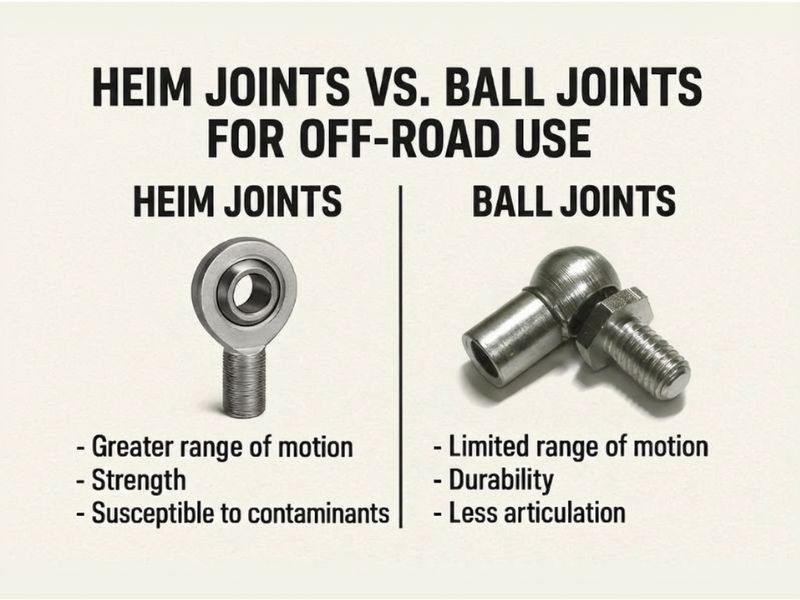
Heim joints stand out for handling high loads while giving you a wide range of misalignment, which is exactly what suspension needs when it's moving through extreme articulation. The metal-to-metal design gives solid strength for off-road setups that need flexibility and quick response.
Common heim joint failure points:
- Deformation at the base of the socket
- Breakage at the jam nut
- Problems from misalignment or incorrect sizing
Correct installation and regular inspection prevent most of these. Keep in mind that heim joints have no protective boot, so dirt and water reach the joint directly and drive wear faster than in a sealed design.
Ball Joint Strength
Ball joints generally offer higher overall strength than heim joints. The sealed design keeps dust and water out, which extends service life, and ball joints handle the combined vertical and horizontal loading that heavy-duty trucks and off-road vehicles see well.
Ball joints resist bending and breaking better than heim joints in most comparable use cases, and they hold up reliably under the repeated stress of jumps, bumps, and uneven terrain. The protective boot keeps grease in and contaminants out, which is the core of that advantage.
Heim Joint vs Ball Joint Durability
Heim Joint Durability
The metal-to-metal design handles dirt, mud, and water without breaking down quickly, and a two-piece heim joint with a PTFE or Kevlar-lined race adds meaningful wear protection on top of that. Regular cleaning and lubrication are what determine actual service life here, off-road racing and rock-crawling communities commonly discuss heim joint life in hours of use rather than miles, since track and trail time doesn't map cleanly to road mileage, and that figure varies enormously with conditions: a well-maintained joint in moderate use can run for a very long time, while the same joint in sustained hard off-road use with poor upkeep can wear out far sooner.
Ball Joint Durability
The sealed design keeps water, mud, and dust out, so ball joints see less wear and need less maintenance than heim joints, no regular cleaning or lubrication required. In off-road trucks specifically, ball joints commonly run in the 30,000 to 60,000-mile range before replacement, shorter than the 70,000+ miles typical for standard passenger vehicles, because of the heavier loads and rougher terrain. Bumpy roads and heavy loads shorten that further.
Heim Joint vs Ball Joint Applications
Heim Joint Uses
Heim joints show up wherever flexibility and strength both matter, and wherever the application needs a wide range of movement:
- Tie rods
- Traction bars
- Sway bars
- 4-links
- Panhard bars
- Spoiler supports
- Steering links
The control and articulation advantage shows up most clearly in vehicles built for rock crawling, dune racing, or demanding trail use.
Ball Joint Uses
Ball joints play a central role in suspension and steering, connecting control arms to steering knuckles and letting the wheels move in all directions. That movement keeps tires planted over rocks, mud, and uneven trails, which is core to both handling and safety on rough terrain.
Choosing the Right Joint
When to Choose Heim Joints
Pick heim joints for maximum articulation and control, custom builds, rock crawlers, and vehicles that need extreme range of motion. That performance comes with a maintenance commitment: heim joints need regular cleaning and lubrication to stay reliable, which makes them a better fit for builds where you're already doing hands-on upkeep.
When to Choose Ball Joints
Choose ball joints for durability and low maintenance, the standard choice for most off-road trucks and daily drivers. The sealed design means less upkeep and generally longer service life under heavy loads. Use bolt-in ball joints from a trusted manufacturer for custom control arms, confirm the knuckle side has a proper taper fit unless the knuckle is custom-built, and check the shear and tensile strength of both the ball joint pin and the arm to match your specific load requirements.
Conclusion
Choosing between heim joints and ball joints for an off-road build comes down to matching the joint to your driving demands. For precision steering and solid, low-maintenance load-bearing, lean toward ball joints. For rapid articulation, extreme angles, and modular replacement, heim joints are the better fit. Either way, proper installation, the right materials, and routine inspection are what keep performance and safety where they need to be.
Want both durability and precision for your suspension components? Profab Machine delivers rod ends and joints engineered for the toughest terrain.
FAQ
What is the main difference between heim joints and ball joints?
Heim joints give more movement and flexibility but need regular maintenance. Ball joints offer better sealed protection and typically last longer with less upkeep. Choose based on how much articulation your build actually needs versus how much maintenance you're willing to do.
Do heim joints need more maintenance than ball joints?
Yes. Heim joints have no protective boot and need regular cleaning and lubrication. Ball joints use a sealed design that keeps contaminants out, requiring significantly less upkeep.