
- By Profab /
- March 11, 2026

Table of Contents
The Cylinder Is Rarely the Problem
When an actuator fails on a food-grade tanker trailer, the cost isn’t just a service call. A contaminated discharge event — traced back to a valve that didn’t close fully — can mean a full cargo rejection. For a liquid dairy or juice concentrate load, that’s a significant financial and compliance exposure. The FDA’s Food Safety Modernization Act (FSMA) places direct accountability on operators when equipment failure contributes to a contamination event.
Here’s what most fleet engineers don’t look at closely enough: the actuator cylinder is almost never the root cause. The failure starts earlier — at the linkage hardware connecting the actuator to the valve. Specifically, at the clevis joints and ball joint linkage ends that translate linear force into valve movement.
This post explains the actual failure mechanisms, what they look like in the field, and what your material and precision choices at the hardware level mean for long-term reliability.
Two Hostile Environments
Food logistics trailers operate in two chemically aggressive environments at the same time, and most actuator linkage hardware is not designed for either one — let alone both.
External: Road Salt and Chloride Attack
In northern operating regions, de-icing salts deposit a continuous chloride load on the trailer undercarriage. Chloride ions are the primary driver of pitting corrosion in austenitic stainless steels. Even 304 stainless, which looks clean in product photos, is vulnerable once chloride concentration exceeds a threshold and the passive oxide film is mechanically disrupted.
The problem with pitting corrosion is that it propagates below the surface. By the time you can see visible pitting on a clevis pin or rod end, the cross-sectional area is already compromised. In a component under cyclic mechanical load — which describes every valve actuator — a pit is a crack initiation site. Fatigue life shortens accordingly.
Internal: CIP Chemistry and Passivation Breakdown
Clean-in-Place (CIP) protocols in food-grade tanker operations typically cycle sodium hydroxide (NaOH) at 0.5–2% concentration, followed by acid rinse — nitric or citric acid — at elevated temperatures. These cycles sanitize product-contact surfaces, but moving linkage hardware near discharge ports consistently ends up in the spray zone.
High-pH caustic at 60–80°C attacks the chromium oxide passive film on stainless steel surfaces. On threaded interfaces and pin bores — where the passive film is mechanically disrupted every operating cycle — the recovery interval between CIP events is often insufficient for re-passivation.
This is why 316/316L is the engineering baseline for food trailer linkage hardware, not an upgrade. The 2–3% molybdenum content in 316 directly improves resistance to chloride pitting and caustic attack. Using 304 in this environment is a maintenance cycle choice, not a cost saving.
Where Failure Actually Begins: The Linkage Hardware
Clevis Joints and the "Slop" Problem
A stainless clevis looks simple — a forked bracket, a pin, a bore. In a vibration environment like a moving trailer, the fit tolerance at this interface has consequences that compound over time.
When a clevis is machined to a loose fit, the pin-to-bore clearance allows micro-movement under cyclic load. On a bench, you can’t feel it. After 50,000 valve cycles, it becomes fretting wear — the pin oxidizes at the contact surface, the bore widens, and the system develops mechanical “play.” A valve that once reached 100% closure now shows 2–3° of misalignment at end-of-stroke. That’s enough for a leak path.
The pin is not just a fastener. It's a precision bearing surface under cyclic load.
The failure cascade: misalignment at the clevis creates off-axis loading on the actuator rod seal. Seal wear accelerates. What gets diagnosed as a failed cylinder is actually a clevis wear problem that was never identified. The new cylinder goes in, and fails on the same timeline.
⚠️ A Pattern Worth Knowing
In stainless valve maintenance, a disproportionate share of actuator cylinder replacements turn out to be unnecessary. The actual wear point is the linkage — the clevis pin, the rod end, or the yoke. Replacing the cylinder without inspecting the linkage hardware means you’ve replaced the expensive part and left the actual problem in place.
Ball Joint Linkage: Why the No-Grease Mandate Matters
Traditional greased rod ends are a liability near food-contact zones. Under FDA 21 CFR Part 178, lubricants near food-contact surfaces must be food-grade — and even then, petroleum-based lubricants in a trailer undercarriage attract road grit. The result is an abrasive paste that grinds down bore surfaces in ball joint linkage assemblies faster than normal wear.
The engineering response is PTFE-lined or self-lubricating spherical bearings in the ball joint end. These allow the angular articulation that a clevis-only system can’t provide — critical when your valve arm travels an arc that isn’t perfectly coaxial with the actuator stroke. A properly specified ball joint linkage in 316L with a PTFE-lined race handles full angular misalignment without requiring any lubrication. No maintenance interval to track. No contamination risk. No lubricant to flush away during CIP.
The caveat: PTFE liners have a defined temperature and load ceiling. If your application involves steam sanitization above 130°C or high-cycle pneumatic loads, verify liner ratings before specifying.
Thread Galling and Fatigue: What Long-Haul Vibration Does
Galling in Stainless-on-Stainless Assemblies
Stainless steel threaded connections carry a specific risk that other metals don’t: galling. Under the friction and heat of assembly — or vibration-induced micro-motion in service — stainless threads can micro-weld to each other and seize. In a trailer linkage, this makes field adjustment impossible and can cause thread shear during emergency disassembly.
Precision-rolled threads in a 316L rod end improve surface finish and introduce residual compressive stress at the thread root, both of which reduce galling tendency compared to cut threads. Food-safe anti-galling compounds exist for field use, but they require a documented re-application interval. Most fleet maintenance programs don’t track this.
Harmonic Loading and Fatigue Life
Every trailer has a natural vibration frequency. At highway speed on concrete roads with regular expansion joints, dominant road input typically falls in the 5–20 Hz range. If your actuator linkage assembly has a resonant frequency in that band — possible with an inadequately constrained rod end — fatigue cycles accumulate at a rate far beyond what normal valve cycle count would predict. This is why surface finish specifications in food-grade mechanical standards extend to thread roots and bore surfaces, not just product-contact areas.
Before You Order a Replacement Cylinder: A Four-Point Check
If your trailer is showing actuator failures, inspect the linkage hardware before authorizing a cylinder replacement:
- Clevis pin — fretting signature: Orange or brown powder at the pin-bore interface is a clevis wear signature. If you see it, the cylinder is likely fine.
- Ball joint — free play: Apply lateral force to the rod end. More than 1–2° of free angular play in a 316L PTFE-lined joint indicates liner wear.
- Thread engagement: Look for thread deformation or galling at the rod end-to-actuator interface before assuming a seal failure.
- CIP spray pattern: If the linkage is in the direct spray zone, confirm whether the current hardware spec includes electropolished or passivated surfaces.
Conclusion
Actuator performance in food logistics is determined by the accumulated quality of every clevis pin, thread interface, and bearing surface in the mechanical chain. In many cases, the cylinder spec sheet is the last place to look for the root cause of a system failure.
Operators who specify minimum compliant linkage hardware often absorb the hidden costs of premature cylinder replacements, unscheduled downtime, and compliance exposure. Those who treat clevis joints and ball joint linkage assemblies as precision components, matching the exact 316L material and tolerance requirements of the actuator itself, see maintenance intervals that reflect the cylinder’s true rated life.
Profab Machine manufactures custom stainless steel precision components designed for these rigorous washdown environments. Contact the Engineering Team for technical requests.
Send Inquiry Now
Related Resource
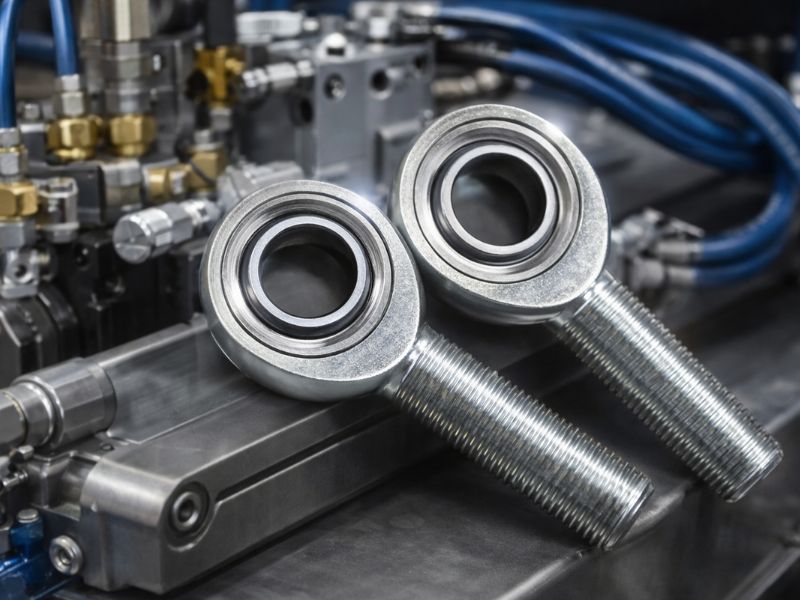
Advantages of Maintenance-Free Rod Ends in Hydraulic Applications
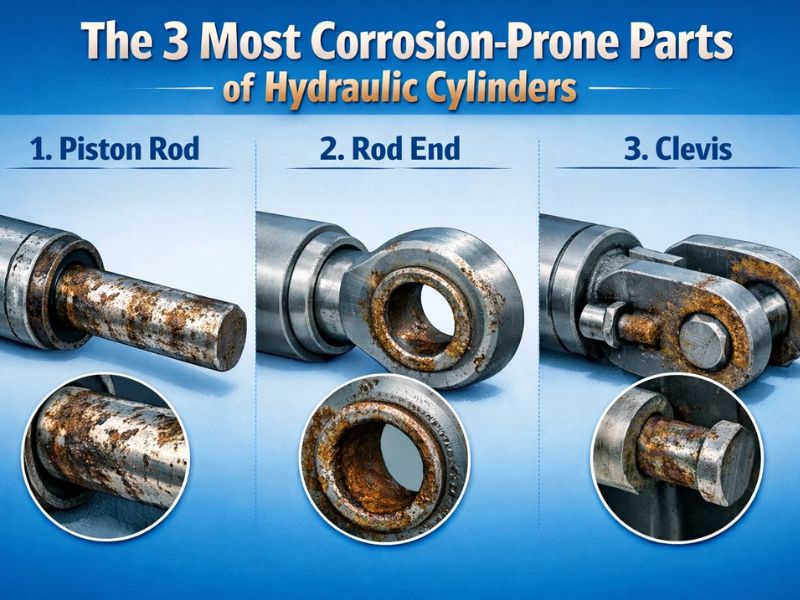
The 3 Most Corrosion-Prone Parts of Hydraulic Cylinder
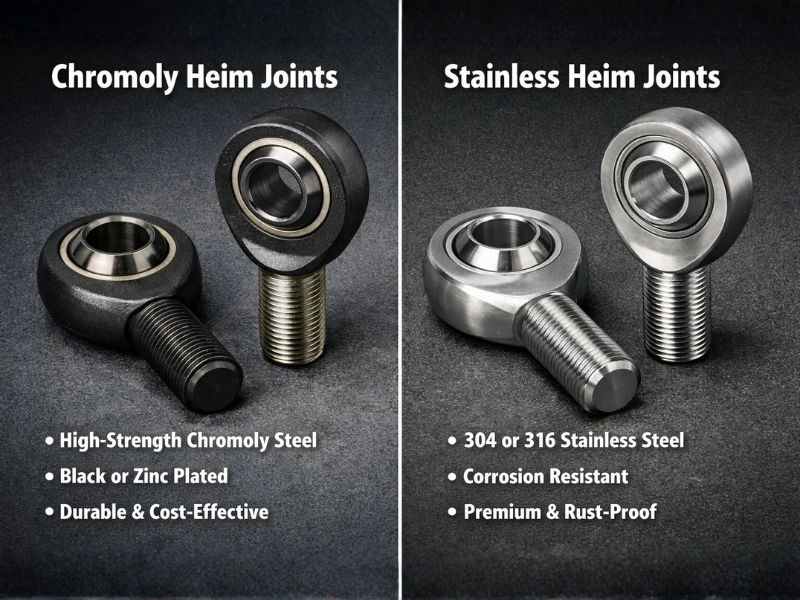
Chromoly Heim Joints vs Stainless Steel Heim Joints