

- By Profab /
- March 23, 2026
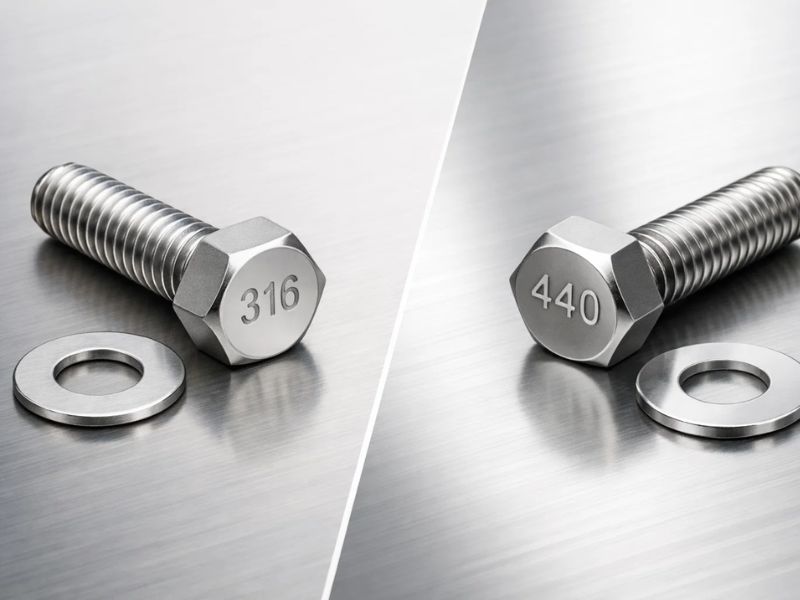
Table of Contents
These two grades show up in the same conversation more often than they should. They are both stainless steel, both used in demanding environments, and both available in bar, rod, and machined form. But they solve completely different engineering problems. If you are trying to decide between them, you are probably looking at a component where corrosion exposure and mechanical load overlap, and that is exactly where material selection mistakes get expensive.
This article breaks down the actual differences in composition, corrosion behavior, mechanical properties, and application fit, so you can make a defensible specification decision.
What the Chemistry Actually Means for You
316 is an austenitic grade. Its defining feature is 2–3% molybdenum, which shifts the passive film’s breakdown potential upward and makes it significantly more resistant to chloride-induced pitting than 304. It is non-magnetic in the annealed state, has good weldability, and does not harden through heat treatment. You get roughly 170–220 HB out of it regardless of what you do post-machining.
440 is a martensitic grade and comes in three sub-variants: 440A, 440B, and 440C. The difference between them is carbon content, which ranges from 0.60% in 440A up to 1.20% in 440C. Higher carbon means higher achievable hardness after heat treatment. 440C hardened and tempered can reach 58–60 HRC, which puts it in the same range as tool steel. That is the whole point of the grade.
The tradeoff is that the high carbon content ties up chromium as chromium carbide during hardening. This reduces the amount of free chromium available to form the passive film, which is why hardened 440 stainless is noticeably less corrosion resistant than 316, and in some chloride environments, less resistant than even 304.
Corrosion Resistance: 316 Wins, But Context Matters
In continuous exposure to chloride environments (seawater, CIP cleaning solutions, marine atmospheres), 316 is the clear choice. The molybdenum stabilizes the passive layer against pitting and crevice corrosion at concentrations and temperatures where 304 and 440C both fail prematurely.
316L (low carbon variant) adds resistance to sensitization during welding. If your component requires welded joints and will operate in a wet or chemically aggressive environment, 316L over 316 is a straightforward call.
440 in the annealed (non-hardened) state has decent corrosion resistance, comparable to 304 in mild environments. But most applications that specify 440 require it to be hardened, and hardened 440C in a humid, chloride-present environment will show surface staining and localized pitting faster than you expect. If the application is a cutting edge in a dry kitchen knife, that is acceptable. If the component is a bearing race exposed to saltwater spray, it is not.
Mechanical Properties: Where 440 Has No Competition
If your application requires surface hardness above 40 HRC, 316 cannot get there. Full stop. You would need to apply a surface treatment (nitriding, hard chrome plating, DLC coating) to achieve wear resistance on an austenitic substrate, which adds cost and process complexity.
440C hardened to 58–60 HRC is used in:
- Precision bearing balls and races
- Surgical instrument blades and cutting jaws
- High-load valve seats
- Pump components handling abrasive slurries in low-chloride conditions
- Gauge blocks and metrology tooling
316, at 170–220 HB, handles fatigue loads, impact, and dynamic loading better than hardened 440 because it retains ductility. Hardened 440C is brittle relative to austenitic grades. Under shock loading or misalignment, it can crack rather than deform.
For motion and linkage components where the failure mode is fatigue rather than surface wear, 316L or 17-4PH is almost always the better specification than 440.
Side-by-Side Comparison
Property | 316 / 316L | 440C (Hardened) |
Structure | Austenitic | Martensitic |
Hardness | ~170–220 HB | ~58–60 HRC |
Corrosion resistance (chloride) | Excellent | Moderate to poor |
Weldability | Excellent | Poor (requires pre/post-heat) |
Magnetic | No (annealed) | Yes |
Heat treatable | No | Yes |
Typical applications | Marine, food, chemical, linkage | Bearings, blades, valve seats |
Which Grade Fits Your Application
Choose 316 when:
Your part operates in wet, chloride-containing, or chemically active environments and the primary load is tension, fatigue, or dynamic cyclic stress. Food processing equipment, marine hardware, clevis rod ends on hydraulic cylinders in coastal installations, and CIP-cleaned conveyor linkages all belong here.
Choose 440 when:
You need surface hardness above 40 HRC for wear resistance or cutting edge retention, and the corrosion exposure is limited (light humidity, non-chloride cleaning, or dry conditions). Bearing races in enclosed gearboxes, cutlery, and surgical blades are the textbook use cases.
When neither is right:
If you need both high hardness and serious corrosion resistance, you are looking at a different material category. 17-4PH (H900 condition, ~40 HRC) offers a reasonable balance. Duplex 2205 gives superior corrosion resistance with higher strength than 316 but without the hardness of 440C. Ceramic or polymer composites cover the cases where metal reaches its limits.
When your application requires custom-machined 316L or 440C components with tight tolerances, Profab Machine provides CNC-machined stainless parts with full material certification, direct from the factory in Ningbo.
FAQ
Can 316 and 440 be used together in the same assembly?
Yes, but you need to account for galvanic compatibility. Both are stainless steel and are relatively close on the galvanic series, so the risk is low in most environments. The bigger concern is that if you are hardening 440C components and running them against 316 counterfaces, the harder surface will eventually wear the softer one. Design the wear pair intentionally.
Is 440 stainless actually stainless in saltwater?
Hardened 440C will corrode in prolonged seawater exposure. The high carbon content reduces free chromium in the matrix, which weakens the passive film. For saltwater applications, 316L or a duplex grade is the correct specification.
Why do some bearing suppliers list 440C as "marine grade"?
It usually refers to its performance relative to carbon steel or lower alloy grades, not relative to 316. In light spray or intermittent moisture exposure, 440C is adequate. In continuous immersion or tidal splash zones, it is not. Read the corrosion data sheets, not just the marketing label.
References
- ASTM A276 / A276M: Standard Specification for Stainless Steel Bars and Shapes
- ASTM A580: Standard Specification for Stainless Steel Wire
- ASM Handbook Vol. 13A: Corrosion Fundamentals, Testing, and Protection
- Wikipedia: Stainless Steel
- NIST: Thermophysical Properties of Stainless Steels
Send Inquiry Now
Related Resource
316 vs 316L Stainless Steel: Why 316L Is the Standard for Food and Pharma Equipment
Key Differences in 420 and 440 Stainless Steel Performance
Common Uses of Marine Grade Stainless Steel in Marine Environments