
Most explanations of single shear versus double shear stop at geometry: one bracket or two. That is accurate, but it skips the part that matters most when the bolt is stainless instead of Grade 8. Stainless starts with less shear strength to begin with, so the same mounting decision carries a different margin depending on what the bolt is made of.
What Single Shear and Double Shear Actually Mean
Single shear mounts a rod end eye against one bracket face. The bolt runs from the bracket, through the rod end bore, and terminates with a nut on the far side, unsupported past the rod end. The bolt carries the load at one plane, and because it is only held on one end, it also picks up a bending moment as the joint tries to rotate under load.
Double shear captures the rod end eye between two bracket faces. The bolt is supported at both ends, so it sees shear at two planes instead of one, and the bending moment that single shear introduces mostly disappears because neither end of the bolt is free to rotate.
A bolt in double shear carries roughly twice the lateral load of the same bolt in single shear before it reaches its shear limit. That is true regardless of bolt material. It is the next part that is usually left out.
A Stainless Bolt Starts With Less Shear Margin Than Grade 8
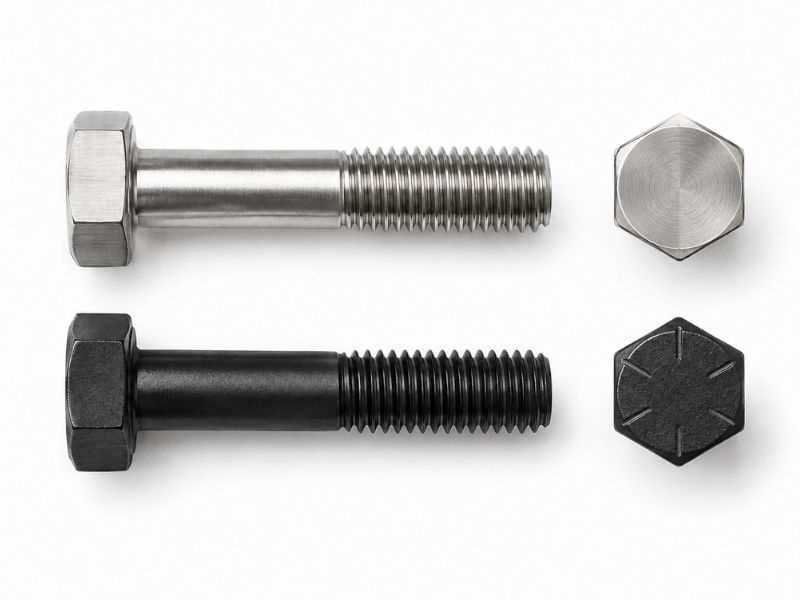
The bolt grade comparison that off-road and steering forums argue about constantly is stainless versus Grade 8, and the forum consensus tracks with published fastener data: an 18-8 stainless bolt sits closer to Grade 5 in mechanical strength, well below Grade 8. Portland Bolt shear strength reference puts Grade 8 shear strength at roughly 60% of its tensile rating. Run 18-8 stainless through the same ratio and it lands at close to half of what a Grade 8 bolt of the same diameter can take.
That gap is not a defect in stainless. It is the tradeoff you are accepting on purpose. Grade 8 strength comes from an alloy and heat treatment that stainless cannot fully match without giving up the corrosion resistance that is the entire reason to spec stainless in the first place. A rod end in a washdown line, a coastal steering linkage, or a marine deck fitting corrodes a Grade 8 bolt fast enough to fail it well before fatigue ever becomes the concern. Stainless survives that environment. It just does the job with less shear reserve in the bolt itself.
Why This Makes the Single Shear Decision Riskier With Stainless
Single shear already asks a bolt to do two jobs at once: resist shear and absorb the bending moment from an unsupported end. A Grade 8 bolt has enough reserve strength that a moderate load in single shear rarely gets close to its limit. A stainless bolt with roughly half that shear capacity has far less room before the same load starts working the bolt at levels closer to its actual limit, especially once vibration and cyclic load are added on top of the static number.
This is why the sizing rule fastener suppliers give for stainless is to go up a size, not keep the same bolt diameter. A rod end mount originally speced for a 3/8 inch Grade 5 bolt typically steps up to 7/16 inch in stainless, and a 3/8 inch Grade 8 bolt typically steps up to 1/2 inch in stainless to land back in the same load range. Skip that step and a like-for-like stainless swap quietly loses a meaningful chunk of the mount shear margin, right at the joint most likely to already be running in single shear for packaging reasons.
⚠️ Note: If a mount is being converted from a Grade 8 bolt to stainless for corrosion reasons, size the bolt for the material change too. Reusing the original Grade 8 bolt diameter in stainless assumes a shear margin that no longer exists.
When Double Shear Stops Being Optional
Double shear removes the bending moment and roughly doubles the shear capacity at the joint, and that combination matters more for a stainless bolt than for Grade 8 simply because stainless has less capacity to spare. Steering linkages, drag links, and any joint that sees shock loading from a wheel hitting an obstacle belong in double shear regardless of bolt material. Add a stainless bolt to that list and the case for double shear gets stronger, not optional-if-convenient.
Where single shear is unavoidable, whether from mounting geometry or an existing bracket that cannot be rebuilt, a safety washer becomes the backstop rather than an accessory. A rod end ball that fractures in single shear can let the housing separate from the mount entirely. The safety washer captures the housing if that happens, buying the operator time to stop instead of losing the joint outright. It does not restore the shear margin lost to single shear or to the switch from Grade 8 to stainless, it only limits what happens after the bolt has already been pushed past what it can hold.
Matching the Bolt to the Mount
The mount type and the bolt material are not separate decisions. They compound each other:
- Grade 8 bolt, moderate static load, dry environment: single shear is usually fine at the original bolt size.
- Stainless bolt replacing Grade 8 for corrosion resistance: size up one bolt diameter to recover the shear margin the material swap gives up, regardless of shear configuration.
- Steering, drag links, shock loading, or any safety-critical joint: double shear, independent of bolt material, because the bending moment single shear introduces is the bigger risk at that load level.
- Single shear unavoidable and the bolt is stainless: add a safety washer. It is a backstop, not a substitute for sizing the bolt correctly in the first place.
Profab Machine manufactures stainless steel rod ends in 304, 316L, and 17-4PH for steering, suspension, and marine linkages, machined to the bore and thread specs your mounting bracket and bolt size actually require.